Ukraine

Ukraine, the largest country in Europe (excluding Russia) is 603,628 square kilometres with a coastline of 2,782 kms.  It borders the Black Sea, Poland, Romania, and Moldova in the west and Russia in the east.  The geographic center of Europe is considered to be in a small Western Ukrainian town called Rahiv.  Ukraine’s population has been declining since the 1990s because of its high death rate and a low birth rate. The population is shrinking by over 150,000 annually since 1993.  Ukrainians are of Slavic origin. About 75% of the population is ethnic Ukrainian. The largest minority group is the Russians at about 20%.

The territory of modern Ukraine has been inhabited since 32,000 BC. During the Middle Ages, the area was a key centre of East Slavic culture, with the powerful state of Kievan Rus’ forming the basis of Ukrainian identity.  It has been ruled and divided by a variety of powers, including Lithuania, Poland, the Ottoman Empire, Austria-Hungary, and Russia.  It is currently in territorial dispute with Russia over the Crimean peninsula which Russia annexed in 2014 but which Ukraine and most of the international community recognise as Ukrainian.

Ukraine suffered the world’s worst recorded nuclear accident. On the morning of April 26, 1986, reactor No. 4 at the Chernobyl Nuclear Power Plant, 80 miles north of Kiev, exploded, sending radioactive contaminants three miles up into the atmosphere and out over parts of Europe, Asia, and North America.

For the visitor it offers a diverse range of sights and activities namely; the Carpathian mountains and National Park, the 16th century Khan’s Palace, Yalta, the laid back beach resort, the quaint town of Lviv, a Unesco World heritage site and Kyiv, the capital with plenty of cultural points of interest.

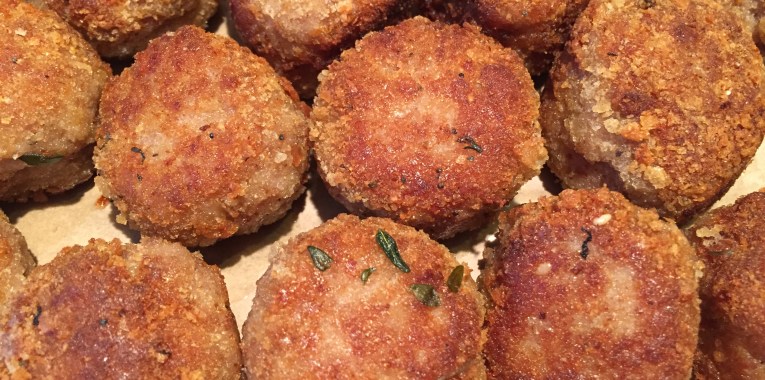
The diet of Ukraine features chicken, pork, beef, fish and mushrooms.  Popular traditional dishes include varenyky (dumplings), nalysnyky (filled pancakes) and of course chicken kiev.  Some other recipes I came across were Kruchenyky (meat rolls), Pyrizhky (stuffed pastry buns) and Shynka (baked ham).  I opted to cook Mazuricks (turkey cutlets with cheese), which I served to a number of guests as a bit of a snack along with drinks and they went down extremely well!

Rating: 9/10

Serves: makes 34 bite size mazuricks
Prep time: 20 mins + 40 mins cooling

Cook time: 15 mins

750g turkey mince
112g finely grated cheddar cheese
75g butter
2 eggs
37ml milk
150g plain flour
75g breadcrumbs
2 tbsp vegetable oil
A few sprigs of thyme
2 garlic cloves bashed
Salt & pepper

Put the turkey mince into a mixing bowl. Melt the butter and add to the meat, stir well.
Add the eggs, milk, salt, pepper, flour and cheese to the meat. Stir well until fully combined.
Shape into balls, sausages or patties and roll in breadcrumbs.
Put them into bowl with a tightly fitted lid and store into fridge for 40 mins.
Heat the vegetable oil in frying pan, add thyme twigs and garlic.
Once garlic is browned, remove it from the oil along with thyme.
Fry the mazuricks on both sides in the flavoured oil, approximately 10 – 15 minutes (depending on the size).
I wasn’t serving them straight away, so I heated them up in the oven on 170c for 10 minutes before serving.

Belarus

Belarus (meaning “White Russia”) is a landlocked country in Eastern Europe bordered by Russia to the northeast, Ukraine to the south, Poland to the west, and Lithuania and Latvia to the northwest. Alexander Lukashenko has been the country’s president since 1994. Belarus has been labeled “”Europe’s last dictatorship”” by some Western journalists on account of Lukashenko’s self-described authoritarian style of government. Belarus is the only country in Europe which retains capital punishment in law and in practice.

About 40% of Belarus is covered by forests and it also has 11,000 lakes. About 70% of the radiation from neighboring Ukraine’s 1986 Chernobyl nuclear disaster entered Belarusian territory, and about a fifth of Belarusian land (principally farmland and forests in the southeastern regions) was affected by radiation fallout. Belarusians continue to suffer from high incidences of cancer and birth defects, and about 25 percent of the land is considered uninhabitable. The United Nations and other agencies have aimed to reduce the level of radiation in affected areas.

Most of the monuments in Belarus dedicated to Lenin. In every city there is a Lenin Street. Highlights for visitors to Belarus include Radziwill Palace Fortress, the Museum of the Great Patriotic War, the 16th century Mir Castle and the Chagall Museum (which houses some of Marc Chagall’s designs and lithographs but sadly there aren’t more Chagall paintings in Belarus because his work was banned by the Soviet government).
Belarus has four UNESCO-designated World Heritage Sites: the Mir Castle Complex, the Nesvizh Castle, the Belovezhskaya Pushcha (shared with Poland), and the Struve Geodetic Arc (shared with nine other countries).

Some of the recipes I came across for Belarus were Zrazy (stuffed meat rolls) , Mazurka (almond cake) , Machanka (pork stew) and Draniki (potato pancakes). I opted to cook Lazanki (Belarusian pasta). I served it with a mushroom, ham and cheese sauce. It was pretty simple and easy to make and tasted good. I would cook the pasta a bit less and make the sauce a bit looser next time! You could also add some saffron to the water before making the pasta in order to give it more of a pleasant colour, as it was a bit anaemic.

Rating: 7/10

Serves: 4
Prep time: 30 mins
Cook time: 7 mins

For the lazanki
1 egg
350g plain flour
5g salt

For the sauce
50g plain flour
70g butter
150ml milk
100g bacon or lardons
75g sliced mushrooms
50g grated cheddar

For the lazanki
Beat the egg.
Add 1/2 cup of water to the egg, add salt and flour (250 g) and then carry on adding flour in small quantities until the dough comes together.
Mix the dough with your hands and divide it into 3 equal parts.
Roll out all of the dough (use a pasta machine if you have one – keep flouring the dough as you put it through)
Cut the dough into small squares with a sharp knife.
Boil salted water, add the lazankis and cook for approximately 7 minutes (or 5 minutes if you like it a bit al dente).
Put lazankis onto the plates and pour over the sauce.

For the sauce
Put the flour & 50g of the butter in a saucepan over a medium heat and stir to a paste.
Add the milk slowly to form a sauce and keep stirring for 5 minutes. Remove from the heat.
Meanwhile heat a small frying pan and fry the bacon until browned, about 5 minutes. Remove to a plate.
Add remaining butter to the pan and fry the sliced mushrooms for 5 minutes.
Heat the sauce on a low heat and add the cheese to the sauce, mix it in, then add the bacon and mushrooms and stir through.


Mauritania

Situated in West Africa, Mauritania (officially the Islamic Republic of Mauritania) is in western North Africa.  The country derives its name from the ancient Berber Kingdom of Mauretania, which existed from the 3rd century BC to the 7th century, in the far north of modern-day Morocco.  Part of French West Africa until independence in 1960, Mauritania is influenced by Arab as well as African cultures.  Some of the world’s richest fishing grounds lie off the coast. The population still largely depends on agriculture and livestock for their livelihood.  Fish exports account for 60% of foreign earnings.
 
Mauritania passed a law to abolish slavery only in 1981. It is one of the last countries to do so.  Despite the legislation against slavery, there still exists around 90,000 slaves in Mauritania according to 2003 estimates.
 
Nouahchott, which means “place of the winds,” was designated as the country’s capital only in 1960 and is therefore one of the world’s newest capitals.  It’s highlights include Port de Pêche (fish market), Mosquée Saudique and the Musée National.
 
Tourists are also attracted to Atar, the ancient capital of the Almoravid kingdom, and Chinguetti, with houses and mosques dating back to the 13th century.
 
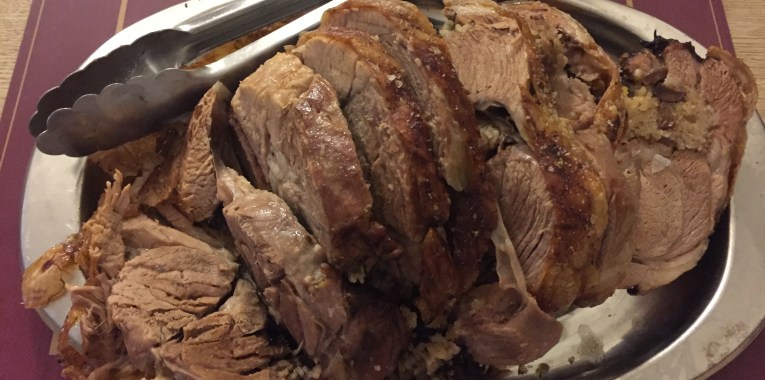
The cuisine of Mauritania has an overlap with Moroccan cuisine in the north and Senegalese cuisine in the south.  Some traditional dishes include Thieboudienne (Cheb-u-jin), a coastal dish of fish and rice, considered to be the national dish, Mahfe (goat or camel meat in a peanut, okra and tomato sauce) and Cherchem (lamb couscous).  I opted to cook Méchoui, whole roasted lamb.  I followed a brilliant recipe from a fellow ‘around the world cook’ Sasha Martin.
 
Rating: 9/10
 
Serves: 6
Prep time: 30 mins
Cook time: 3 hours
 
1 deboned leg of lamb
1/4 cup raisins
2 pitted dates, chopped
4 dried figs, chopped
1 onion, diced
1 cup rice, uncooked
2 1/2 cups stock
salt & pepper
1/2 tsp coriander
 
Chop the onion, dried fruits, and add to a skillet with rice, stock, salt, pepper and ground coriander. Cover and simmer for about 10 minutes and then let it cool slightly.
Preheat the oven to 160C.
Stuff the lamb with the rice & fruit mix and then tie up the lamb with string.
Put the remaining rice mix in a small casserole dish and cover with foil.
Roast the lamb for 2 1/2 to three hours. Put the casserole of stuffing in for the last 30-45 minutes of roasting.
Let the meat rest for 10 minutes before slicing.
Serve with the extra rice and roasted carrots.
 

Guinea-Bissau

The Republic of Guinea-Bissau on the Atlantic coast of West Africa is bordered by Senegal to the north and Guinea to the south and east.
Guinea-Bissau is among the world’s least developed countries, with most people engaged in subsistence agriculture and fishing.  More than two-thirds of the population lives below the poverty line.  It’s history is one of painful wars and coups and since 1974, no president has successfully served a full five-year term.


Tourist attractions include the Former Presidential Palace in the capital of Bissau, Orango Islands National Park (home to rare saltwater hippos) and the beautiful island of Bolama.


The food of Guinea-Bissau is dominated by rice, fruit, vegetables and peanuts.  Soups and stews are popular.  Recipes I came across include Frango com bagique (chicken with spinach) , Macarra with Citi (Chicken with peanuts and palm oil), Bolinhos de mancarra com peixe (fish and peanut balls).  I decided to cook Cafriela de Frango (grilled spicy chicken) which was very simple and really tasty.


Rating: 9/10

Serves: 4
Prep time: 10 mins + 3 hours marinating time
Cook time: 45 mins
1 medium chicken, jointed
1 tsp salt
5 hot chilies, sliced
3 cloves garlic, crushed
1 medium onion, sliced
1 1/2 lemons, juice only
salt
1 tbsp vegetable oil

Place the chicken pieces in a large plastic zipper bag with the garlic, chilies, half the sliced onions and lemon juice. Marinate for 3 hours (or more) in the fridge.
Add the oil to a large skillet and add the marinated ingredients.
Add 3/4 cup of water and cook over a medium heat, covered, for 30 minutes, until the chicken is cooked through, adding a little more water if it is drying out.
Preheat the BBQ or grill.
Remove the chicken to a plate leaving the excess liquid in the pan.
BBQ or grill the chicken pieces for 15 minutes or until well browned.
In the meantime heat the liquid adding the rest of the finely sliced onions. Cook over a medium heat for 15 minutes, adding a little more water if necessary.
When the chicken is well-browned, place it onto a serving plate and pour the sauce over it.

Moldova

Moldova is a landlocked nation located in eastern Europe, between Ukraine and Romania, although it is only a stone’s throw from the Black Sea. Most of Moldova was part of Romania before World War II, and two-thirds of Moldovans speak Romanian. It gained independence in 1991.

Moldova has a very vibrant wine industry dating back many many years. 67 Million bottles are exported every year. Vineyards planted in villages around the houses used to make home-made wine, or “vin de casa”. Many families have their own recipes and strands of grapes that have been passed down through the generations. Since 2013 Russia has imposed a ban on Moldovan wine being sold in the country, ever since Moldova signed a draft treaty with the European Union. This has damaged the wine industry of Moldova significantly.

According to Trip Advisor the top 3 things to do in Moldova are: 1. Stefan cel Mare Park in Central Chişinău (the capital). Formerly known as Pushkin Park, it is the oldest park in Moldova and spans about 7 hectares. – Victory Memorial and Eternal Flame is the national memorial commemorating the nameless Moldovan soldiers who fell during WWII. – Milestii Mici winery. Its underground wine city in limestone stretches for 250 km of which 120 km are currently in use. Milestii Mici cellar complex is recognized to be the largest in the world.

Recipes that I came across during my research include; Ciorba (sour soup) , Mititei (minced meat), Mamaliga (cornmeal mash) , Sarmale (stuffed cabbage rolls), Colțunași (dumplings). I opted to cook the popular dish Zeama (chicken noodle soup). It had a subtle flavour and felt like a healthy bowl of goodness! According to my husband a bit of chilli would’ve given it a nice zing!

Rating: 7/10

Serves: 2 hungry people
Prep time: 10 minutes
Cook time: 1.5 hours + 30 mins standing time

4 chicken thighs on the bone
800ml water
salt & black pepper
1/2 medium onion, chopped
1/2 medium carrot, chopped
1/2 big fresh tomato, chopped
100g egg noodles (I used medium but fine would be better)
2 tbsps lemon juice
1 tbsp finely chopped medium celery stalk (reserve celery leaves, if any)
1 tbsp finely chopped fresh parsley
1 tbsp finely chopped fresh dill weed
3 fresh thyme sprigs

Saute the onion and carrots until soft in a deep stock pot. Add the chicken and water then bring to a boil.
Turn heat down to medium-low heat and simmer for about 45 minutes to an hour. Skim any froth.
Add a teaspoon of salt, black pepper, tomato and celery and cook for 5 minutes.
(The recipe didn’t say to do this, but I’m not a fan of chicken on the bone in a bowl of noodle soup so at this point I removed the chicken to a plate, removed the skin & bones, cut it up and then placed it back into the pot)
Add the egg noodles and lemon juice.
Continue cooking on medium-low for about 5 more minutes.
Add the fresh herbs (including celery leaves, if any).
Cover, remove from heat. Let stand for at least 30 minutes to let flavors blend.


North Korea

The world’s most secretive country is situated in the northern part of the Korean Peninsula.  Early European visitors to Korea remarked that the country resembled “a sea in a heavy gale” because of the many successive mountain ranges that crisscross the peninsula.


After the Japanese surrender at the end of World War II in 1945, Korea was divided into two zones by the United States and the Soviet Union, with the north occupied by the Soviets and the south by the Americans. Negotiations on reunification failed, and in 1948 two separate governments were formed: the Democratic People’s Republic of Korea in the north, and the Republic of Korea in the south. An invasion initiated by North Korea led to the Korean War (1950–53). Although the Korean Armistice Agreement brought about a ceasefire, no official peace treaty was ever signed.  Both states were accepted into the United Nations in 1991.
North Korea has the highest number of military and paramilitary personnel in the world, with a total of 9,495,000 active, reserve, and paramilitary personnel.


It isn’t impossible to visit North Korea, however it isn’t straightforward.  Koryo Group offer group or independent tours to North Korea from China.
You can expect to pay from €1,800 for a 3 night basic tour departing from Beijing, including round-trip tickets to Pyongyang on Air Koryo, accommodation, guide fee, private transport, meals, and entry fees.  You cannot travel alone at any time, you must always be accompanied by 2 state employed guides.


A few of the highlights according to Lonely Planet include Paekdu (the country’s highest mountain and an extinct volcano with a vast crater lake at its centre), Pyongyang’s Juche Tower and the Arirang Mass Games annual event in May.


Korea cuisine is based on rice, meat & vegetables. Some of the recipes I came across include Dae Ji Bool Gogi (spicy marinated pork) , Chap Chee or Japchae Noodles (mixed vegetables with noodles) , Bulgogi (Korean grilled meat on skewers) and Naengguk (cold soup).  I decided to cook Kalbi (BBQ short ribs).  The recipe called for short cooking time, although the beef short ribs I bought stated they should be slow cooked.  The marinade was really tasty but our palates would’ve preferred the meat to be slow cooked.


Rating: 6/10


Serves 2 – 3
Prep time: 10 minutes + 3 hours or overnight marinating
Cook time: 25 minutes


1/2 cup soy sauce
1/2 cup brown sugar
1/2 cup water
1 garlic clove, minced
2 spring onions, chopped
1 tbsp toasted sesame oil
700g beef short ribs


In a bowl, stir together the soy sauce, brown sugar, water, garlic, green onions, and sesame oil until the sugar has dissolved.
Place the ribs in a large plastic zipper bag. Pour the marinade over the ribs, squeeze out all the air, and refrigerate the bag for 3 hours to overnight.
Preheat an outdoor grill to medium-high heat, and lightly oil the grate.
Remove the ribs from the bag, shake off the excess marinade, and discard the marinade.
Grill the ribs on the preheated grill until the meat is still pink but not bloody nearest the bone about 10 – 12 minutes per side.
Serve with boiled rice.


Taiwan

Taiwan, officially the Republic of China, is an island of approximately 36,000 square kilometers.  It is one of the most densely populated countries in the world with 649 people per km2.  The island was given the name “Formosa” (meaning “beautiful”) by the Portuguese in the 16th century.  The political situation of Taiwan is still up in the air and the question remains as to whether it should stay independent as territory of the Republic of China (ROC); become unified with the territories now governed by the People’s Republic of China (PRC) or formally declare independence and become the Republic of Taiwan.  In July 2009 the leaders of China and Taiwan exchanged direct messages for the first time in more than 60 years, albeit in their respective party functions, and not as national leaders.  In June 2010, the two countries signed an historic trade pact that was described by some analysts as the most significant agreement in 60 years of separation.


Taiwan blends scenic mountains, hidden waterfalls, historic temples and technology driven skyscrapers.  The five famous tourist magnets outside Taipei are the Taroko Gorge, Alishan (mountain resort), Sun Moon Lake, Lukang (urban township) and Kenting (national park known for its white-sand beaches, caves, coral reefs & northern mountains).  Taipei is Asia’s 2nd most richest city and features the 3rd tallest building in the world, the Taipei 101 tower.


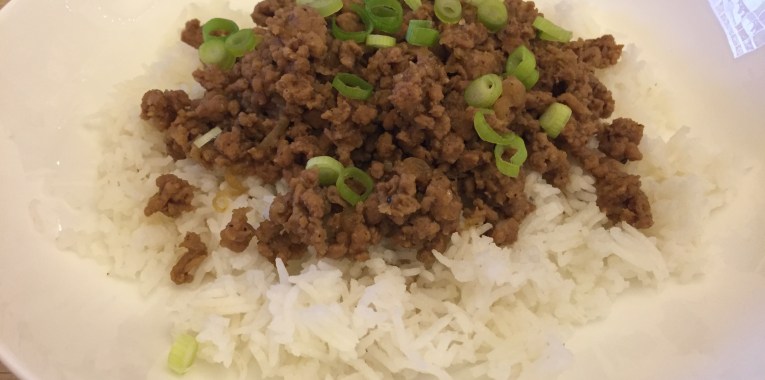
Popular ingredients in Taiwanese cuisine are pork, seafood, chicken, rice & soy.  Some of the recipes I came across include Pork chops with noodle soup , Bah-Tzang (Taiwanese rice dumpling), Gu Bah Mi (beef noodle soup) and Cuttlefish geng (soup).  Chou Doufu ‘stinky tofu’ which is marinated in brine made from decomposing vegetables and shrimps wasn’t high of my choices to cook but is a popular street food.  I opted to cook Ló͘-bah-pn̄g (minced pork rice), which we thoroughly enjoyed.


Rating 10/10


Serves 3-4
Prep time: 10 mins
Cook time: 45 mins


1 cup thinly sliced shallots
2 tbsp oil
500g organic minced pork
4 tbsp white wine
60ml soy sauce
1 tbsp sugar or honey
2 cups water
1 tsp black pepper
1 star anise
1 bay leaf
1 tsp five spice powder
salt to taste
2 spring onions


Heat a large cast iron skillet on medium heat with 1 tbsp of the oil.
Once the oil is hot add the shallots and fry until they turn light golden in color – about 5 minutes.
Remove the shallots from the pan, transfer to a plate lined with a paper towel and set aside.
In the same skillet add the remaining oil and the minced pork on a high heat.
Break up the mince and stir until the pork starts to brown.
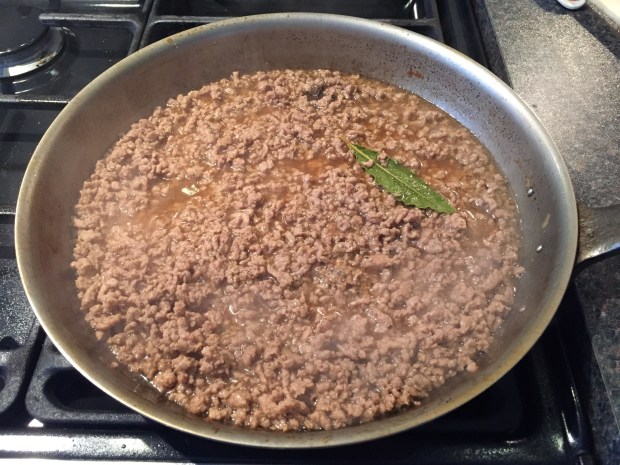
Add the wine, soy sauce, sugar or honey, water, pepper, star anise, bay leaf, and five spice.
Stir to combine, bring the liquid to a boil and then reduce to a low heat.
Cover and let simmer for 30 minutes, stirring every 10 minutes.
While the pork is simmering, take the fried shallots and crush them with a mortar and pestle to a paste or blend them in a mini mixer.
After the pork has simmered for 30 minutes, stir in the crushed shallots and let everything simmer for another 10 minutes.
Salt to taste.
Remove from the heat, garnish with sliced spring onions and serve over boiled rice.
IMG_8464
Ingredients for Taiwanese minced pork

In the same skillet add the remaining oil and the minced pork on a high heat.
Break up the mince and stir until the pork starts to brown.
Add the wine, soy sauce, sugar or honey, water, pepper, star anise, bay leaf, and five spice.
Stir to combine, bring the liquid to a boil and then reduce to a low heat.
Cover and let simmer for 30 minutes, stirring every 10 minutes.
While the pork is simmering, take the fried shallots and crush them with a mortar and pestle to a paste or blend them in a mini mixer.
After the pork has simmered for 30 minutes, stir in the crushed shallots and let everything simmer for another 10 minutes.
Salt to taste.
Remove from the heat, garnish with sliced spring onions and serve over boiled rice.

IMG_8471
Taiwanese minced pork
taiwan-654398_1280
Taiwan

img_84881

Ló͘-bah-pn̄g (minced pork rice)


taiwan-553521_1280
Taiwanese monk


Denmark

Denmark is an archipelago made up of 406 islands and 7,314 miles of coastline, which is longer than the Great Wall of China.  No place in Denmark is more than 30 miles from the sea.


The Danish monarchy is the oldest continuing monarchy in the world and has existed for over 1,000 years.  Queen Margarethe II is the current head of state.


Denmark has more than twice the amount of bicycles (4.2 million) than cars (1.8 million). Copenhageners pedal more than 1.13 million km on their bicycles each day.


Salaries in Copenhagen are the third highest in the world – only surpassed by Zurich and Geneva.  The UN World Happiness Report has rated Danes as the happiest people on earth two years in a row.


With its palaces and gardens, Copenhagen hosts more visitors than any other Nordic city.  The name Lego® is an abbreviation of two Danish words leg godt, meaning “play well.” The company was started in 1932 by Ole Kirk Christiansen. Lego began producing its iconic bricks in 1958. For more than 60 years, over 320 billion Lego bricks have been sold worldwide—nearly 60 bricks for every human on the planet.


The Danes are certified foodies. They are the fifth largest exporter of food in the world, despite their small population.  Copenhagen has more Michelin-starred restaurants than any other city in Scandinavia.  Some of their traditional dishes include Æblekage, (apple charlotte) , Hakkebøf (ground beef steak), Stegt flæsk med persillesovs (pork slices with potato and bechamel sauce) and Klipfisk (dried cod).  I decided to cook Frikadeller (pan fried meatballs) with Danish brown gravy.
I was skiing in France when I cooked this dish for 18 people!! (I quadrupled the volume of ingredients).  It was generally well received, although some felt the gravy was a little too vinegary.
Rating overall 7/10


Serves 4 hungry people
Prep time: 45 minutes
Cook time: 15-25 minutes


For the Frikadeller:
275g ground pork
275g ground veal
½ tsp salt
½ tsp pepper
1 large onion
2 tbsps flour
1 small egg


Chop the onion into fine pieces, and mix meat and onions together.
Add egg and mix again.
Add flour and remaining ingredients.
Form mix into 6-8 balls.
Melt butter in frying pan and cook for 10 min on each side over a medium heat.
(If you are doing this for a large volume of people you can brown the meatballs in the frying pan and then transfer to the oven for about 15 minutes or until the meatballs are cooked through)


For the brown gravy:
4 tbsps Danish butter
4 tbsps flour
3 cups beef stock
3 tbsps white vinegar
Salt and pepper
3 tbsps sherry
Colouring to darken the gravy (optional)


Melt butter over low heat in a pot.
Add flour and stir until smooth.
Add half of the meat stock slowly while constantly stirring.
Add the rest of the stock with vinegar and boil slowly, while constantly stirring.
Add salt and pepper.
Add sherry at the very end, just before removing from heat.
Remove from heat, allow gravy to cool for 4-5 minutes while stirring constantly.


I served the dish with buttered tagliatelle.


IMG_8337
Danish dinner for the skiers!!

Republic of the Congo

Republic of the Congo, not to be confused with the Democratic Republic of the Congo is situated in Central Africa.  Sadly neither country have ‘the Conga’ as their national dance (which originated in Cuba!).  The capital, Brazzaville, is located on the Congo River, in the south of the country, immediately across from Kinshasa, the capital of the Democratic Republic of the Congo.  This is the only place in the world where 2 capital cities are situated on the opposite banks of a river within sight of each other.
The current president, Denis Sassou Nguesso, has ruled for 26 of the past 36 years.  He first became president in 1979 after the previous incumbent was forced from power.  Sassou aligned the country with the Eastern Bloc and signed a twenty-year friendship pact with the Soviet Union.  Pascal Lissouba became Congo’s first elected president from 1992 to 1997.  In mid 1997, civil war broke out and Lissouba and Sassou fought for power.  During the 4 month conflict much of Brazzaville was destroyed or damaged and it caused tens of thousands of civilian deaths.  In October 1997 the Lissouba government fell and soon thereafter, Sassou declared himself president once again.  In 2015 a referendum to change the constitution was approved, allowing Sassou to run for a third consecutive term in office.  The opposition claimed the government’s ‘approval’ statistics were false.
Tourism is still relatively in its infancy in the Republic of Congo despite it’s diversity.  It boasts beautiful landscapes characterised by undulating virgin rainforest, waterfalls, lagoons, river rapids and swamps.  The highlights include Nouabalé-Ndoki National Park (home to elephants, apes, gorillas, chimpanzees and bongo forest antelopes), Basilique St. Anne in Brazzaville, Conkouati-Douli National Park and The Gorges of Diosso, spectacular cliffs formed by the erosion of the sea.
Congolese cuisine incorporates French, Asian and Arabic influences into more starchy, traditional African fare.  Some of the specialities include Mwamba (stew of chicken, beef or lamb), Chickpea salad and Muamba Nsusu (chicken soup).  I opted to cook Mbisi Ye Kalou (fish stew) which I served with little roasted potatoes (not very Congolese I know, but my lovely Irish husband wouldn’t be too keen on fufu or cassava).
Rating: 6/10.  Even though it had chilli, it was quite bland in flavour.
Serves 4
Prep time: 10 minutes
Cook time: 40 minutes
4 firm white fish fillets
1 large onion, sliced
1 green pepper, seeded and sliced
4-6 tablespoons butter or oil
1 red chilli or 1 tsp crushed chilli flakes
250g baby spinach
1 cup water
In a medium saucepan, fry the onion and green pepper in 2 tbsps of the oil or butter.
Add chilies, spinach and water. Cover it and simmer for about 10 minutes.
Add 2-4 tbsps of oil or butter and the fish.
Continue to simmer, covered for about 20 minutes or until fish flakes easily.

Serbia

Serbia is a land locked country situated in the central part of the Balkan Peninsula.  Bordered by 8 countries; Hungary, Romania, Bulgaria, Macedonia, Albania, Montenegro, Croatia and Bosnia and Herzegovina.
Nearly half of Serbia is mountainous, with the Dinaric Alps on the western border, the North Albanian Alps (Prokletija) and the Sar Mountains in the south, and the Balkan Mountains along the southeast border.
Serbia had previously been a dominant state within Yugoslavia.  Serbia’s brutal war in the southern province of Kosovo, started in 1998, causing Montenegro to distance itself from Slobodan Milosevic and his Yugoslav government. On February 4, 2003, the name “Yugoslavia” passed into history, replaced by the union of “Serbia and Montenegro.”  Serbia became a stand-alone sovereign republic in the summer of 2006 after Montenegro voted in a referendum for independence from the Union of Serbia and Montenegro.  The two republics had been united in one form or another for nearly 90 years.
Some interesting facts:
Serbia is the largest exporter of raspberries in the world, contributing 30% to the international market.
‘Vampire’ is a Serbian word and is known the world over.
Serbia is ahead of the Swiss in clock making. They started this almost 600 years before the Swiss took over the industry.
Nikola Tesla was Serbian and there has been a museum in his name in Belgrade since 1952.
I came across many different meat dishes when researching Serbia namely; Ćufte u paradajz sosu (meatballs in tomato Sauce) , Đuveč (stewed vegetables and pork or chicken similar to pilaf) , Paprikaš (pork or chicken and pepper stew), Ćevapi u lepinji sa kajmakom (kebabs in flatbread with kaymak) and Podvarak (roast meat with Sauerkraut).  I decided to cook Pljeskavica (a ground beef/pork patty).
Rating: 6/10 – I felt there was too much paprika which overpowered the flavour for me.  I would halve the quantity if I made them again.
Serves 6
Prep time: 10 minutes + 8 hours fridge time
Cook time: 10 – 15 minutes
450g ground beef chuck
225g ground pork
225g ground lamb
2 cloves garlic, finely chopped
1/2 cup finely chopped onions
1 1/2 tsp salt
1 tbsp sweet or hot paprika (I would use half this amount)
Mix together all ingredients until thoroughly combined and refrigerate for several hours for flavours to meld and mixture to firm.
Heat griddle pan.
Using slightly dampened hands, divide meat mixture into 6 portions.
Form into thin patties, 20 cm x 1cm, or about the size of a small dinner plate.
Pan fry pljeskavica about 5 minutes per side.

Serve in a pitta bread with salad.

IMG_8087
Pljeskavica mix
IMG_8105
Pljeskavica
IMG_8107
Griddling the Pljeskavica
IMG_8119
Pljeskavica


river-882718_1280
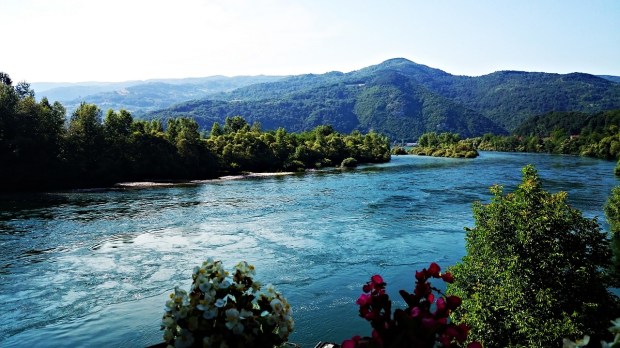
Serbian river
belgrade-466173_1280
Belgrade, Serbia

Ireland

As I had my mother in law staying with us from Ireland and the kids were also here, it felt only right to cook Ireland on St Patrick’s Day!
So, The Emerald Isle, my husband’s homeland .. the pressure’s on!!
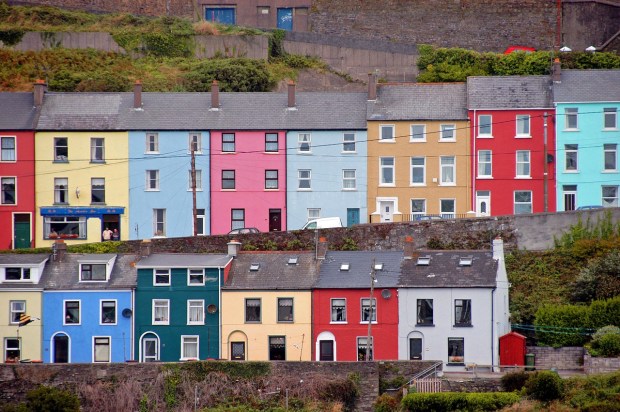
I’ve been to Ireland several times and have had the pleasure of visiting Cork, Dublin and Galway.  All very different and yet delightful in their own unique way.  Beautiful beaches and sea views in Cork, great food, shopping and bars in Dublin and stunning scenery in Galway.
The land of potatoes, guinness, shamrocks and leprechauns has a very long and interesting history.  The first people arrived in Ireland in around 7000 BC and lived by farming and fishing.
In 432 a man named Patrick arrived in Ireland from Western England.  He had been captured by Irish pirates, brought to Ireland as a slave and was forced to work as a herdsman.  He managed to escape back to England but had a vision in which he read a letter asking him to come to Ireland, so he returned to become a missionary and the first bishop of Ireland.  He is said to have died on 17th March 461.
The Great Famine was a period of mass starvation, disease, and emigration in Ireland between 1845 and 1852.  The famine was caused by potato blight.  One third of the population was dependent on the potato for a range of ethnic, religious, political, social and economic reasons and therefore impacted Ireland significantly.  During the famine, approximately 1 million people died and a million more emigrated from Ireland causing the island’s population to fall by between 20% and 25%.
A few quick facts:
Ireland’s top tourist attraction is the Guinness storehouse in Dublin, where over 1 million people visit every year.
In 2010, Dublin was designated UNESCO City of Literature, one of only four in the world (the others are Edinburgh, Iowa and Melbourne).
James Hoban, designer of The White House was Irish.
Rotunda Hospital in Dublin is the longest continually operating maternity hospital in the world.
The Titanic made it’s last port of call in Cobh (then called Queenstown) on 11th Feb, 1912.
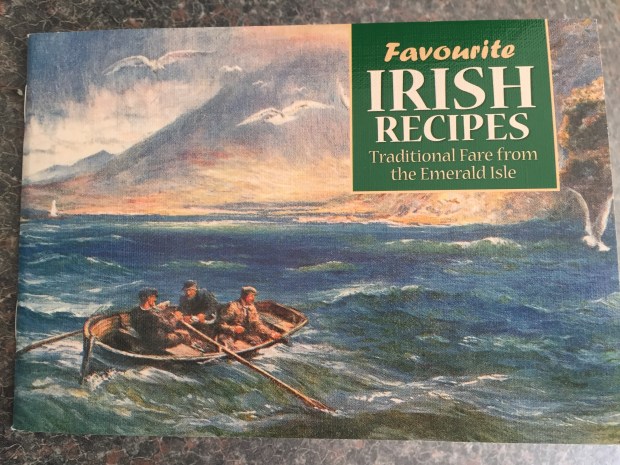
When it comes to Irish food, there was a lot to choose from.  A few years ago, my mother in law had given me an Irish recipe book which came in very handy!  Some obvious options I considered were Irish stew, Colcannon and a full Irish breakfast!  However, I opted for Scallop pie and Soda bread.  Thankfully both went down extremely well.
Rating: 9/10
Recipe for Scallop pie:
Prep time: 1 hour

Cook time: 45 minutes

IMG_7961


Recipe for Soda bread:
Prep time: 10 minutes
Cook time: 40 minutes (longer than the recipe states)
IMG_8022


IMG_7962
Irish cookbook
dublin-1049403_1280
The Ha’penny Bridge, Dublin
cliff-of-mohar-324746_1280
Cliffs Of Moher, County Clare
cobh-cove-285147_1280
Cork
ireland-531137_1280
Guinness
IMG_8021
Family fun on St Patrick’s Day 2016

Eritrea

Eritrea is bordered by Sudan to the north and west, the Red Sea to the north and east with Ethiopia and Djibouti to the south.  Eritrea literally means “red”, and gets its name from the Red Sea.  Much of the country is mountainous. It’s narrow Red Sea coastal plain is one of the hottest and driest places in Africa. The cooler central highlands have fertile valleys that support agriculture.The Dahlak Islands, within the Red sea contain untouched sea reefs.


Eritrea only has one political party: People’s Front for Democracy and Justice. Isaias Afewerki is the first and the current President of Eritrea. He assumed office on May 24, 1993 after declaration of independence from Ethiopia.  After independence, Eritrea entered into a war over Red Sea islands with Yemen and then a more devastating border war with Ethiopia in 1998, causing an estimated 100,000 casualties. A peace agreement in 2000 established a UN-patrolled buffer zone along the Eritrean-Ethiopian border.


Eritrea were subject to a social media hoax earlier this year regarding supposed new marriage laws – “Due to the recent troubles in our country, we are experiencing a serious shortage of men, and an abundance of woman. Men are now legally required to take at least two wives, and any that fail to do so will face strict punishment.”  When the hoax went viral the Government took to twitter to dispel the rumour – “the media frenzy to parrot this ludicrous, fabricated and trite story… on mandatory polygamy is appalling”.


Some Eritrean recipes I came across were: Zigini (spicy beef stew) with injera (flatbread),   Gored gored (raw beef dish), Fata (spicy tomato bread salad with yoghurt).  I opted to cook Tsebhi Dorho (spicy chicken) which involved making Berbere (a spice blend) and Tegelese Tesmi (herbed butter).
Rating: 8/10
Serves 4-5 with rice & bread on the side
Prep time: 1 hour + 30 mins marinating time

Cook time: 30 mins for the Tegelese Tesmi & 1 hr 15 mins for the Tesbhi Dorho


For the Tesbhi Dorho:
3 medium onions, finely chopped
3 tbsp Berbere spice – see below
3 tbsp Tegelese Tesmi (herbed butter) – see below
1 tsp fresh ginger, chopped
1 tsp garlic, chopped
2 tbsp lemon juice
2 tbsp tomato paste
2 tsp salt
1 tin chopped tomatoes
500g chicken breast or thigh meat, cut into serving pieces
Salt & black pepper to taste
Hard boiled eggs, sliced (optional)
For the Berbere spice mix:
1 tsp (level) crushed chillies
1 tbsp paprika
1/2 tbsp salt
1/2 tsp ground ginger
1/2 tsp ground onion powder
1/4 tsp fenugreek
1/4 tsp ground cardamom
1/4 tsp ground coriander
Pinch ground nutmeg
Pinch garlic powder (not salt)
2 small cloves ground in pestle
Pinch ground cinnamon
Pinch ground allspice

For the Tegelese Tesmi:
100g unsalted butter
50ml water
1 small onion very finely chopped
1 cloves of garlic, crushed
1 tsp fresh ginger, finely grated

For the Tegelese Tesmi:
Put the butter and the water in a frying-pan and heat them until the butter has melted.
Add the other ingredients and simmer the mixture on a low fire for 30 minutes, until the mixture stops skimming and the butter is clear.
Do NOT stir the mixture.
Sieve the butter and allow to cool down in a well closed jam jar.

For the Berbere spice blend:
Mix all the spices together and put in a closed jar until you need to use them.

For the Tesbhi Dorho:
Sprinkle chicken with lemon juice and salt and allow to marinate for about thirty minutes.
In a skillet, sauté onions in a small amount of water.
Add Berbere spice and cook for about 2 minutes.
Add Tegelese Tesmi and cook an additional 5 minutes.
Add tomatoes, tomato paste, garlic, ginger and simmer for 20 minutes.
Add chicken and 1/2 cup water and simmer for about 45 minutes, or until the chicken is tender and fully cooked.
If you are using eggs, add them and cook for a couple of minutes.
Serve with cooked basmati rice and plain nan.


South Africa

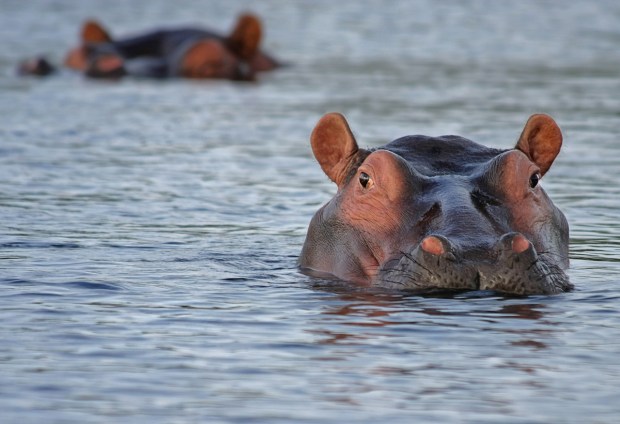
The Republic of South Africa is Africa’s largest and most developed economy.  It’s main exports are gold, diamonds, metals, minerals, cars & machinery.  It is an extremely diverse nation, home to hippos, penguins, zebras, dolphins and of course ‘the big five’ (African lion, African elephant, Cape buffalo, African leopard, and White/Black rhinoceros).  It hosts four of the seven fastest mammals in the world, namely the wildebeest, the African lion, the springbok and the cheetah.
A turbulent political history, dominated by apartheid from 1948 to 1994.  Racial segregation had been in place for centuries but a new policy, started in 1948 made it stricter and more systematic.  The people of South Africa were divided by their race and were forced by law to live apart from each other.  In 1990 President Frederik Willem de Klerk began negotiations to end apartheid.  The multi-racial democratic elections in 1994 were won by the African National Congress, led by Nelson Mandela and he became the first President of South Africa and also the first black president.   Nelson Mandela won the Nobel Peace Prize for his leadership of anti-apartheid activism in 1993.  The apartheid system was banned in 1994.
There are many inviting tourist highlights for visitors to South Africa; The Cape of Good Hope, Table Mountain, Kruger National Park, The Garden Route, Cape Town, Johannesburg to name a few!
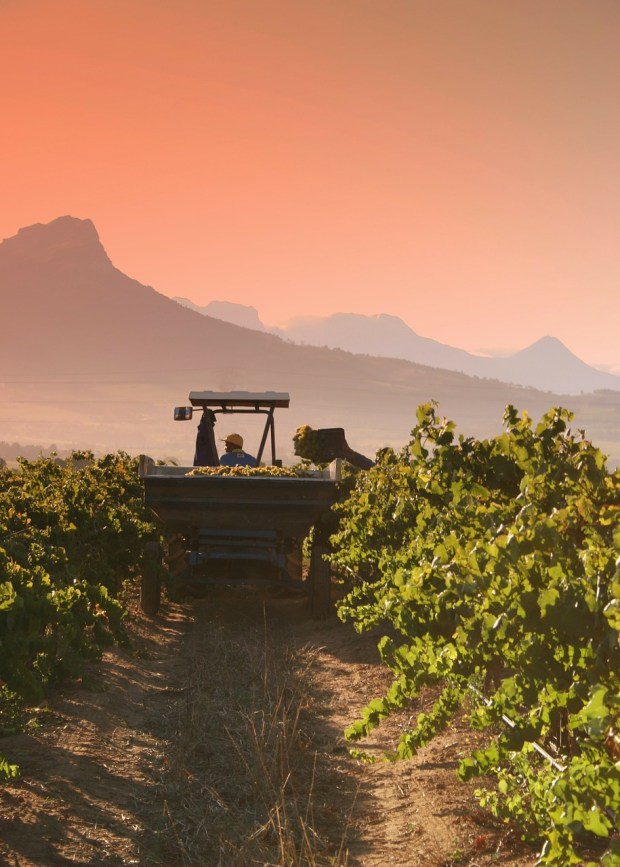
South Africa’s Garden Route is the longest stretching wine route in the world.  Route 62 is 850 km long from Cape Town to Port Elizabeth.  There are over 560 wineries in the Cape area.
It also has the highest commercial bungee jumping bridge in the world at Bloukrans, which is 216 metres long.  It’ll set you back £39.50 for the privilege.
When it comes to the food, again it is very diverse with influences from the Dutch, French, Indians and Malaysians.  Some of the recipes I came across were
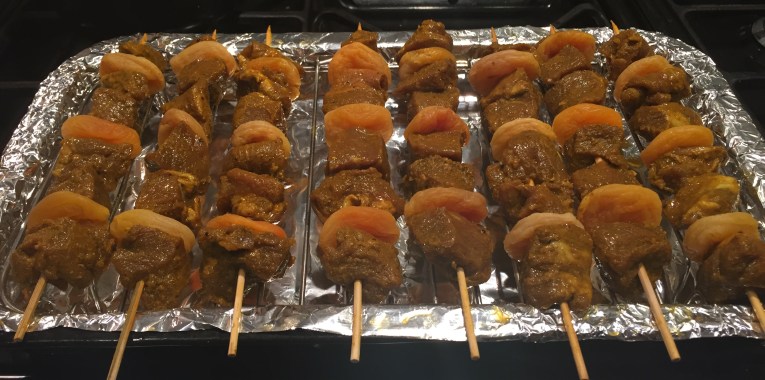
Bobotie (meatloaf with egg based topping), Chicken Curry Potjie, Buttermilk pudding and Koeksisters (sweet twisted pastries).  I decided to cook Sosaties (grilled lamb kebabs).
Rating: 8/10.
Prep time: 40 minutes + 24 hours marinating time
Cook time: 15 – 20 minutes
Sosaties:
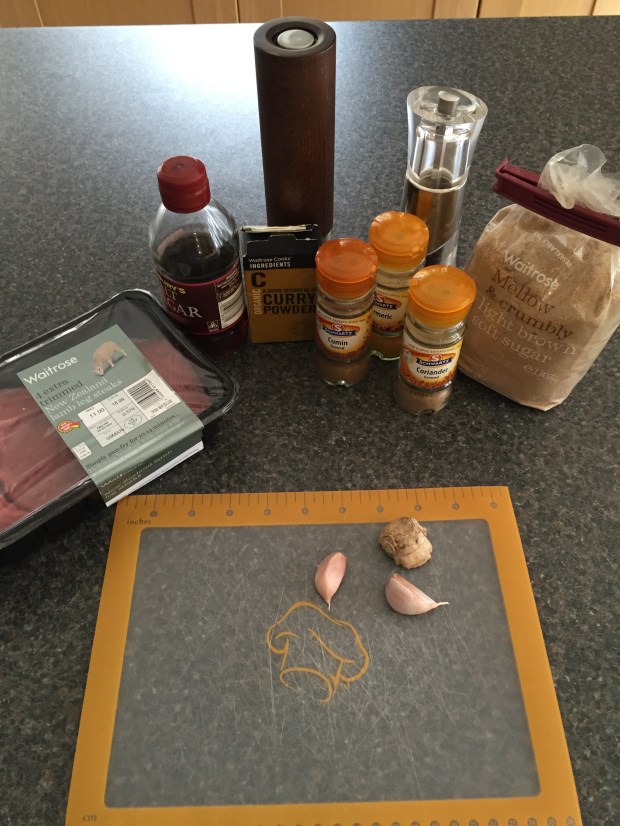
500g trimmed lamb leg cut into chunks
200g dried apricots
8 metal or wooden skewers
Sosatie Marinade:
1 tbsp apricot jam
2 tbsp soft brown sugar
1 tbsp crushed garlic
6 cloves
3 bay leaves
2 tbsp curry powder
2 tbsp malt vinegar
2 tsp salt
1 tsp ground black pepper
1 tsp fresh ginger
2 tsp turmeric
2 tsp ground cumin
2 tsp ground coriander
1/4 cup water
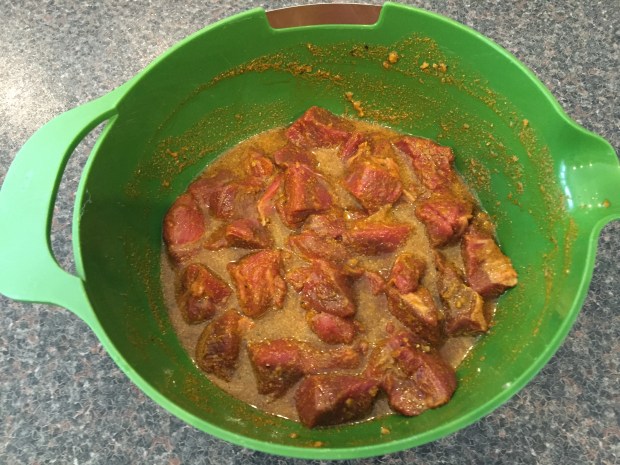
Place all the marinade ingredients in a bowl and mix well together.
Add the lamb to the marinade and mix well.
Cover and leave in the fridge for 24 hours (or more). Stir the lamb 3 or 4 times during the marinating process.
If using wooden skewers, soak in water for a couple of hours before using.
Soak the apricots in warm water until they plump up.
Remove the lamb from the bowl and thread it on to the skewers alternating pieces of lamb and apricots.
Reserve the marinade.
Preheat the grill or BBQ and cook the sosaties for 10 – 15 minutes, turning regularly so they don’t burn.
Meanwhile pour the marinade into a saucepan and heat until almost boiling.
When serving pour the hot marinade over the sosaties and serve.
IMG_7738
Sosatie ingredients
IMG_7740
Lamb marinating in sosatie marinade
IMG_7823
Marinated lamb in sosatie marinade
IMG_7830
Lamb Sosaties
hippo-515027_1280
Hippo
cape-of-good-hope-1219192_1280
The Cape of Good Hope
cape-town-997521_1280
Cape Town
chardonnay-227786_1280
Stellenbosch

Uruguay

Uruguay is situated on the east coast of South America, sharing borders with Brazil and Argentina.
Often called the Switzerland of South America for it’s stable democracy and social benefits such as free education.
Uruguay is ranked first in Latin America for democracy, peace, lack of corruption and quality of living.  It boasts one of the highest literacy rates in the world with 98.1% for adults.  The Economist named Uruguay “country of the year” in 2013.  It is regarded as one of the most liberal nations in the world and most socially developed.  In December 2013, Uruguay became the world’s first country to legalise the marijuana trade.
Uruguay is the only country that keeps track of 100 per cent of its cattle, of which, apparently there are 3 to every person!
The Uruguay national football team has won the FIFA World Cup on two occasions – at the inaugural tournament in 1930 and again in 1950.  It has also won gold for football at the 1924 and 1928 Olympics, which are the only gold medals they have ever won so far.
“Liberta o Murte” is Uruguay’s motto – “freedom or death”.
Thanks to it’s relatively temperate climate and stretches of beaches, it attracts many tourists each year.  Highlights include Montevideo, it’s culturally rich capital city, idyllic fishing villages such as Cabo Polonio, gaucho cowboys and tasty Parillas (steakhouses).
Beef is a major part of Uruguayan cuisine with Asado being very popular (a BBQ of different types of beef).  Also empanada (a meat filled turnover), Ñoquis (gnocchi which is traditionally eaten on the 29th of each month as years ago they only had flour & potatoes left at the end of the month!)

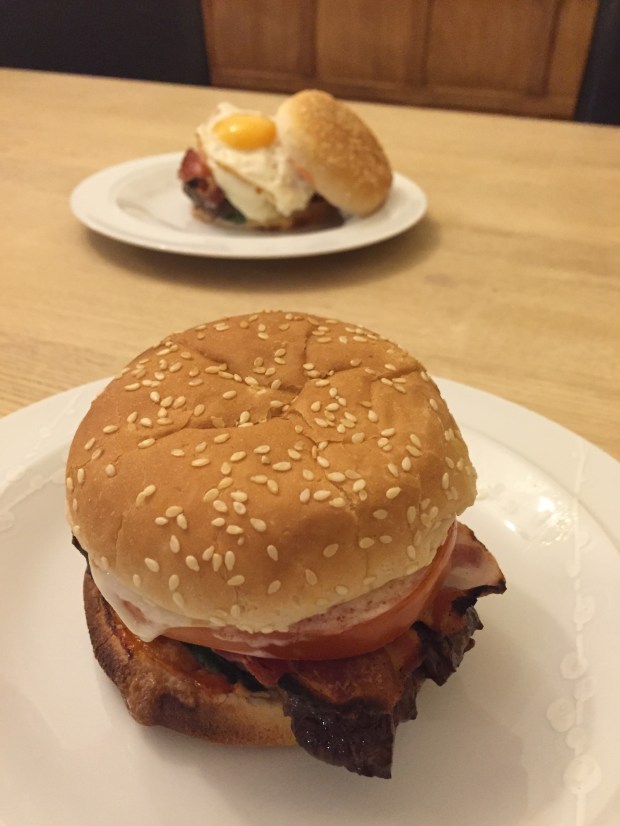
I opted to cook ‘Chivito’, Uruguay’s national sandwich!

Rating: 9/10.  It would’ve been a 10/10 if I had chosen a better bun like ciabatta.  It is important that you buy quality ingredients for this recipe.  Don’t scrimp on the steak, bacon or mozzarella!
Prep time: 20 mins
Cook time: 10 mins
2 burger buns or ciabatta (or your preferred type of bread roll)
2 beef fillet steaks
2 pieces of bacon
2 slices of deli ham
2 tomato slices
2 slices of mozzarella cheese
2 eggs
1-2 tablespoons butter
Lettuce
Mayonnaise
Ketchup
Salt and pepper to taste

Place a large skillet over medium heat and cook the bacon slices until crispy. Set aside on paper towels to cool.
Drain the excess bacon fat out of the skillet.
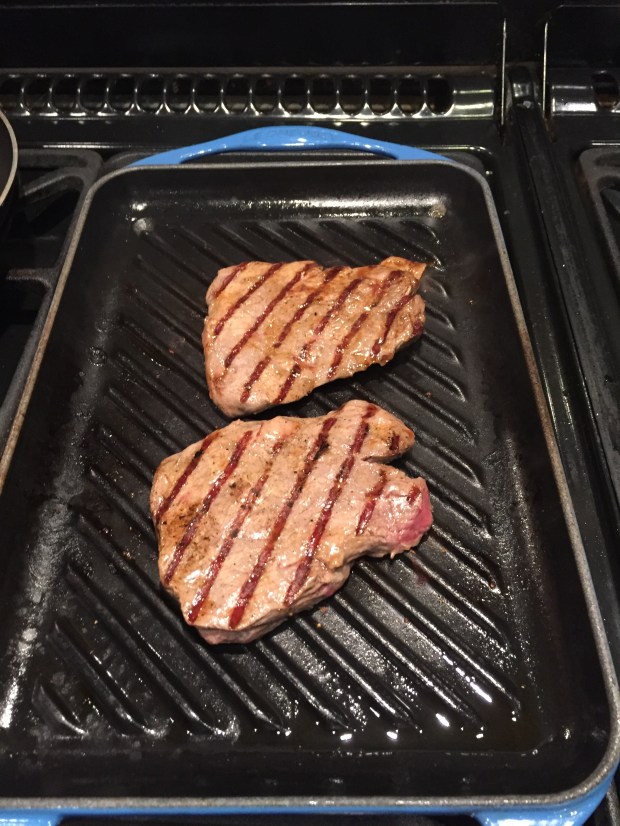
Sprinkle each steak with coarse salt, and use a mallet to pound the steaks. Heat the skillet over medium high heat until hot, and place steaks on the skillet.
Cook for about 1 and a half minutes per side, or until desired doneness.
Set aside on paper towels to rest.
Wipe the skillet clean. Melt the butter over medium heat, and fry eggs sunnyside up until desired doneness.
Preheat the grill.
Assemble sandwiches: Spread the inside of buns with ketchup and mayonnaise.
Place lettuce slices over bottom half of buns.
Top with a slice of beef, 2 bacon slices, a slice of ham, a slice of tomato, and a slice of mozzarella.
Place sandwiches (uncovered) under the grill briefly (keeping a close eye on them) to melt the cheese.
Remove from the grill and add the fried egg over the cheese, then top with the other half of the bun.
Serve immediately.

IMG_7753
Ingredients
IMG_7756
Cooking the steak
IMG_7759
Seared steak
IMG_7765
Chivito
IMG_7766
Chivito
IMG_7776
Chivito
fair-1122376_1280
Asador cooking Asado
canelones-91226_1280
Uruguayan beach

Côte d’Ivoire

The Ivory Coast or Côte d’Ivoire is considered the cultural hub of West Africa.  It has two official capitals. Yamoussoukro is the political and administrative capital, while Abidjan serves as the economic capital of the country. Abidjan is often called the “Paris of West Africa,” and much of its beauty derives from its setting on the rim of a lagoon at the edge of the ocean.
A few interesting facts …
Ivory Coast is one of the largest producers and exporters of coffee, cocoa beans, and palm oil.
The Basilica of Our Lady of Peace in Yamoussoukro is the largest church building in the world with an area covering 323,000 sq ft.
The trade in ivory which gave the country its name had almost died out by the 18th century.
The Ivory Coast national football team is nicknamed “Les Eléphants” (the elephants).
Côte d’Ivoire (which is the country’s preferred name for itself) is an anagram of “erotic video”.
According to Lonely Planet some of the highlights include surfing at Assinie beach, the rainforest of Parc National de Taï and hiking to the summit of Mt Tonkoui for a view of 3 countries.
Some recipes I came across for Côte d’Ivoire – Maafe (meat in peanut sauce), Attiéké (grated cassava) and poulet bicyclette (guinea fowl).  I opted to cook Kedjenou (slow cooked chicken) with rice.  It was very simple and pleasantly tasty.
Rating 7/10
Prep time: 10 minutes
Cook time: 1.5 hours
Serves 2-3
4 chicken drumsticks & 2 chicken breasts
1 medium onion
1 spring onion
1/2 fresh red or green pepper
1 can of tomatoes
1/2 tablespoon bouillon (1 maggi cube)
1/2 tablespoon ginger paste
1/2 tablespoon garlic puree
1 fresh sprig thyme
1 bay leaf
1/2 teaspoon smoked paprika
1/2 habenero chilli pepper
Salt and pepper


Preheat the oven to 170.

Remove the skin from the drumsticks and trim off excess fat, pat the chicken dry with a kitchen towel and sprinkle with salt.
Slice the onion, spring onion and pepper.
Add all the ingredients to an oven proof casserole dish with lid and stir until everything is mixed together.
Seal the dish with aluminum foil and then cover it with the lid.
Place in the oven and shake the pot once or twice during cooking without removing the lid.
Cook for 1 & half hours.
Let it stand for 5 minutes, then remove the chicken from the bones and serve with rice.

Ghana

Situated in West Africa on the Gulf of Guinea, covering an area of 92,100 square miles.  Home to the largest man made lake in the world – Lake Volta. The word Ghana is known to mean Warrior King, Ghana’s former name was “Gold Coast” after the large amount of gold that colonizers found in the country.  It’s biggest exports are cocoa (the world’s second largest producer) and gold.

Top of the things to see and do would include: searching for elephants in Mole National Park, strolling along the beach at Princess town and overlooking the Atlantic from the 18th Century castle of Elmina, a UNESCO World Heritage Site.

The travel operator, Viator, has a plethora of different tours to explore Ghana.  You can take an 3 day private tropical forest hike in Togo & Ghana from £277 or a 12 day wildlife & cultural tour of Northern Ghana from £1,400 (without flights).

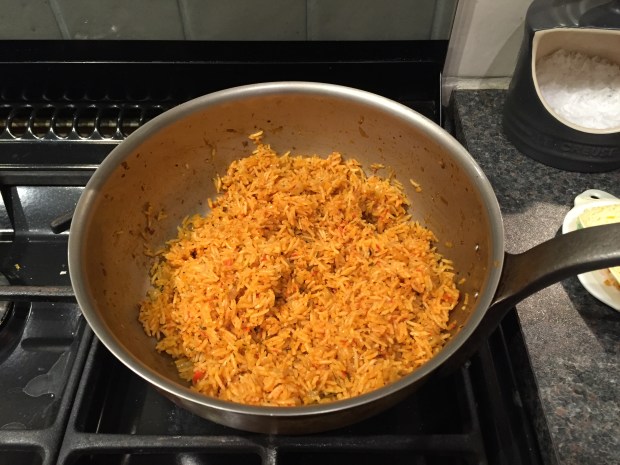
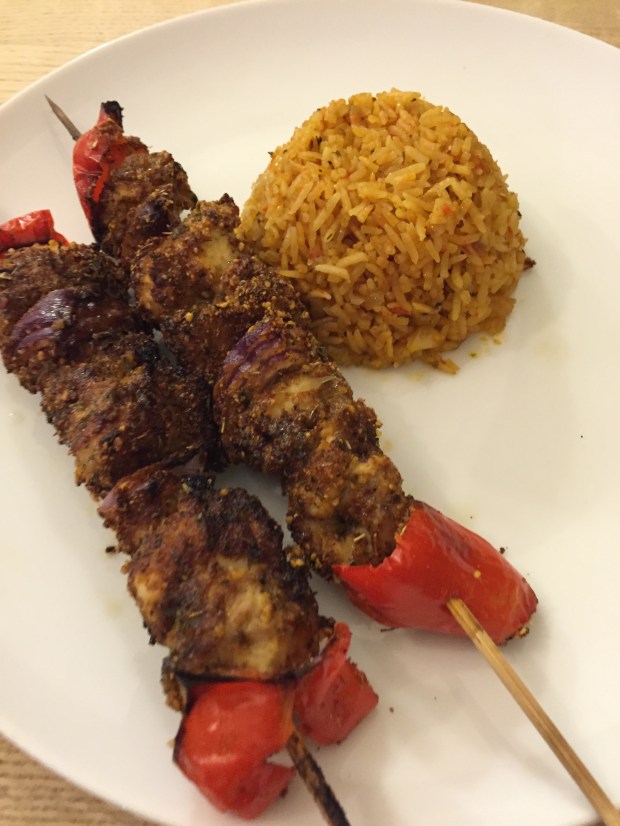
Ghanaian cuisine highlights include; Fufu (pounded cassava), Groundnut stew, Omo tuo (rice balls served in fish or meat soup).  I opted to cook a couple of popular dishes – Jollof rice and Kyinkyinga (Pronounced chinchinga), a Ghanaian version of kebab.  Jamie Oliver cooked a Jollof rice recipe in Jun 2014, sparking reactions of outrage on social media from West Africans, who were not happy with his interpretation – #jollofgate!
Rating: 5/10.  Both dishes are quite dry and therefore I shouldn’t have served them together .. you live & learn.  The rice is very spicy!  We thought the kyinkyinga would’ve been better in a pitta bread with salad & mayo .. if we so dare to suggest.
Jollof rice
Serves 2
Prep time: 20 mins
Cook time: 40 mins
3/4 cups basmati rice
2.5 tbsp olive oil
1/2 heaped tbsp tomato puree
1/2 onion chopped
1 medium sized onion
2 medium tomatoes
1 clove of garlic
A small piece of ginger
1 scotch bonnet chilies (reduce if you don’t like it spicy)
1 tsp chicken or vegetable stock powder
Dried mixed herbs
1 small bay leaf
Salt to tasteBlend the ginger, garlic, chilli, tomatoes and two onions and set aside for later.
Heat oil in a non-stick pan and fry the chopped onions till soft and golden brown, about 10 minutes, then add the tomato puree and cook for a further 3 minutes.
Add the blended tomato and onion mixture from earlier and leave to cook through till the tomato mixture has lost its raw taste and the oil is visible at the top.
Add the stock powder, bay leaf and a sprinkle of the mixed herbs. Leave to simmer for about 3 minutes while you rinse the rice to remove excess starch.
When rice is rinsed, add to the sauce stirring it to make sure nothing sticks to the bottom. Now add 1/2 cup of water to the rice and sauce mix and stir, add salt to taste and cook till the water is almost evaporated.
Then cover and simmer on a low heat till rice is fully cooked, stir occasionally to prevent it sticking an add a dash of water if necessary .

Kyinkyinga (chicken kebab)
Prep time: 20 mins + 1 hour marinating time
Cook time: 15-20 mins

250g chicken thigh fillet, cut into cubes
2 tbsp olive oil
2 fat cloves of garlic
2 tbsp grated ginger
1 small onion
1 heaped tsp chicken stock powder
1 red pepper cut in cubes
1 red onion cut in cubes

Suya spice
mix 1/4 cup grounded roasted peanuts (milled into powder with excess oil taken out so that it is very dry)
8g chili powder
8g cup paprika
8g cup of garlic salt
8g cup Onion powder
8g cup dried mixed herbs
1 tsp chicken stock powder
Salt to taste

Blend the ginger, garlic, onion, stock cube seasoning with the oil to form a smooth paste.
Add the paste to the chicken and marinate for about an hour.
Skewer the marinated chicken pieces alternating with the peppers and onions and set aside.
Combine all the ingredients for the suya seasoning and mix together.
Sprinkle some of the suya spice on the skewered chicken and grill till it is cooked and browned both sides.
Remove from the heat and sprinkle a bit more of the suya powder on it, then serve.
IMG_7302
Jollof rice ingredients
IMG_7303
Kyinkyinga ingredients
IMG_7306
Kyinkyinga kebabs
IMG_7312
Cooking the jollof rice
IMG_7314
Kyinkyinga & Jollof rice
africa-634231_1280
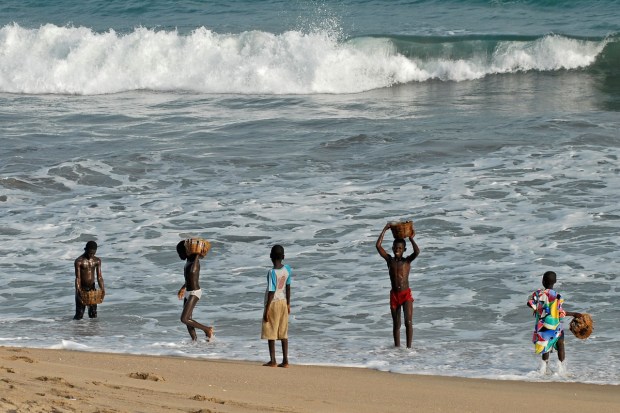
Fishermen in Ghana
africa-634236_1280
Castle of Elmina, a UNESCO World Heritage Site
ghana-700979_1280
Ghanaian children enjoying the beach

Poland

“Cześć” … “Hello”
The world’s tallest statue of Jesus is found in the town of Swiebodzin in Poland.  The 167 foot tall statue (including its 55 foot pedestal) is called Christ The King and towers higher than Rio de Janeiro’s Christ The Redeemer which stands at a mere 125 feet.
It is also home to Wroclaw, Europe’s Capital of Culture 2016, which is often called The Venice of the North, due to it’s location on the Odra River, with its 12 islands, 130 bridges and riverside parks.
One of the world’s oldest salt mines is the Wieliczka Salt Mine which was built in the 13th century and produced table salt until 2007.   It is also referred to as “the Underground Salt Cathedral of Poland” due to its three chapels and an entire cathedral which was carved out of the rock salt by the miners and was placed on the UNESCO list of World Heritage Sites in 1978.
Many notable people hail from Poland including; Marie Curie, Chopin, Roman Polanski and Pope John Paul II.
Poland has been invaded or fought for freedom in insurrections 43 times from 1600 – 1945.
In September 1939, World War II started with the invasions of Poland by Nazi Germany and the Soviet Union (as part of the Molotov–Ribbentrop Pact). More than six million Polish citizens died in the war.

Some popular Polish recipes include Bigos (hunters stew), Pierogi (dumplings),   On a wet and cold February evening however, we were in the mood for something relatively simple & quick, so I cooked Kotlet schabowy (breaded pork cutlet) and served it with little roasted rosemary spuds.
Rating: 7/10.  It could’ve benefited from a little more seasoning, so I have adapted the recipe slightly.

Prep time: 10 mins
Cook time: 15 mins

2 boneless pork shoulder steaks (or 1 each for however many you want to feed!)
Salt and black pepper
1 tsp season all
Plain flour
1 large egg beaten with 1 tsp water
Panko breadcrumbs
Vegetable oil

Bash the pork between two pieces of clingfilm to 1/4-inch thickness.
Season both sides of the steaks with salt and pepper.
Put flour on a plate with 1 tsp of season all.
Dredge each steak in flour, then egg, then panko breadcrumbs.
Allow cutlets to dry for 10 minutes before frying.
Heat oil to a depth of 1/2 inch in a large skillet.
Fry the pork cutlets one at a time in the pan for 5 minutes per side until golden.
Put in the oven covered with foil to keep warm whilst you cook the other steak(s).
Serve with chips or little roasted potatoes.

Burma / Myanmar

Well is it Burma or is it Myanmar?

That’s a tricky question … so we’ll start with the basics.  It is the largest country in mainland Southeast Asia, and the 40th-largest in the world.  It has a population of over 55,000 with the majority being Buddhist.  The capital is Yangon.

There has been a hell of a lot going on here so I’ve tried to do my best to summarise (very badly).  There’s a bit more info here than I would usually go into, which is at the request of one of my intellectual readers!

The country has been called “Burma” in English since the 18th century.
General Aung San, who was generally considered the father of independent Burma was assassinated in 1947.
Burma became independent from the UK in 1948.
In 1962, left-wing general Ne Win staged a coup, banned political opposition, suspended the constitution, and introduced the “Burmese way of socialism.”
In 1987, Ne Win suddenly cancelled certain currency notes which caused a great down-turn in the economy as it wiped out the savings of the vast majority of people. The main reason for the cancellation of these notes was superstition on Ne Win’s part, as he considered the number nine his lucky number—he only allowed 45 and 90 kyat notes, because these were divisible by nine.
After 25 years of economic hardship and repression, the Burmese people held massive demonstrations in 1987 and 1988. These were brutally quashed by the State Law and Order Council (SLORC).
In 1989, the military government officially changed the name of the country to Myanmar.  At the same time, they changed the name of Rangoon, the former capital, to Yangon.
Daughter of the assassinated general Aung San and leader of the opposition, Aung San Suu Kyi, was awarded the Nobel Peace Prize in 1991, which focused world attention on SLORC’s repressive policies.
In Nov 2005, the military junta, in a massive and secretive move, relocated the seat of government from the capital Yangon to a mountain compound called Pyinmanaa in Naypyidaw. The move perplexed many, and the junta was vague in its explanation, saying, “Due to changed circumstances, where Myanmar is trying to develop a modern nation, a more centrally located government seat has become a necessity.”
In May 2008, Cyclone Nargis ravaged the Irrawaddy Delta and Yangon, killing 22,500 people and leaving up to a million homeless. Another 41,000 people were reported missing and feared dead. Most of the death and destruction were caused by a 12-foot high tidal wave that formed during the storm.
Days after elections in Oct 2010, the country’s first elections in 20 years, opposition leader Aung San Suu Kyi was freed after nearly 20 years under house arrest, she won a seat in parliament and took office in May.  Thousands of supporters gathered outside her home, where she gave a speech calling for a “peaceful revolution”.
The country’s first Parliament in 20 years convened in Jan. 2011 and elected Prime Minister Thein Sein as president. The military junta officially disbanded in March 2011. However, Parliament is civilian largely in name only. The military won about 60% of the seats in October 2010 elections, and another 25% are reserved for members of the military
In his first year as president, Thein Sein initiated stunning changes in political and economic philosophy that saw a loosening of the tight grip the authoritarian junta held on the country. He initiated talks with opposition leader Aung San Suu Kyi, allowed her and her party, the NLD, to run in upcoming parliamentary elections, freed more than 800 political prisoners and signed a cease-fire with ethnic Karen rebels.
In Jan. 2012 the U.S. restored full diplomatic relations with Myanmar following a visit from Hilary Clinton, Secretary of State in Dec 2011.
In 2015, Aung San Suu Kyi announced that her party, the National League for Democracy (NLD), would take part in the election after boycotting the previous one in 2010, which was condemned for irregularities by international organisations.
In Feb 2016 Aung San Suu Kyi won the election in a landslide victory, but she cannot become president due to the constitution, which among other things:
i) prevents leaders having foreign relatives, her two sons are both British citizens; and
ii) demands the president has military experience, of which she has none.
According to Transparency International, Burma ranked 157 out of 177 countries in terms of perceived corruption. The Corruption Perceptions Index ranks countries/territories based on how corrupt a country’s public sector is perceived to be. It is a composite index, drawing on corruption-related data from expert and business surveys carried out by a variety of independent and reputable institutions
And on to the cooking.  Through my research I came across Mohinga (rice vermicelli with fish soup), which is the traditional breakfast dish and Burma’s national dish, Sanwinmakin (Semonlina cake) and Laphet Thohk (pickled tea leaf salad).  Also popular are curries of many varieties.  I chose Kyetha hin (chicken curry).
Rating: 9/10
Prep time: 30 mins
Cook time: 40 mins
390g chicken breast cut into bite size
1/2 med onion, chopped roughly
1 large garlic clove, smashed
1 strip of lemon peel, sliced
1/2 tsp ginger, grated
Vegetable oil
3/4 tbsp salt
1/2 tsp turmeric
1/4 tsp chilli powder
2 cups water
1 tbsp tomato puree
1/2 tbsp fish sauce
1/4 tsp tamarind paste or use tbsp lemon juice
Fresh coriander, chopped
Pinch ground cardamom
Blend the onion, garlic, lemon peel and ginger with a little oil to make a smooth paste.
Heat 1 tbsp oil in a pan and when hot add the paste, salt, turmeric & chilli powder.
Fry over a med heat for a few minutes stirring regularly and add a few drops of water if it starts to stick to the pan.
Reduce to a low heat and simmer for 10 minutes until all the liquid has evaporated and its turned deep brown.
Add the chicken pieces, stirring well to coat with the paste.
Cover and simmer for 15 minutes. T
hen add the water, potato, tomato puree, fish sauce, tamarind or lemon juice and stir to mix well.
Cover and continue to simmer for another 20 – 25 minutes, until the potato is soft.
Turn the heat off, sprinkle over the coriander & cardamom.
Serve with boiled rice.


Suriname

Suriname is the smallest country in South America, bordered by Guyana, French Guiana and Brazil.  It has a population of c.542,000, most of whom live on the country’s north coast, in and around the capital and largest city, Paramaribo. In 2002, the historic inner city of Paramaribo was declared as a UNESCO World Heritage Site.
The Saint Peter and Paul Cathedral in Paramaribo is the biggest wooden structure in the Western Hemisphere and is the seat of the Roman Catholic Diocese of Paramaribo.  It is 59.1m long, 14.6m high, 16.5m wide and reaches 44m high in the tower up to the bronze cross.

Tropical rainforests make up about 80% of Suriname´s total landscape.  One of the top tourist attractions, from April to August, is watching the giant leatherback turtles lay their eggs on the beach at Galibi Nature Reserve.
Suriname is a member of the Carribbean Community (CARICOM), officially a Dutch speaking country and is the only territory outside Europe where Dutch is spoken by the majority of the population.
Through the services of ‘Cynthia rent a house’, a 4 star, 1 bed apartment within a luxury resort, 20 min drive from Paramaribo, will cost €500 per month for long term rental.

The current president Desi Bouterse is a controversial figure.  In 2007 he was put on trial for allegedly ordering the killing of 15 political opponents as military ruler in 1982.  The case was put on hold when parliament passed a law giving him & his co-defendents blanket immunity for human rights violations committed during military rule.  In 1999, he was convicted in the Netherlands to 11 years imprisonment for cocaine trafficking, but he remains free in Suriname.

The cuisine of Suriname is a combination of many international cuisines including East Indian, African, Indonesian, Chinese, Dutch, Jewish, Portuguese and Amerindian.  I came across Pastei (creole-style chicken pot pie), Bami goreng (fried noodles) & Roti (flat bread).  However, within the Surinamese community, in both Surinam and The Netherlands, Pom is the most popular and best known festive dish.  It was introduced by the Portuguese-Jewish plantation owners as the Portuguese potato (“pomme de terre”) oven dish. Because the potato did not grow in Suriname and had to be imported it was replaced with the root of the tayer plant – pomtajer.  I used potato in my ‘Pom’ as I didn’t fancy my chances of finding pomtayer in the supermarket and because Bern is obsessed with potatoes!  I found many variations of the recipe in my research so this is my take on ‘Pom’.
Rating: 8/10


Prep time: 30 minutes
Cook time: 1 hour
For 2 people
3 med sized potatoes, peeled and grated (remove most of the excess water with a tea towel)
Juice of 1/2 lime
1/4 cup orange juice
1/4 tbsp brown sugar 1
/2 tsp nutmeg
Pinch turmeric
Salt & ground white pepper
1 tsp chicken stock powder or cube
1/2 cup water
1 tbsp chopped parsley
250g chicken chopped in to bite size pieces
50g butter
1/2 onion, chopped
1 tin chopped tomatoes


Melt 30g of butter in a pan and saute the onion on a med-low heat for 5 minutes, then set aside.
Add a little oil to the pan and add the chicken on a med heat. After a few minutes, add a pinch of salt, white pepper, a pinch of nutmeg, tsp chicken stock powder, half the lime juice and cook for a further few mins.
Add the onion back into the pan and stir.
Add the chopped tomatoes, 1/2 cup water, mix well and let it simmer on a low heat for 20 minutes.
Meanwhile, put the grated potato in a bowl with the rest of the lime juice, orange juice, sugar, parsley, a pinch of nutmeg and turmeric and mix well.
Preheat oven to 180c / 350f.
Butter 2 small oven proof dishes or 1 medium sized dish (enough for 2 large portions).
Spread each dish with a layer of the potato mix, using about half.
Let the chicken & tomato mix cool a little, then put a layer of chicken into each dish on top of the spuds.
Drain any excess liquid from the remaining potatoes and then spread the rest over the chicken.
Dot with the remaining butter and bake for 1 hour, until golden brown.

Sweden

Some interesting stats about Sweden:
86% of Swedes live in cities
There are 95,700 lakes in Sweden, making up approx 9% of its total area
The highest & lowest ever recorded temperatures are 38 degrees celsius (Jun) and -53 celsius (Feb)
Swedes are entitled to 480 days of paid parental leave, 90 of those days are reserved for the Dad
Students are paid $187 per month to attend high school
They’ve won 25 Oscars over the years – Ingrid Bergman won 3
Despite being a military power in the 17th century and one of the world’s largest producers of weapons, Sweden has not participated in any war for almost two centuries, including both world wars
With a tax rate of 51.4% of GDP, Swedes are one of the most highly taxed populations in the world. Ironically, they are generally happy to pay a high tax rate, and the Swedish word for tax is skatt, or “treasure.”
Between 300,000 and 400,000 moose (Alces alces) roam the Swedish woods. Over 100,000 are shot during the annual hunt, and about 250,000 people participate in the hunt. The moose is also considered the most dangerous animal in Sweden. Every year, they cause approximately 6,000 road accidents.

ABBA is the fourth-best selling music act in history, after Elvis Presley, the Beatles, and Michael Jackson. The group has sold over 375 million records worldwide. At one point, ABBA was second only to Volvo as Sweden’s biggest export earner.

And finally .. 1.8m Ikea meatballs are eaten on average every day worldwide!
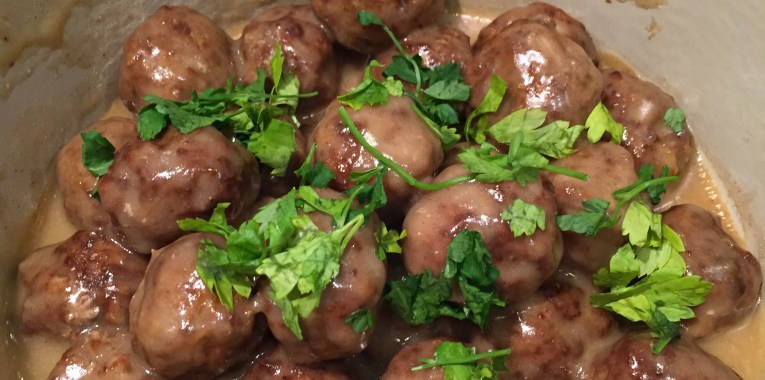
When it comes to the food, I really was spoilt for choice.  Some of the mouthwatering temptations include Semlas (cream filled buns), Jansson’s temptation (a creamy potato and anchovy casserole), Västerbotten cheese pie & a huge array of fish & shellfish dishes.  However, I simply couldn’t resist the obvious. I cooked Köttbulla (Swedish meatballs) and they were absolutely delicious!
Rating: 10/10


45g fresh white bread, crusts removed and bread cut into 1/2-inch pieces
1/4 cup milk
2.5 tbsps unsalted butter
1/2 medium onion, chopped finely
340g minced beef chuck (about 20% fat)
140g minced pork (about 25% fat)
2 tsp salt
1 large egg
1/8 tsp ground white pepper
Pinch ground allspice
Vegetable oil, for frying
1.5 tbsp flour
1 cup chicken stock
1/2 tsp soy sauce
1/4 tsp apple cider vinegar
Chopped flat-leaf parsley, for garnish
In a medium bowl, combine bread with milk, tossing to coat. Let stand until bread is completely softened and most of the milk absorbed, about 10 minutes.
Meanwhile, in a small skillet, melt 1 tablespoon butter over medium-high heat.
Add half of the onion and cook, stirring, until onion is golden and tender, about 5-6 minutes.
In a stand mixer fitted with the paddle attachment or in a food processor, combine minced beef, minced pork, bread and any remaining milk, cooked onion, remaining raw onion, salt, egg, white pepper, and allspice.
Starting on low speed and increasing to medium-high, beat mixture until ingredients are thoroughly combined, about 30 seconds to 1 minute.
Line a baking sheet with parchment paper.
Dipping your hands in water as needed to prevent meatball mixture from sticking, roll roughly 1-tablespoon-sized portions of meatball mixture into balls slightly smaller than golf-ball size.
Transfer to lined baking sheet.
Set a rack over a clean baking sheet and heat oven to 200°F. Heat about 1/2 inch of oil in a wide skillet to 350°F.
Working in batches, lower meatballs into oil and fry, turning until well browned all over, about 2 minutes. Transfer browned meatballs to the rack and keep warm in the oven.
In a medium saucepan, melt remaining 1.5 tablespoons butter over medium-high heat until foamy.
Whisk in flour and cook, whisking, until raw flour smell is gone, about 3 minutes.
Whisk in chicken stock, bring to a boil, lower heat to a simmer and cook until thickened, about 3 minutes.
Whisk in soy sauce and cider vinegar. Season with salt and white pepper.
Add meatballs to gravy and stir to coat. Simmer until meatballs are heated through.
Serve with buttered mashed potatoes.