Suriname

Suriname is the smallest country in South America, bordered by Guyana, French Guiana and Brazil.  It has a population of c.542,000, most of whom live on the country’s north coast, in and around the capital and largest city, Paramaribo. In 2002, the historic inner city of Paramaribo was declared as a UNESCO World Heritage Site.
The Saint Peter and Paul Cathedral in Paramaribo is the biggest wooden structure in the Western Hemisphere and is the seat of the Roman Catholic Diocese of Paramaribo.  It is 59.1m long, 14.6m high, 16.5m wide and reaches 44m high in the tower up to the bronze cross.

Tropical rainforests make up about 80% of Suriname´s total landscape.  One of the top tourist attractions, from April to August, is watching the giant leatherback turtles lay their eggs on the beach at Galibi Nature Reserve.
Suriname is a member of the Carribbean Community (CARICOM), officially a Dutch speaking country and is the only territory outside Europe where Dutch is spoken by the majority of the population.
Through the services of ‘Cynthia rent a house’, a 4 star, 1 bed apartment within a luxury resort, 20 min drive from Paramaribo, will cost €500 per month for long term rental.

The current president Desi Bouterse is a controversial figure.  In 2007 he was put on trial for allegedly ordering the killing of 15 political opponents as military ruler in 1982.  The case was put on hold when parliament passed a law giving him & his co-defendents blanket immunity for human rights violations committed during military rule.  In 1999, he was convicted in the Netherlands to 11 years imprisonment for cocaine trafficking, but he remains free in Suriname.

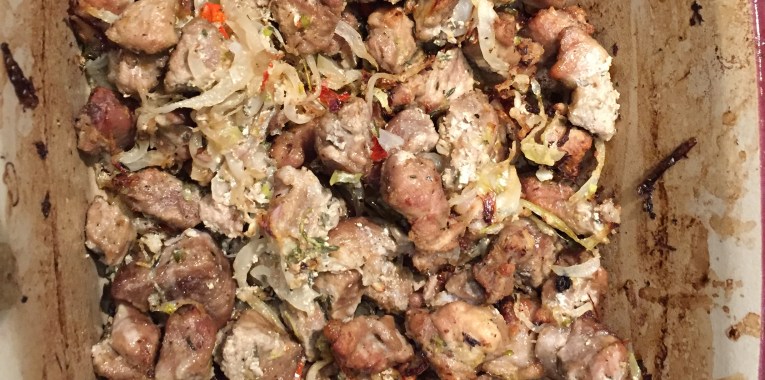
The cuisine of Suriname is a combination of many international cuisines including East Indian, African, Indonesian, Chinese, Dutch, Jewish, Portuguese and Amerindian.  I came across Pastei (creole-style chicken pot pie), Bami goreng (fried noodles) & Roti (flat bread).  However, within the Surinamese community, in both Surinam and The Netherlands, Pom is the most popular and best known festive dish.  It was introduced by the Portuguese-Jewish plantation owners as the Portuguese potato (“pomme de terre”) oven dish. Because the potato did not grow in Suriname and had to be imported it was replaced with the root of the tayer plant – pomtajer.  I used potato in my ‘Pom’ as I didn’t fancy my chances of finding pomtayer in the supermarket and because Bern is obsessed with potatoes!  I found many variations of the recipe in my research so this is my take on ‘Pom’.
Rating: 8/10


Prep time: 30 minutes
Cook time: 1 hour
For 2 people
3 med sized potatoes, peeled and grated (remove most of the excess water with a tea towel)
Juice of 1/2 lime
1/4 cup orange juice
1/4 tbsp brown sugar 1
/2 tsp nutmeg
Pinch turmeric
Salt & ground white pepper
1 tsp chicken stock powder or cube
1/2 cup water
1 tbsp chopped parsley
250g chicken chopped in to bite size pieces
50g butter
1/2 onion, chopped
1 tin chopped tomatoes


Melt 30g of butter in a pan and saute the onion on a med-low heat for 5 minutes, then set aside.
Add a little oil to the pan and add the chicken on a med heat. After a few minutes, add a pinch of salt, white pepper, a pinch of nutmeg, tsp chicken stock powder, half the lime juice and cook for a further few mins.
Add the onion back into the pan and stir.
Add the chopped tomatoes, 1/2 cup water, mix well and let it simmer on a low heat for 20 minutes.
Meanwhile, put the grated potato in a bowl with the rest of the lime juice, orange juice, sugar, parsley, a pinch of nutmeg and turmeric and mix well.
Preheat oven to 180c / 350f.
Butter 2 small oven proof dishes or 1 medium sized dish (enough for 2 large portions).
Spread each dish with a layer of the potato mix, using about half.
Let the chicken & tomato mix cool a little, then put a layer of chicken into each dish on top of the spuds.
Drain any excess liquid from the remaining potatoes and then spread the rest over the chicken.
Dot with the remaining butter and bake for 1 hour, until golden brown.

Sweden

Some interesting stats about Sweden:
86% of Swedes live in cities
There are 95,700 lakes in Sweden, making up approx 9% of its total area
The highest & lowest ever recorded temperatures are 38 degrees celsius (Jun) and -53 celsius (Feb)
Swedes are entitled to 480 days of paid parental leave, 90 of those days are reserved for the Dad
Students are paid $187 per month to attend high school
They’ve won 25 Oscars over the years – Ingrid Bergman won 3
Despite being a military power in the 17th century and one of the world’s largest producers of weapons, Sweden has not participated in any war for almost two centuries, including both world wars
With a tax rate of 51.4% of GDP, Swedes are one of the most highly taxed populations in the world. Ironically, they are generally happy to pay a high tax rate, and the Swedish word for tax is skatt, or “treasure.”
Between 300,000 and 400,000 moose (Alces alces) roam the Swedish woods. Over 100,000 are shot during the annual hunt, and about 250,000 people participate in the hunt. The moose is also considered the most dangerous animal in Sweden. Every year, they cause approximately 6,000 road accidents.

ABBA is the fourth-best selling music act in history, after Elvis Presley, the Beatles, and Michael Jackson. The group has sold over 375 million records worldwide. At one point, ABBA was second only to Volvo as Sweden’s biggest export earner.

And finally .. 1.8m Ikea meatballs are eaten on average every day worldwide!
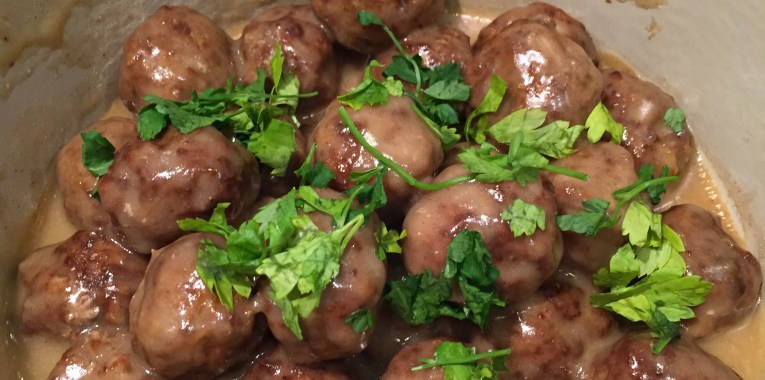
When it comes to the food, I really was spoilt for choice.  Some of the mouthwatering temptations include Semlas (cream filled buns), Jansson’s temptation (a creamy potato and anchovy casserole), Västerbotten cheese pie & a huge array of fish & shellfish dishes.  However, I simply couldn’t resist the obvious. I cooked Köttbulla (Swedish meatballs) and they were absolutely delicious!
Rating: 10/10


45g fresh white bread, crusts removed and bread cut into 1/2-inch pieces
1/4 cup milk
2.5 tbsps unsalted butter
1/2 medium onion, chopped finely
340g minced beef chuck (about 20% fat)
140g minced pork (about 25% fat)
2 tsp salt
1 large egg
1/8 tsp ground white pepper
Pinch ground allspice
Vegetable oil, for frying
1.5 tbsp flour
1 cup chicken stock
1/2 tsp soy sauce
1/4 tsp apple cider vinegar
Chopped flat-leaf parsley, for garnish
In a medium bowl, combine bread with milk, tossing to coat. Let stand until bread is completely softened and most of the milk absorbed, about 10 minutes.
Meanwhile, in a small skillet, melt 1 tablespoon butter over medium-high heat.
Add half of the onion and cook, stirring, until onion is golden and tender, about 5-6 minutes.
In a stand mixer fitted with the paddle attachment or in a food processor, combine minced beef, minced pork, bread and any remaining milk, cooked onion, remaining raw onion, salt, egg, white pepper, and allspice.
Starting on low speed and increasing to medium-high, beat mixture until ingredients are thoroughly combined, about 30 seconds to 1 minute.
Line a baking sheet with parchment paper.
Dipping your hands in water as needed to prevent meatball mixture from sticking, roll roughly 1-tablespoon-sized portions of meatball mixture into balls slightly smaller than golf-ball size.
Transfer to lined baking sheet.
Set a rack over a clean baking sheet and heat oven to 200°F. Heat about 1/2 inch of oil in a wide skillet to 350°F.
Working in batches, lower meatballs into oil and fry, turning until well browned all over, about 2 minutes. Transfer browned meatballs to the rack and keep warm in the oven.
In a medium saucepan, melt remaining 1.5 tablespoons butter over medium-high heat until foamy.
Whisk in flour and cook, whisking, until raw flour smell is gone, about 3 minutes.
Whisk in chicken stock, bring to a boil, lower heat to a simmer and cook until thickened, about 3 minutes.
Whisk in soy sauce and cider vinegar. Season with salt and white pepper.
Add meatballs to gravy and stir to coat. Simmer until meatballs are heated through.
Serve with buttered mashed potatoes.

Tajikistan

Tajikistan, a landlocked former Soviet republic, covers an area of 142,000 sq km (55,000 sq miles). It borders Kyrgyzstan in the north, China in the east, Afghanistan in the south and Uzbekistan in the northwest. The capital is Dushanbe.
The area of Tajikistan has been inhabited since 4000 BC.
The Pamir mountains, topping 7,000 meters (23,000 feet) and known locally as the “Roof of the World”, make up more than 90 percent of its territory There are more than 900 rivers in Tajikistan and about 20 main lakes.
The legendary Silk Road passed through Tajikistan going from China to Europe. The Silk Road (or Silk Route) is an ancient network of trade routes that were central to cultural interaction through regions of the Asian continent connecting the West and East from China to the Med. The Silk Road derives its name from the lucrative trade in Chinese silk carried out along its length.
Tajikistan remains the poorest of the 15 post-Soviet nations.
According to wiki, part of the 1985 American comedy film, Spies Like Us, directed by John Landis starring Chevy Chase and Dan Aykroyd was set in Tajikstan. Although they didn’t actually do any filming there.
The cuisine of Tajikstan includes Plov (a rice dish fried with vegetables & meat), Qurutob (salted cheese) and Fatir (flaky flatbread). I decided to cook lamb kebabs with mint & star anise.  They were a very unusual (if not an acquired) taste.
Rating: 7/10

Kebabs:
400g ground lamb
1 large red onion
1 medium tomato
2 tsp salt
1 tsp ground black pepper
1 tsp ground coriander
4 star anise corms, ground
1 tsp ground cinnamon
1 tbsp fresh, chopped mint leaves
1 small bunch of coriander leaves, chopped (15-20 sprigs)
3 hot, dried, red chili peppers
1/4 cup flour (optional)
Stew:
2 large yellow onions, peeled, sliced and separated into crescents
3 tbsps unsalted butter
1 tsp granulated sugar
1 generous tbsp of garlic, peeled and chopped
3 hot, dried red chili peppers
1/2 tsp salt
1/4 tsp ground black pepper
1 small bunch of coriander leaves, chopped (15-20 sprigs)
1 cup beef stock
1/2 cup plain yogurt

1. In a food processor combine onion tomato and spices and blend lightly so that the vegetables are chopped but still have their form. Add meat, blend lightly again to mix. Let set in the refrigerator for several hours before rolling into kebabs.
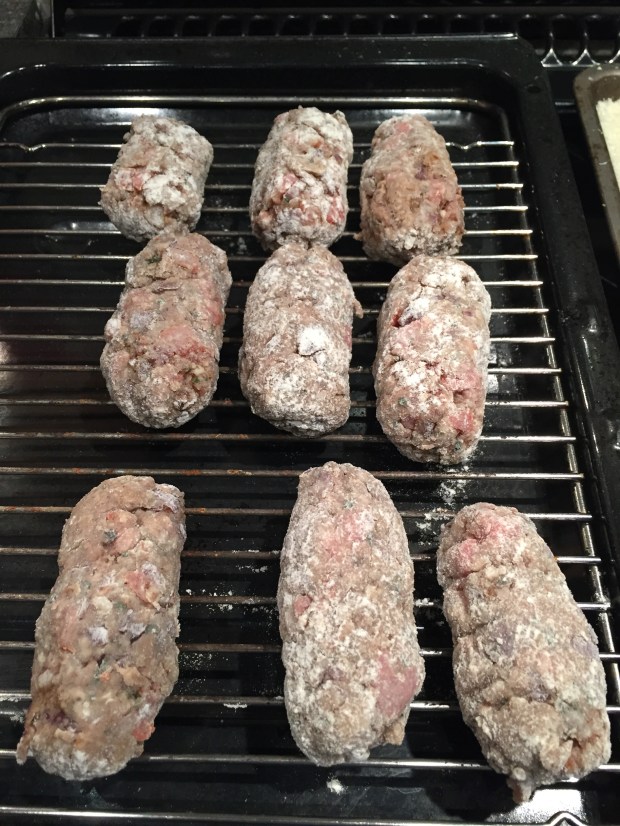
2. Preheat grill on the highest setting. Remove meat mix from refrigerator and roll the kebabs into sausages or loaves about 3 inches long and 1½ inches wide. Flour very lightly, if desired, to help the meat hold together.
3. Place on a baking sheet that has been oiled or sprayed. Cook about 6 inches from the flame for 5 minutes on each side. If meat still feels soft to the touch, cook for another few minutes, but do not let the kebabs burn. When done, remove from heat and set aside as you make the stew.
4. Melt butter in a large saucepan or sauté pan. When hot, add onions and sauté briefly to coat the onions. Cook for a few minutes stirring often and then add the sugar and lower the heat to the lowest setting. Let onions cook and caramelize, stirring them only every 10 minutes or so. When they are light brown and very soft, add the garlic, chili peppers and coriander and stir well. Cook until garlic begins to brown.
5. Add the yogurt and the beef stock to the onions and garlic, stirring well. Add the lamb kebabs and, if necessary, add more beef stock. Cover and continue to cook over a low flame until the kebabs are hot. Serve the kebabs on a bed of rice or bulgur and spoon the onions and sauce over the kebabs for a bit of extra flavor.

IMG_6877IMG_6883tajikistan-992123_1280

Seychelles

The Seychelles has been on my personal bucket list for quite some time.  Being a fan of relaxing in the sun and watching beautiful sunsets, the islands of the Seychelles look idyllic.  However, it has a lot more to offer visitors, than just beach paradise.  There are 115 islands, most of which are not permanently inhabited.  Almost half of the landmass of the country is made up of national parks and reserves.
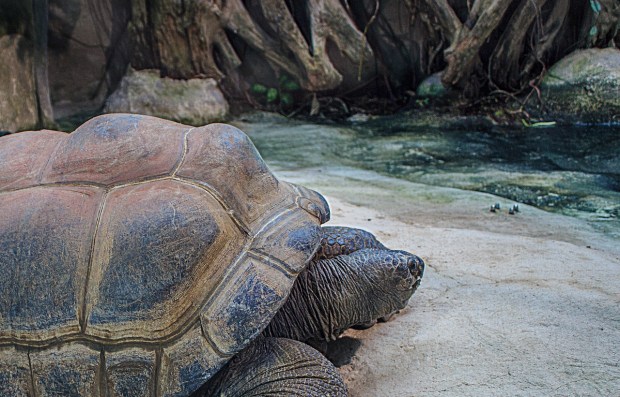
Bird Island is home to the heaviest land tortoise living in the wild – Esmerelda, who weighs in at a whopping 670 pounds (47.8 stone).  A few of the more popular islands to visit include Mahe, La Digue, Fregate & Praslin.  One of Mahe’s highlights is Morne Seychellois National Park which contains coastal mangrove forests as well as the country’s highest peak, the Morne Seychellois (905m).
Seychelles is the right place to visit if you want to see unique endemic species. These include the paradise flycatcher, the warbler, the jelly fish tree and the female Coco de Mer, which is the world’s heaviest nut.
Until the opening of the international airport on Mahé in 1971, the Seychelles Islands were entirely dependent on the sea for their links with the rest of the world.  By 2004, there were 15 airports.  In 2013, 230,000 tourists visited the Seychelles, 12,500 came from the UK.
Seychellois cuisine has been influenced by African, British, French, Indian and Chinese cuisines.  Fish & seafood are very popular and spices play an integral part in flavouring dishes.
A big thanks to Rakesh Shah, who shared an authentic recipe from his uncle for Red Snapper.
Rating: 7/10
Red Snapper Seychelles style!

450g red snapper, cut into serving size pieces – 3/4″ thick
1/2 cup chopped shallots
1 clove garlic
1 tsp olive oil
1/4 cup fresh lemon juice
1/4 cup snipped fresh parsley
1/2 tsp paprika
1/2 tsp cumin
2 medium tomatoes, sliced

Heat oven to 350ºF. Spray 8-inch square baking dish with nonstick vegetable cooking spray. Arrange snapper skin-down in dish. Set aside.
Combine shallots, garlic and oil in 10-inch nonstick skillet. Cook over medium for 3 to 4 minutes, or until shallots are tender-crisp, stirring frequently. Remove from heat. Stir in juice, parsley, paprika, cumin and pepper. Pour shallot mixture over snapper.
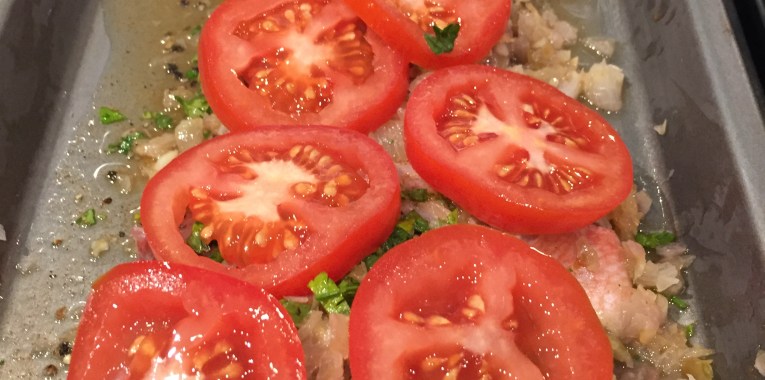
Arrange tomato slices evenly over snapper.
Cover dish with foil and bake for 20 to 25 minutes, or until fish is firm and opaque and just begins to flake.
Serves 4 as a starter or 2 as a main.

IMG_6885la-dique-795232_1280IMG_6892seychelles-giant-tortoises-854045_1280

Indonesia

The fourth most populated country in the world with over 255m people and it has the fourth largest coastline.
It comprises of over 17,000 islands that lie between the Pacific Ocean & the Indian Ocean.  The most known islands are Sumatra, Bali & Java.  Java is the most populated island in the world.
Some of Lonely planet’s highlights include; catching waves at Ulu Watu, Bali’s surfing mecca; Java’s Borobudur temple; trekking to Dani villages in Papua’s Baliem Valley and the enigmatic orangutan in Tanjung Puting National Park.
There are 400 active volcanoes, more than any other country.  Krakatoa is the site of the largest volcanic eruption ever recorded. Occurring on August 27, 1883, it had a force equivalent to 2,000 Hiroshima bombs and resulted in the death of 36,000 people.
It is home to some pretty scary wildlife, namely, the Komodo dragon (the largest lizard on earth), Python Reticulates, (the longest snake in the world) and the largest volume of shark species, approx 150.
As for Indonesia’s cuisine, according to wiki it is one of the most vibrant and colourful in the world, full of intense flavour.  So hopefully we are in for a treat!  I was entertaining friends so I opted for 3 of the most popular dishes; Sate Ayam Madura (chicken satay with peanut sauce); Padang Style Beef Rendang (rich beef curry) and Nasi Goreng (fried rice).

Rating:  10/10 – Sate, 9/10 – Rendang Beef and 8/10 – Nasi Goreng.  Overall 9/10

Sate Ayam Madura
Peanut Sauce:
250g peanut, toasted/roasted
3 candlenuts (kemiri)
6 red chilies
4 tbsp palm sugar
2½ tsp salt
600 ml water
Satay:
600 gram chicken thigh meat, cut into ½ inch cubes
4 tablespoon sweet soy sauce (Kecap manis)
2 tsp oil Bamboo skewers (about 20)
Peanut Sauce: In a food processor, grind together peanut, candlenuts, and chilies. Transfer to a sauce pot along with the rest of the peanut sauce ingredients, and bring to a boil.
Reduce heat to a simmer and continue cooking until the sauce thickens. Turn off heat.Satay: Place chicken, sweet soy sauce, oil, and 150 gram of peanut sauce in a mixing bowl. Mix together and marinate for 30 minutes. Skewer the marinated chicken with bamboo skewers. Grill until cooked and slightly charred, baste with marinating sauce as needed. Serve the satay with peanut sauce & lime wedges 

IMG_6851
Padang Style Beef Rendang
600g beef chuck steak, cut into 2 inch by 2 inch cubes
1 litre of water
150 ml thick coconut cream
3 kaffir lime leaves
3 bay leaves
1 lemon grass, gently bruised
1 inch galangal, peeled and gently bruised
1/2 tbsp tamarind pasteGrind the following into spice paste:
15 shallots
5 cloves garlic
50g red chilies
10 candlenuts (I used macadamia as I couldn’t find these)
1 inch fresh ginger
1 inch fresh turmeric
1 /2 tbsp pepper
1 /2 tbsp salt
Put all ingredients in a soup pot and bring to a boil. Reduce heat a bit (still above simmering point) and leave the pot uncovered.
Cook until the liquid is reduced and thickened. Once the liquid has thickened, reduce the heat and simmer until all the liquid is almost gone and the beef looks a bit dark – this should take around 2 hours.
Remove from heat and serve hot or at room temperature.
Nasi Goreng
6 shallots
3 garlic cloves
5g shrimp paste
10 g red chilli
3 eggs
150 g chicken breast, deep-fried and shredded
1/4 cup cooking oil
600 g rice, cooked & cold
1 tsp pepper
3 tbsp sweet soy sauce (kecap manis)
1 tbsp soy sauce
1 spring onion, chopped
4 shallots quick fried & left to dryGrind shallots, garlic, shrimp paste and chili to fine paste.
Heat cooking oil in a wok and stir-fry spice paste for 2 minutes on a medium heat, till brownish and fragrant.
Push spices to side of wok and pour egg into the wok. Quickly scramble the egg for a minute. Mix egg with spices, break them into smaller pieces.
Add rice, pepper, kecap manis, soy sauce & chicken.
Stir-fry everything quickly over high heat, for 6-7 minutes.
Sprinkle with the spring onion and fried shallots & serve 

Cameroon

Cameroon has been described as “Africa in miniature” because it exhibits all major climates and vegetation of the continent: coast, desert, mountains, rainforest, and savanna.  Cameroon is one of the wettest lands on the earth with annual rainfall of about 1,028cm.

The people are as diverse as its terrain; including ancient tribal kingdoms, forest-dwelling pygmies and Muslim pastoralists, making it one of the most culturally diverse countries on the African continent. One third of the population lives below the poverty line.

Mount Cameroon, an active volcano that last erupted in 2000,  is the highest mountain in West Africa at 4,085m. Cameroon is the first African country to have reached the quarter-final in the Football world cup.

Cuisine varies by region, but a large, one-course, evening meal is common throughout the country. A typical dish is based on cocoyams, maize, cassava, millet, plantains, potatoes, rice, or yams, often pounded into dough-like fufu (cous-cous).  I did also come across several recipes for Poulet DG (Poulet Directeur Général), which is served in up market Cameroon restaurants.

In honour of Shrove Tuesday coming up, I opted to go for Cameroon pancakes which the kids had for breakfast, and we saved for our dessert.

Pancakes have always been my nemesis, but this recipe seemed to be much easier to cook – Happy Pancake day!

Rating: 7/10

2 cups flour
1½ cup milk
⅔ cup sugar
6 eggs
¼ cup melted butter
¼- 1/2 tsp nutmeg
½ cup oil for frying

Sift together flour, sugar, nutmeg and salt; set aside.
In a large bowl, beat eggs and milk together with a mixer or by hand.
Mix in flour mixture until everything has been incoporated.
Finally stir in melted butter. Let the batter rest for about an hour or more in the refrigerator (overnight is fine)
Heat a skillet or a non stick frying pan then lightly coat the hot pan with vegetable oil, cooking spray, or clarified butter.
Then pour about a ½ cup of batter depending on your fry pan or skillet.
Tilt pan so the batter spreads across the bottom of the pan.
Cook the pancake for about 2 minutes, until the bottom is light brown. Lift with a spatula, turn and cook the other side.
Serve hot sprinkle with cinnamon sugar, powder sugar or syrup
(You only need to oil the pan for the first pancake)

Botswana

Botswana is located in southern Africa. It is mainly flat and almost 80% is made up of the Kalahari Desert. Botswana is bordered by South Africa, Namibia and Zimbabwe. It also meets Zambia at a single point but there is no border. The official language of Botswana is English although Setswana is the most spoken.

Botswana is the world’s largest producer of diamonds. Most Botswanan diamonds are mined by the Desbwana company – 50% owned by DeBeers and 50% owned by the government of Botswana. Diamond revenues enables every child in Botswana to receive free education up to the age of 13. The Jwaneng Diamond Mine in southern Botswana is the world’s richest diamond mine.

It is home to the Okavango Delta (the largest inland delta in the world), which became the 1000th inscribed site on the World Heritage List of Unesco in 2014. Chobe National Park has one of the most concentrated population of African elephants and was Botswana’s first national park in 1968. Almost 40% of it’s land is under some form of Wildlife protection. Botswana has been chosen by Lonely Planet as the top country to visit in 2016.

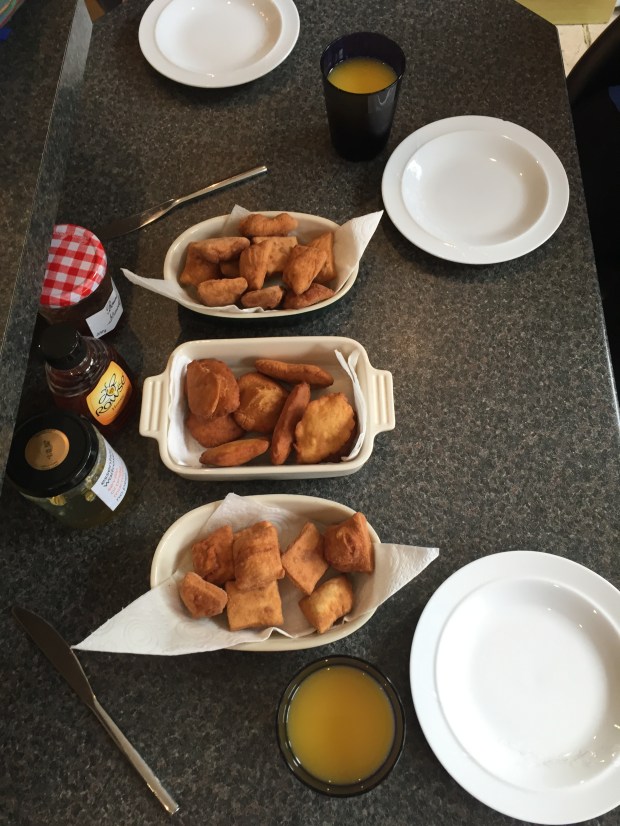
Botswana’s national dish is Seswaa, a salted stewed beef which is usually served with Morogo (a leafy green). One of the more unusual dishes is mophane worms. These are worms similar to caterpillars, that are picked off the mophane tree during summer. They are dried and can be eaten as a snack or rehydrated and cooked in a spicy tomato sauce. However, not being partial to eating worms, I decided to cook Phaphatas (flat dumplings). We had them for breakfast with bacon. Rating: 9/10 (Ellis rated them a 10!)

500g bread flour
8g dried yeast
2 tsps sugar
Half a teaspoon salt
About a cup or so of lukewarm water
Extra flour for kneading

Sift the flour and yeast into a bowl. Add the sugar and salt
Gradually add water and combine with your hands to form a dough. Only add enough water to form the dough.
Knead the dough for about 5 minutes till it’s soft and pliable.
Put aside in a bowl covered with a damp cloth and leave to rise for 30 minutes.
On a floured surface, roll out the dough to about half an inch thickness.
Using a round object like a plastic cup or cookie cutter, cut the dough into circles.
Dust the phaphathas liberally on both sides and place in a flat pan on medium heat with enough space between them to allow for rising.
The heat should not be too high or the phaphatha will burn before it fully cooks on the inside.
The phaphatha should rise while cooking. Keep an eye on them and when they’ve turned brown on the bottom, turn over to cook on the other side.  It took about 40 minutes in total.
Remove from heat when cooked through and enjoy while warm.


Andorra

Andorra is probably best known for its ski resorts.  Grandvalira is the largest ski area in the Pyrenees, with 210 km of ski slopes.  It was founded in 2003 when two of the oldest ski resorts Pas de la Casa-Grau Roig and Soldeu-El Tarter joined together.  This year it is hosting the Freeride Junior World Championship, the Speed Skiing World Cup trials and the seventh annual Skiers Cup.

Andorra is the only co principality in the world.  A principality is a place ruled by a prince, such as Monaco.  Andorra, however, is a co-principality, having two princes who jointly share the position, neither of whom are actually from Andorra!
Its population is about 84,000 and boasts the third highest life expectancy in the world. 
Tourism is its biggest industry, with 10.2m visitors every year, which is no doubt encouraged by its tax haven status and duty-free shopping.
Andorra la Vella is the highest capital in Europe at 1023 meters above sea level.
Apparently, by law the male head of each family in Andorra is required to own a gun in case of attack or emergency.
Its cuisine includes Escudella, which means ‘bowl’ (a stew containing more cholesterol than most people consume in a year!), Trinxat (cabbage & bacon potato cake), Brac de Gitano (cream roll)  and Cunillo (rabbit & tomato stew).  I decided to cook the simple but tasty Truites de Carreroles (mushroom omelette).
Rating: 7/10
 
Enough for a healthy breakfast for 2:
1 large shallot, thinly sliced
3 tbsps unsalted butter
1⁄2 tsp salt
1⁄4 tsp black pepper
1 1⁄2 cups portabella mushrooms, thinly sliced
1 tbsp chopped fresh tarragon (or 1 tsp. dried)
5 large eggs
1⁄2 cup coarsely grated gruyere cheese
 
Cook shallot in 2 tbsp butter with 1/4 tsp salt and 1/8 tsp pepper in a 10-inch nonstick skillet over medium heat, stirring occasionally, until softened, 3 to 4 minutes.
Stir in mushrooms and cook, stirring often, until tender, about 5 minutes. Stir in tarragon and transfer to a bowl.
Beat eggs with 1/4 tsp salt and 1/8 tsp pepper until well combined.
Heat remaining butter in same skillet over medium-high heat until foam subsides, then add eggs and cook until underside is set, about 1 minute.
With a fork, pull set eggs to center, letting uncooked eggs run underneath.
Before eggs are completely set, add mushroom mixture and cheese to one half, on the side away from handle.
Fold other half of eggs over filling with a heatproof rubber spatula.
Tilt the pan as you roll the omelette onto a plate.
 

São Tomé and Príncipe

São Tomé and Príncipe, is Africa’s second smallest country in terms of population c. 194,000, after The Seychelles.  It is formed of 2 islands in the Gulf of Guinea, close to the equator and they are part of an extinct volcanic range featuring striking rock, coral formations, rainforests and beaches.  It is home to much wildlife including five species of turtle.
It is the smallest Portuguese speaking nation in the world, “Leve leve” (Easy, easy) it a mellow ‘hello’ and the motto of Sao Tome.
Cocoa is the main crop and it represents 95% of the country’s export.
It was on the island of Principe where the first experimental verification of Albert Einstein’s theory of relativity happened in an experiment by Arthur Stanley Eddington in 1919.
The cuisine is based on tropical root crops, plantains, and bananas, with fish as the most common source of protein. The vegetables that are eaten consist of gathered indigenous greens that are cooked in red palm oil.  They have a famous TV chef – João Carlos Silva, who presents “Na Roça com os Tachos” – In the Roça with the Pots.
Some recipes I came across include Fish Calulu (stew) , Chicken with coffee sauce and Rancho de terra (beans & rice).  I opted for Sonhos de Bananas (banana doughnuts) served with chocolate sauce.

Rating: 8/10

4 bananas, peeled
2 tablespoons sugar
1 cup flour
1/2 cup milk
1 egg
Sugar & 1/2 tsp cinnamon mix
Oil for frying

Mash the bananas with a fork and mix with the sugar and flour. Whisk together milk and egg then stir in the banana mixture to form a batter. Heat oil in a deep fryer or saucepan to 350 F. Pour batter a tablespoon at a time into hot oil and fry for about 5 minutes, turning halfway through cooking, until the doughnuts are golden brown. Drain on paper towels and serve dusted with the cinnamon sugar & chocolate sauce.

Albania

Albania has had a wild history, like a lot of eastern Europe.  It’s little visited by tourists and is little developed.  Mother Teresa is probably Albania’s most famous citizen, having won a Nobel peace prize and well on her way to being a saint. Tirana International airport was named after her in 2001.

Skanderbeg is also another important name in Albania, for his freedom struggle. He successfully overthrew three Ottoman sieges and also led several anti-Ottoman agitations in Albania. Ahmet Bey Zogu became the first president of Albania in 1925 and in 1928 ascended the throne under the name Zog.  Having a King Zog is interesting enough, but he is also the only national leader in modern times to return fire during an assassination attempt.

Elvanagjata is the most popular artist of Albania .. and worth a google search 😉
Albanians nod their head up and down to mean ‘no’, and shake it from side to side for ‘yes’.It’s one of only 3 European capitals to be without a McDonalds.Thank you to Mimoze for her tip on this dish 🙂

Rating: 9/10 .. lovely flavour

3 tbsp unsalted butter

1/2 tbsp olive oil
600g lamb shoulder cut into chunks
Salt and freshly ground black pepper, to taste
1/4 cup flour
50g long grain white rice
2 cloves garlic, finely chopped
1.5 tbsp finely chopped oregano
250g plain yoghurt
2 large eggs
Freshly grated nutmeg
Heat 1.5 tbsp. butter and the oil in a saucepan over medium-high heat
Season lamb with salt and pepper and toss with 1 tbsp flour
Working in batches, cook lamb, turning as needed, until browned, 10–12 minutes
Add rice, garlic, oregano, and 1/4 cup water; boil
Reduce heat to medium-low; cook, covered, until rice is just tender, about 15 minutes
Add salt, and pepper and transfer to a baking dish
Heat oven to 375°
Melt remaining butter in a small saucepan over medium-high heat
Whisk in remaining flour; cook until smooth
Remove from heat; whisk in yoghurt, nutmeg, eggs, salt, and pepper until smooth
Pour yoghurt sauce evenly over lamb mixture
Bake until golden and the lamb is tender, 45–60 minutes
Serve with green beans & salad

IMG_6767IMG_6771IMG_6762