Chile

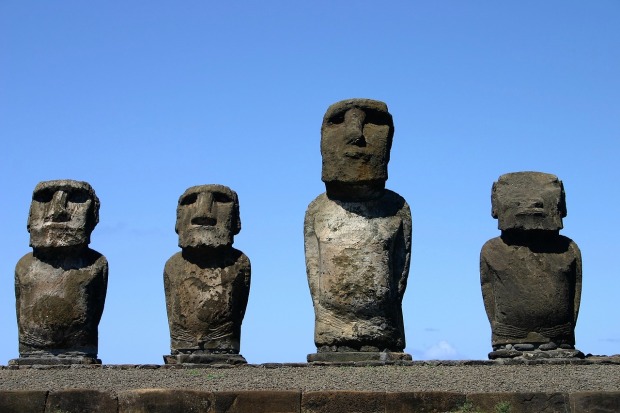
I’m lucky enough to have been to Chile and it really is one of the most stunning countries in the world with a remarkable variety of climates and landscapes. It stretches for 4,000 km down the west coast of South America between the Andes to the east and the Pacific Ocean to the west, but averages only 175 km wide. Chilean territory also includes the Pacific islands of Juan Fernández, Salas y Gómez, Desventuradas, and Easter Island in Oceania. Chile claims about 1,250,000 square km of Antarctica, although all claims are suspended under the Antarctic Treaty. 80% of Chile is covered by mountains.
The diverse climate of Chile ranges from the world’s driest desert in the north—the Atacama Desert—through a Mediterranean climate in the centre, humid subtropical in Easter Island, to an oceanic climate, including alpine tundra and glaciers in the east and south.

Some facts about this extremely diverse nation:
The Atacama Desert is the driest place in the world. It witnessed the longest record of 40 years without rain.
The world’s southernmost city “Puerto Williams” is in Chile.
Chile has the second largest volcano chain in the world after Indonesia and Ojos del Salado Volcano, located on the border of Chile and Argentina, is the highest active volcano in the world.
Escondida is the largest copper mine in the world and Chile produces a third of the world’s copper.
It ranks 5th in the world for wine production, at 1,832,000 tonnes per annum.
Gabriela Mistral was the first Latin American to receive a Nobel Prize in Literature in 1945.
Chile’s national bird, the Andean condor is the largest flying bird in the world by combined measurement of weight and wingspan. It has a maximum wingspan of 3.3 m.
The largest bunch of grapes ever grown was by Bozzolo Y Perut Ltda of Santiago, Chile weighing 9.4 kg (20 lb 11½oz).

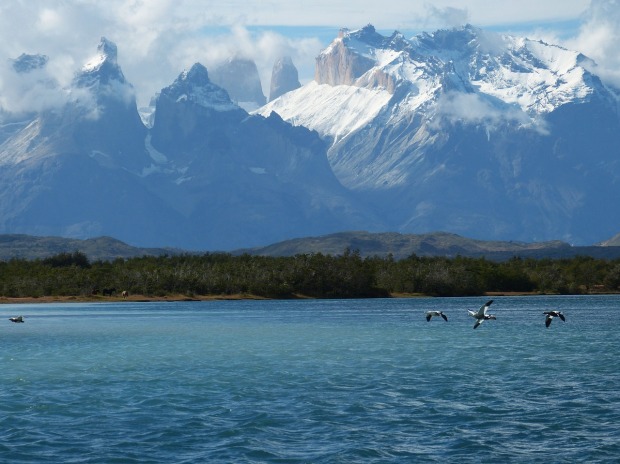
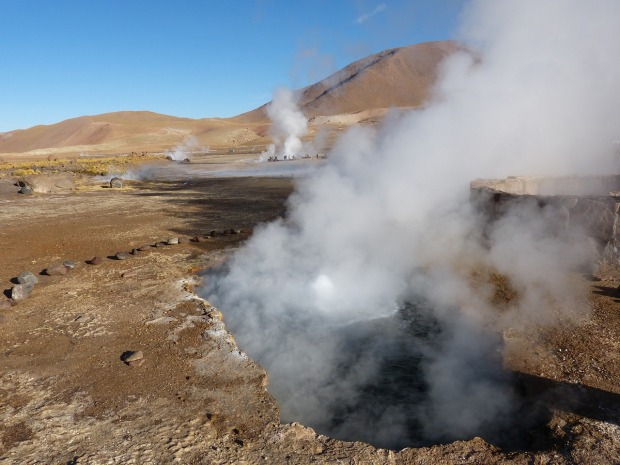
Having had first hand experience, there are so many attractions for the visitor. My highlights would include the breathtaking Torres del Paine National Park, meandering up the steep hills in Valparaiso, the peace and tranquility watching El Tatio Geysers in the Atacama desert at sun break and sipping wine whilst watching the beautiful sunset at La Serena beach.

Chilean cuisine takes influence from traditional Spanish, as well as the indigenous Mapuche culture. Recipes in Chile are notable for the variety of flavours and ingredients, with the country’s diverse geography and climate. There are many regional specialities including asado (barbequed meat) in the north, Pastel de choclo (layered pie with meat and corn) from the central valley and Mapuche chicken in the south. Other popular recipes include cazuela (stew with fish, meat or poultry), Chicharrón de papa (meat and fat from llama and lamb, boiled and then fried) and Leche asada (baked milk dessert with caramel). I decided to make empanadas, as I remember enjoying them very much when I was in Chile. They can be filled with a variety of ingredients, but traditionally they are filled with minced beef & onions. The recipe I found also included raisins, olives & hard boiled egg in the filling, which I’m not a fan of, so I opted to leave these out. The pastry was very simple to make and easy to work with. I will definitely be experimenting with different fillings.

Rating: 9/10

Makes 10 – 12
Prep time: 1 hour
Cook time: 1 hour 10 mins

For the dough:
1/2 cup milk
1/2 cup warm water
2 tsp table salt
1 lb all-purpose flour
2 egg yolks
3 oz melted butter

For the beef filling:
2 tbsp of oil
2 lb good quality minced beef
1/2 tsp paprika
1/2 tsp dry oregano
1 tsp salt
Pepper to taste
1/2 tsp of cumin
1/2 cup water
1 large onion chopped
1 tbsp all-purpose flour

Optional other filling ingredients:
20 black olives, chopped
40 raisins
2 hard-boiled eggs, chopped

To make the dough:
Mix together the milk, water and salt and stir until salt is completely dissolved
In a large bowl combine the flour and egg yolks, and mix using a knife
Add butter and gradually add the milk & water mix to form a dough
Knead dough for about 10 minutes until it is smooth and elastic
At this point you can put it in clingfilm in the fridge until you’re ready to use it.

To make the filling:
In a large frying pan, heat oil at medium to high heat
Fry the meat for 3 minutes without mixing
Turn over and brown for another couple of minutes
Add paprika, oregano, salt, pepper and cumin, and mix well
Add water and chopped onion
Cover and cook for 30 minutes on low heat
Add flour and mix well, modifying the seasoning if you like
Turn off heat, leave to cool and refrigerate

To assemble:
Preheat oven to 175c
Separate dough into 10 – 12 portions and cover with a clean kitchen cloth
Working each portion individually, shape into a ball and with a rolling pin smooth out the dough to about the size of a side plate (8 inches)
Fill each with 2 tablespoons of beef (you can also add a few raisins, chopped olives & chopped hard boiled egg if you like them)
Make sure to release trapped air before closing. Lightly brush the edges with milk, press firmly and fold. Brush the top of the empanadas with egg before putting them in the oven.
Bake for 30 to 35 minutes until browned, keeping a close eye on them. If they bubble up or swell, poke with a toothpick, so that they don’t come undone or open up.
Serve hot


torres-del-paine-675737_1280
Torres del Paine
el-tatio-1038353_1280
El Tatio geysers, Atacama desert
easter-island-1336918_1280
Maoi statues, Easter Island

Estonia

The territory of Estonia consists of a mainland and 2,222 islands and islets in the Baltic Sea. It is bordered to the north by the Gulf of Finland, to the west by the Baltic Sea, to the south by Latvia, and to the east by Lake Peipus and Russia.

Invaded by both the USSR and Germany during WW2 and after, Estonia became independent (for the second time) in September 1991. The Singing Revolution is the term used for the events between 1987 and 1991 that led to the independence of Estonia, Latvia and Lithuania. The term was coined by an Estonian activist and artist, Heinz Valk, in an article published a week after spontaneous mass night-singing demonstrations at the Tallinn Song Festival Grounds. In 1989 in a landmark demonstration for independence, more than two million people formed a human chain stretching through Lithuania, Latvia and Estonia, called the Baltic Way. Despite not being directly involved in the WW2 (only fighting against the occupation of its land), Estonia lost around 20-25% of its population during the war; some left the country and some died as a result of the war.

The first version of the Skype software was created by three Estonians (Ahti Heinla, Priit Kasesalu, and Jaan Tallinn) in 2003, in cooperation with Janus Friis from Denmark and Niklas Zennström from Sweden. Today it has nearly 700 million users worldwide, of which over 100 million use it each month. Most of the development team and nearly half of all employees of Skype are still situated in Estonia. It is often described as one of the most internet-focused countries in Europe with Tallinn being listed among the top 10 digital cities in the world.

Tallinn’s Old Town is listed as a UNESCO World Heritage Site and it’s highlights include the award winning KUMU art museum, the Alexander Nevsky Orthodox Cathedral and Kadriorg Park. The residents of Tallinn receive completely free public transport, which has helped to reduce cars in the city and decrease pollution.

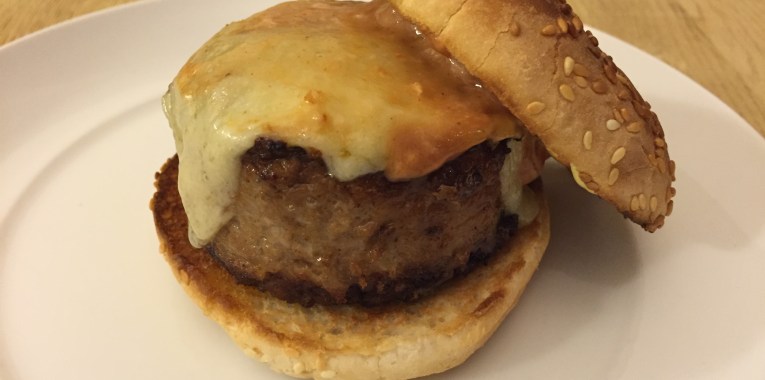
Traditional Estonian cuisine has substantially been based on meat and potatoes, and fish in coastal and lakeside areas. Today it is influenced by many countries. Recipes I came across include Taidetud vasikarind (Roast stuffed shoulder of veal) , Kringel (cinnamon buns), Karask (Barley bread) and Rosolje (sausages served with potatoes). I decided to cook Hakklihakotlet (ground meat patties) and I served them in burger buns with melted cheese. They were simple to make and pretty tasty.

Rating: 8/10

Makes 8 patties

Prep time: 20 mins
Cook time: 20 mins

220g lean ground beef
220g lean ground veal
220g ground lean pork
2 eggs
1 1/2 cup fresh breadcrumbs
1 tsp salt
1⁄4 tsp ground black pepper
1⁄2 cup onion, finely chopped
1/4 cup cold water
4 tablespoons vegetable oil

In a large mixing bowl, combine everything except for 1 cup bread crumbs and the oil, and knead with your hands for 5-10 minutes or until mixture is smooth, light and fluffy.
Moisten your hands with cold water and shape the mixture into 8 thick, round patties, then dip each in the remaining bread crumbs, coating all sides.
Heat the vegetable oil in a heavy frying pan over a medium to high heat.
Fry the patties 4 at a time for about 5-10 minutes on each side, keeping an eye on the heat so that they brown but don’t burn.
To make sure that they are fully cooked insert the tip of a knife into one of the patties and look to see that there is no pink. If it is still pink in the middle, lower the heat and cook for a few minutes longer.
Serve in burger buns with your choice of melted cheese.


Malawi

Malawi lies landlocked in southeast Africa.  It was formerly known as Nyasaland.  The name Malawi comes from the Maravi, an old name of the Nyanja people that inhabit the area. The country is also nicknamed “The Warm Heart of Africa”.  Lake Malawi, which takes up a third of Malawi’s area is a huge freshwater lake, lined with excellent beaches and filled with colorful fish, as well as the occasional hippo and crocodile.   Lake Malawi was once called “The Lake of the Stars” by the famed Scottish explorer David Livingstone, because lantern lights he saw from the fishermen’s boats resembled the stars at night.

Malawi has been independent from Britain since 1964.  President Hastings Kamuzu Banda ruled for more than 25 years until democratic elections in 1994 brought in new leadership.

Apparently Malawi is the only country in the world that has a Carlsberg factory (with the exception, of course, of Denmark) – so Carlsberg beer is sold here at just about 35p!

Highlights for the visitor are aplenty with several wildlife national parks and reserves (Nyika, Nkhotakota, Lilongwe and Majete to name a few), the beaches of Likoma Island, Mt Mulanje and the impressive Manchewe Falls.

Popular cuisine of Malawi includes different types of fish, nsima (ground corn), kachumbari (tomato & onion salad) and kondowole (cassava flour & water). They also enjoy tea & coffee, so I opted to cook a dish called Mandasi (doughnuts) which are generally served with a hot drink.  We had some family visiting for the weekend so I served these for breakfast alongside Yovo Doko fritters from Benin and the kids really tucked in!!

Rating: 9/10

Makes 12 doughnuts
Prep time: 10 mins
Cook time: 15 mins

2 cups plain flour
Pinch of salt
2 tsps of baking powder
2 tbsps of sugar
1 beaten egg
1 cup of milk
Vegetable oil for frying

Mix the flour, salt, baking power in a bowl. Add the sugar, egg, milk and beat until smooth.
Drop spoonfuls of the batter into a deep fat fryer with hot oil and fry until golden brown, turning once.
Drain on kitchen towel and serve with a dusting of icing sugar.


Japan

Japan is a place I’ve always wanted to go to, but I haven’t quite made it yet.  A quote from Chris Rowthorn on the Lonely Planet website sums it up beautifully;
“I’ve spent most of my adult life in Japan and now it feels like home to me. I love the food: it’s incredibly varied and nourishing and there seems to be no end to the culinary discoveries one can make. I love the combination of a hike in the mountains followed by a long soak in an onsen. But, most of all, I love the meticulous and careful nature of the Japanese people, reflected in every aspect of Japanese life, from trains that run right on time to sublime works of art. Put it all together and you come away with a country that still intrigues me even after two decades of living there.”


Japan is a stratovolcanic archipelago of 6,852 islands. The four largest are Honshu, Hokkaido, Kyushu and Shikoku, which make up about ninety-seven percent of Japan’s land area.  Over 70% of Japan is mountainous and there are over 100 active volcanoes.  The population of 126 million is the world’s tenth largest.  It has the world’s third-largest economy by nominal GDP and the world’s fourth-largest economy by purchasing power parity.  Japan has the highest life expectancy ranking in the world with an overall life expectancy of 84 (vs 81 in the UK, which is ranked no.20).


Some quick facts …
Coffee is very popular and Japan imports approximately 85% of Jamaica’s annual coffee production.
On average there are around 1,500 earthquakes every year in Japan.
Japan is the largest automobile producer in the world.
It is home to the world’s longest railroad tunnel at 54 kilometers (33 miles) – the Seikan Tunnel linking Honshu to Hokkaido.
As of 2011, Japan overtook France in the highest number of Michelin starred restaurants and has maintained the title since.


I received a few suggestions from friends for Japanese recipes including Shabu shabu (hotpot of meat & vegetables), Katsu curry (deep fried pork or chicken in curry sauce) and Okonomiyaki (savoury pancake).  Other traditional dishes include miso soup, soba or udon noodles, sashimi (raw fish), chahan (fried rice), tempura (deep fried fish or vegetables), gyoza (dumplings) and teriyaki (grilled meat, fish or vegetables).


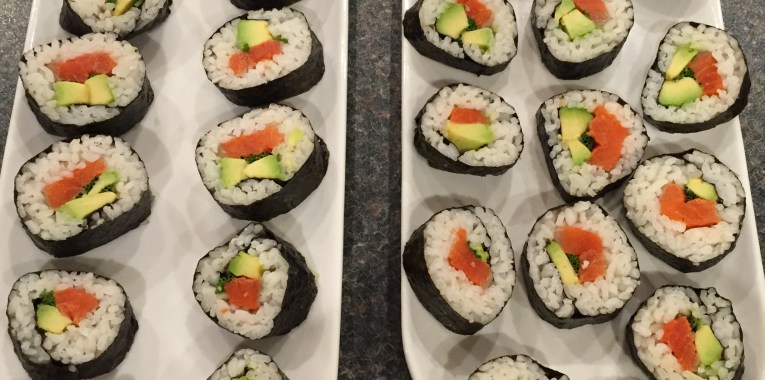
As I was having a little get together with friends I decided to make Maki-zushi (sushi rolls) with salmon & avocado to serve as a nibble with drinks.  It seemed the jury is still out for some of my guests when it comes to raw fish.


Rating: 8/10

Makes 32 sushi rolls
Prep time: 20 minutes
Cook time: 10 minutes

300g sushi rice
2 tbsp rice or white wine vinegar
1 tsp caster sugar
1 large avocado
juice ½ lemon
4 sheets nori seaweed
2 previously frozen salmon fillets thawed
1 bunch chives
Soy sauce & wasabi to serve

Put the rice in a small pan with 600ml water. Bring to the boil and cook for 10 mins until the water is absorbed and the rice is tender. Stir through the vinegar and sugar, cover and cool.
Skin, stone and slice the avocado. Put in a bowl and squeeze over the lemon juice, turning the avocado to ensure the pieces are covered.
Divide the rice between the nori sheets and spread it out evenly, leaving a 1cm border at the top and bottom. Lay the salmon over the rice, followed by the chives and finally position the avocado across the centre.
Fold the bottom edge of the seaweed over the filling, then roll it up firmly. Dampen the top border with a little water to help it seal the roll. Repeat to make 4 rolls. At this stage, the rolls can be wrapped individually in cling film and chilled until ready to serve.
Using a serrated knife, cut each roll into 8 rounds. Serve with sweet soy sauce for dipping.

Ukraine

Ukraine, the largest country in Europe (excluding Russia) is 603,628 square kilometres with a coastline of 2,782 kms.  It borders the Black Sea, Poland, Romania, and Moldova in the west and Russia in the east.  The geographic center of Europe is considered to be in a small Western Ukrainian town called Rahiv.  Ukraine’s population has been declining since the 1990s because of its high death rate and a low birth rate. The population is shrinking by over 150,000 annually since 1993.  Ukrainians are of Slavic origin. About 75% of the population is ethnic Ukrainian. The largest minority group is the Russians at about 20%.

The territory of modern Ukraine has been inhabited since 32,000 BC. During the Middle Ages, the area was a key centre of East Slavic culture, with the powerful state of Kievan Rus’ forming the basis of Ukrainian identity.  It has been ruled and divided by a variety of powers, including Lithuania, Poland, the Ottoman Empire, Austria-Hungary, and Russia.  It is currently in territorial dispute with Russia over the Crimean peninsula which Russia annexed in 2014 but which Ukraine and most of the international community recognise as Ukrainian.

Ukraine suffered the world’s worst recorded nuclear accident. On the morning of April 26, 1986, reactor No. 4 at the Chernobyl Nuclear Power Plant, 80 miles north of Kiev, exploded, sending radioactive contaminants three miles up into the atmosphere and out over parts of Europe, Asia, and North America.

For the visitor it offers a diverse range of sights and activities namely; the Carpathian mountains and National Park, the 16th century Khan’s Palace, Yalta, the laid back beach resort, the quaint town of Lviv, a Unesco World heritage site and Kyiv, the capital with plenty of cultural points of interest.

The diet of Ukraine features chicken, pork, beef, fish and mushrooms.  Popular traditional dishes include varenyky (dumplings), nalysnyky (filled pancakes) and of course chicken kiev.  Some other recipes I came across were Kruchenyky (meat rolls), Pyrizhky (stuffed pastry buns) and Shynka (baked ham).  I opted to cook Mazuricks (turkey cutlets with cheese), which I served to a number of guests as a bit of a snack along with drinks and they went down extremely well!

Rating: 9/10

Serves: makes 34 bite size mazuricks
Prep time: 20 mins + 40 mins cooling

Cook time: 15 mins

750g turkey mince
112g finely grated cheddar cheese
75g butter
2 eggs
37ml milk
150g plain flour
75g breadcrumbs
2 tbsp vegetable oil
A few sprigs of thyme
2 garlic cloves bashed
Salt & pepper

Put the turkey mince into a mixing bowl. Melt the butter and add to the meat, stir well.
Add the eggs, milk, salt, pepper, flour and cheese to the meat. Stir well until fully combined.
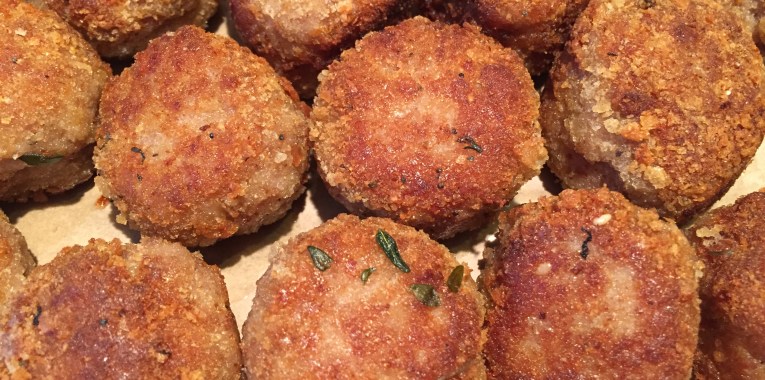
Shape into balls, sausages or patties and roll in breadcrumbs.
Put them into bowl with a tightly fitted lid and store into fridge for 40 mins.
Heat the vegetable oil in frying pan, add thyme twigs and garlic.
Once garlic is browned, remove it from the oil along with thyme.
Fry the mazuricks on both sides in the flavoured oil, approximately 10 – 15 minutes (depending on the size).
I wasn’t serving them straight away, so I heated them up in the oven on 170c for 10 minutes before serving.

Belarus

Belarus (meaning “White Russia”) is a landlocked country in Eastern Europe bordered by Russia to the northeast, Ukraine to the south, Poland to the west, and Lithuania and Latvia to the northwest. Alexander Lukashenko has been the country’s president since 1994. Belarus has been labeled “”Europe’s last dictatorship”” by some Western journalists on account of Lukashenko’s self-described authoritarian style of government. Belarus is the only country in Europe which retains capital punishment in law and in practice.

About 40% of Belarus is covered by forests and it also has 11,000 lakes. About 70% of the radiation from neighboring Ukraine’s 1986 Chernobyl nuclear disaster entered Belarusian territory, and about a fifth of Belarusian land (principally farmland and forests in the southeastern regions) was affected by radiation fallout. Belarusians continue to suffer from high incidences of cancer and birth defects, and about 25 percent of the land is considered uninhabitable. The United Nations and other agencies have aimed to reduce the level of radiation in affected areas.

Most of the monuments in Belarus dedicated to Lenin. In every city there is a Lenin Street. Highlights for visitors to Belarus include Radziwill Palace Fortress, the Museum of the Great Patriotic War, the 16th century Mir Castle and the Chagall Museum (which houses some of Marc Chagall’s designs and lithographs but sadly there aren’t more Chagall paintings in Belarus because his work was banned by the Soviet government).
Belarus has four UNESCO-designated World Heritage Sites: the Mir Castle Complex, the Nesvizh Castle, the Belovezhskaya Pushcha (shared with Poland), and the Struve Geodetic Arc (shared with nine other countries).

Some of the recipes I came across for Belarus were Zrazy (stuffed meat rolls) , Mazurka (almond cake) , Machanka (pork stew) and Draniki (potato pancakes). I opted to cook Lazanki (Belarusian pasta). I served it with a mushroom, ham and cheese sauce. It was pretty simple and easy to make and tasted good. I would cook the pasta a bit less and make the sauce a bit looser next time! You could also add some saffron to the water before making the pasta in order to give it more of a pleasant colour, as it was a bit anaemic.

Rating: 7/10

Serves: 4
Prep time: 30 mins
Cook time: 7 mins

For the lazanki
1 egg
350g plain flour
5g salt

For the sauce
50g plain flour
70g butter
150ml milk
100g bacon or lardons
75g sliced mushrooms
50g grated cheddar

For the lazanki
Beat the egg.
Add 1/2 cup of water to the egg, add salt and flour (250 g) and then carry on adding flour in small quantities until the dough comes together.
Mix the dough with your hands and divide it into 3 equal parts.
Roll out all of the dough (use a pasta machine if you have one – keep flouring the dough as you put it through)
Cut the dough into small squares with a sharp knife.
Boil salted water, add the lazankis and cook for approximately 7 minutes (or 5 minutes if you like it a bit al dente).
Put lazankis onto the plates and pour over the sauce.

For the sauce
Put the flour & 50g of the butter in a saucepan over a medium heat and stir to a paste.
Add the milk slowly to form a sauce and keep stirring for 5 minutes. Remove from the heat.
Meanwhile heat a small frying pan and fry the bacon until browned, about 5 minutes. Remove to a plate.
Add remaining butter to the pan and fry the sliced mushrooms for 5 minutes.
Heat the sauce on a low heat and add the cheese to the sauce, mix it in, then add the bacon and mushrooms and stir through.


Guinea-Bissau

The Republic of Guinea-Bissau on the Atlantic coast of West Africa is bordered by Senegal to the north and Guinea to the south and east.
Guinea-Bissau is among the world’s least developed countries, with most people engaged in subsistence agriculture and fishing.  More than two-thirds of the population lives below the poverty line.  It’s history is one of painful wars and coups and since 1974, no president has successfully served a full five-year term.


Tourist attractions include the Former Presidential Palace in the capital of Bissau, Orango Islands National Park (home to rare saltwater hippos) and the beautiful island of Bolama.


The food of Guinea-Bissau is dominated by rice, fruit, vegetables and peanuts.  Soups and stews are popular.  Recipes I came across include Frango com bagique (chicken with spinach) , Macarra with Citi (Chicken with peanuts and palm oil), Bolinhos de mancarra com peixe (fish and peanut balls).  I decided to cook Cafriela de Frango (grilled spicy chicken) which was very simple and really tasty.


Rating: 9/10

Serves: 4
Prep time: 10 mins + 3 hours marinating time
Cook time: 45 mins
1 medium chicken, jointed
1 tsp salt
5 hot chilies, sliced
3 cloves garlic, crushed
1 medium onion, sliced
1 1/2 lemons, juice only
salt
1 tbsp vegetable oil

Place the chicken pieces in a large plastic zipper bag with the garlic, chilies, half the sliced onions and lemon juice. Marinate for 3 hours (or more) in the fridge.
Add the oil to a large skillet and add the marinated ingredients.
Add 3/4 cup of water and cook over a medium heat, covered, for 30 minutes, until the chicken is cooked through, adding a little more water if it is drying out.
Preheat the BBQ or grill.
Remove the chicken to a plate leaving the excess liquid in the pan.
BBQ or grill the chicken pieces for 15 minutes or until well browned.
In the meantime heat the liquid adding the rest of the finely sliced onions. Cook over a medium heat for 15 minutes, adding a little more water if necessary.
When the chicken is well-browned, place it onto a serving plate and pour the sauce over it.

Moldova

Moldova is a landlocked nation located in eastern Europe, between Ukraine and Romania, although it is only a stone’s throw from the Black Sea. Most of Moldova was part of Romania before World War II, and two-thirds of Moldovans speak Romanian. It gained independence in 1991.

Moldova has a very vibrant wine industry dating back many many years. 67 Million bottles are exported every year. Vineyards planted in villages around the houses used to make home-made wine, or “vin de casa”. Many families have their own recipes and strands of grapes that have been passed down through the generations. Since 2013 Russia has imposed a ban on Moldovan wine being sold in the country, ever since Moldova signed a draft treaty with the European Union. This has damaged the wine industry of Moldova significantly.

According to Trip Advisor the top 3 things to do in Moldova are: 1. Stefan cel Mare Park in Central Chişinău (the capital). Formerly known as Pushkin Park, it is the oldest park in Moldova and spans about 7 hectares. – Victory Memorial and Eternal Flame is the national memorial commemorating the nameless Moldovan soldiers who fell during WWII. – Milestii Mici winery. Its underground wine city in limestone stretches for 250 km of which 120 km are currently in use. Milestii Mici cellar complex is recognized to be the largest in the world.

Recipes that I came across during my research include; Ciorba (sour soup) , Mititei (minced meat), Mamaliga (cornmeal mash) , Sarmale (stuffed cabbage rolls), Colțunași (dumplings). I opted to cook the popular dish Zeama (chicken noodle soup). It had a subtle flavour and felt like a healthy bowl of goodness! According to my husband a bit of chilli would’ve given it a nice zing!

Rating: 7/10

Serves: 2 hungry people
Prep time: 10 minutes
Cook time: 1.5 hours + 30 mins standing time

4 chicken thighs on the bone
800ml water
salt & black pepper
1/2 medium onion, chopped
1/2 medium carrot, chopped
1/2 big fresh tomato, chopped
100g egg noodles (I used medium but fine would be better)
2 tbsps lemon juice
1 tbsp finely chopped medium celery stalk (reserve celery leaves, if any)
1 tbsp finely chopped fresh parsley
1 tbsp finely chopped fresh dill weed
3 fresh thyme sprigs

Saute the onion and carrots until soft in a deep stock pot. Add the chicken and water then bring to a boil.
Turn heat down to medium-low heat and simmer for about 45 minutes to an hour. Skim any froth.
Add a teaspoon of salt, black pepper, tomato and celery and cook for 5 minutes.
(The recipe didn’t say to do this, but I’m not a fan of chicken on the bone in a bowl of noodle soup so at this point I removed the chicken to a plate, removed the skin & bones, cut it up and then placed it back into the pot)
Add the egg noodles and lemon juice.
Continue cooking on medium-low for about 5 more minutes.
Add the fresh herbs (including celery leaves, if any).
Cover, remove from heat. Let stand for at least 30 minutes to let flavors blend.


North Korea

The world’s most secretive country is situated in the northern part of the Korean Peninsula.  Early European visitors to Korea remarked that the country resembled “a sea in a heavy gale” because of the many successive mountain ranges that crisscross the peninsula.


After the Japanese surrender at the end of World War II in 1945, Korea was divided into two zones by the United States and the Soviet Union, with the north occupied by the Soviets and the south by the Americans. Negotiations on reunification failed, and in 1948 two separate governments were formed: the Democratic People’s Republic of Korea in the north, and the Republic of Korea in the south. An invasion initiated by North Korea led to the Korean War (1950–53). Although the Korean Armistice Agreement brought about a ceasefire, no official peace treaty was ever signed.  Both states were accepted into the United Nations in 1991.
North Korea has the highest number of military and paramilitary personnel in the world, with a total of 9,495,000 active, reserve, and paramilitary personnel.


It isn’t impossible to visit North Korea, however it isn’t straightforward.  Koryo Group offer group or independent tours to North Korea from China.
You can expect to pay from €1,800 for a 3 night basic tour departing from Beijing, including round-trip tickets to Pyongyang on Air Koryo, accommodation, guide fee, private transport, meals, and entry fees.  You cannot travel alone at any time, you must always be accompanied by 2 state employed guides.


A few of the highlights according to Lonely Planet include Paekdu (the country’s highest mountain and an extinct volcano with a vast crater lake at its centre), Pyongyang’s Juche Tower and the Arirang Mass Games annual event in May.


Korea cuisine is based on rice, meat & vegetables. Some of the recipes I came across include Dae Ji Bool Gogi (spicy marinated pork) , Chap Chee or Japchae Noodles (mixed vegetables with noodles) , Bulgogi (Korean grilled meat on skewers) and Naengguk (cold soup).  I decided to cook Kalbi (BBQ short ribs).  The recipe called for short cooking time, although the beef short ribs I bought stated they should be slow cooked.  The marinade was really tasty but our palates would’ve preferred the meat to be slow cooked.


Rating: 6/10


Serves 2 – 3
Prep time: 10 minutes + 3 hours or overnight marinating
Cook time: 25 minutes


1/2 cup soy sauce
1/2 cup brown sugar
1/2 cup water
1 garlic clove, minced
2 spring onions, chopped
1 tbsp toasted sesame oil
700g beef short ribs


In a bowl, stir together the soy sauce, brown sugar, water, garlic, green onions, and sesame oil until the sugar has dissolved.
Place the ribs in a large plastic zipper bag. Pour the marinade over the ribs, squeeze out all the air, and refrigerate the bag for 3 hours to overnight.
Preheat an outdoor grill to medium-high heat, and lightly oil the grate.
Remove the ribs from the bag, shake off the excess marinade, and discard the marinade.
Grill the ribs on the preheated grill until the meat is still pink but not bloody nearest the bone about 10 – 12 minutes per side.
Serve with boiled rice.


Taiwan

Taiwan, officially the Republic of China, is an island of approximately 36,000 square kilometers.  It is one of the most densely populated countries in the world with 649 people per km2.  The island was given the name “Formosa” (meaning “beautiful”) by the Portuguese in the 16th century.  The political situation of Taiwan is still up in the air and the question remains as to whether it should stay independent as territory of the Republic of China (ROC); become unified with the territories now governed by the People’s Republic of China (PRC) or formally declare independence and become the Republic of Taiwan.  In July 2009 the leaders of China and Taiwan exchanged direct messages for the first time in more than 60 years, albeit in their respective party functions, and not as national leaders.  In June 2010, the two countries signed an historic trade pact that was described by some analysts as the most significant agreement in 60 years of separation.


Taiwan blends scenic mountains, hidden waterfalls, historic temples and technology driven skyscrapers.  The five famous tourist magnets outside Taipei are the Taroko Gorge, Alishan (mountain resort), Sun Moon Lake, Lukang (urban township) and Kenting (national park known for its white-sand beaches, caves, coral reefs & northern mountains).  Taipei is Asia’s 2nd most richest city and features the 3rd tallest building in the world, the Taipei 101 tower.


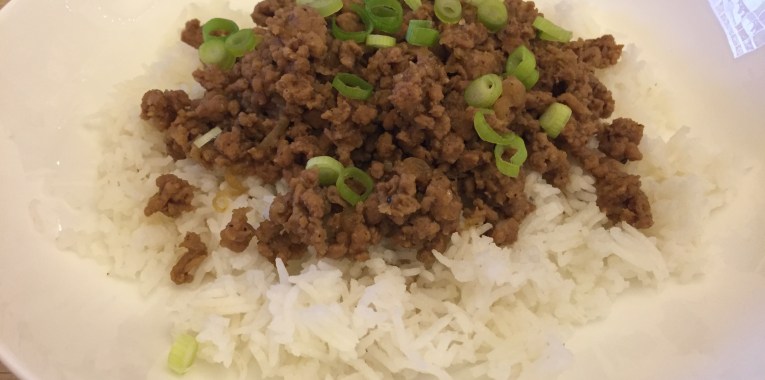
Popular ingredients in Taiwanese cuisine are pork, seafood, chicken, rice & soy.  Some of the recipes I came across include Pork chops with noodle soup , Bah-Tzang (Taiwanese rice dumpling), Gu Bah Mi (beef noodle soup) and Cuttlefish geng (soup).  Chou Doufu ‘stinky tofu’ which is marinated in brine made from decomposing vegetables and shrimps wasn’t high of my choices to cook but is a popular street food.  I opted to cook Ló͘-bah-pn̄g (minced pork rice), which we thoroughly enjoyed.


Rating 10/10


Serves 3-4
Prep time: 10 mins
Cook time: 45 mins


1 cup thinly sliced shallots
2 tbsp oil
500g organic minced pork
4 tbsp white wine
60ml soy sauce
1 tbsp sugar or honey
2 cups water
1 tsp black pepper
1 star anise
1 bay leaf
1 tsp five spice powder
salt to taste
2 spring onions


Heat a large cast iron skillet on medium heat with 1 tbsp of the oil.
Once the oil is hot add the shallots and fry until they turn light golden in color – about 5 minutes.
Remove the shallots from the pan, transfer to a plate lined with a paper towel and set aside.
In the same skillet add the remaining oil and the minced pork on a high heat.
Break up the mince and stir until the pork starts to brown.
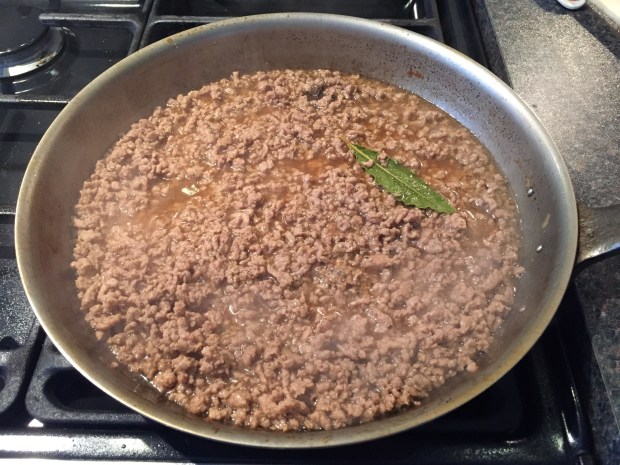
Add the wine, soy sauce, sugar or honey, water, pepper, star anise, bay leaf, and five spice.
Stir to combine, bring the liquid to a boil and then reduce to a low heat.
Cover and let simmer for 30 minutes, stirring every 10 minutes.
While the pork is simmering, take the fried shallots and crush them with a mortar and pestle to a paste or blend them in a mini mixer.
After the pork has simmered for 30 minutes, stir in the crushed shallots and let everything simmer for another 10 minutes.
Salt to taste.
Remove from the heat, garnish with sliced spring onions and serve over boiled rice.
IMG_8464
Ingredients for Taiwanese minced pork

In the same skillet add the remaining oil and the minced pork on a high heat.
Break up the mince and stir until the pork starts to brown.
Add the wine, soy sauce, sugar or honey, water, pepper, star anise, bay leaf, and five spice.
Stir to combine, bring the liquid to a boil and then reduce to a low heat.
Cover and let simmer for 30 minutes, stirring every 10 minutes.
While the pork is simmering, take the fried shallots and crush them with a mortar and pestle to a paste or blend them in a mini mixer.
After the pork has simmered for 30 minutes, stir in the crushed shallots and let everything simmer for another 10 minutes.
Salt to taste.
Remove from the heat, garnish with sliced spring onions and serve over boiled rice.

IMG_8471
Taiwanese minced pork
taiwan-654398_1280
Taiwan

img_84881

Ló͘-bah-pn̄g (minced pork rice)


taiwan-553521_1280
Taiwanese monk


United Arab Emirates

The United Arab Emirates (UAE) is a federation of seven emirates established in 1971 – Abu Dhabi (the capital), Ajman, Dubai, Fujairah, Ras al-Khaimah, Sharjah, and Umm al-Quwai.
Once a quiet Bedouin backwater, now an astonishing blend of Arabian tradition and economic innovation.  The UAE’s oil reserves are the seventh-largest in the world and as such is one of the wealthiest countries in the Middle East.
In 2013, the UAE’s total population was 9.2 million, of which 1.4 million are Emirati citizens and 7.8 million are expatriates.   Dubai is the most populated Emirate with about 36% of the UAE population.
The climate of the U.A.E is subtropical-arid with hot summers and warm winters. The hottest months are July and August, when average maximum temperatures reach above 45 °C on the coastal plain.  In 2004, there was snow in the UAE for the very first time.
According to Lonely Planet there are 186 sights in the UAE.  The top picks include Sheikh Zayed Grand Mosque in Abu Dhabi, Dubai museum, Al Jahili Fort in Al Ain, Deira Souqs and Emirates Palace.  The Burj Khalifa, in Dubai, was completed in January 2010 and became the world’s tallest building at 2,716 feet (828 meters) and 160 stories. It contains the world’s fastest elevators and 20.7 acres of glass.
The Telegraph states that the most expensive hotel room in Dubai is the Royal Suite in Burj Al Arab Jumeirah, priced at up to £12,000 per night.  This is a snip in comparison to the Royal Penthouse Suite at the President Wilson Hotel in Geneva which would set you back £53,000 per night!!
When it comes to the food, they have adopted most of their foods from other West and South Asian countries including Iran, Saudi Arabia, Pakistan, India and Oman.  Seafood is popular along with meat and rice.  Alcohol is only allowed to be served in hotel restaurants, bars and nightclubs.  Although one may consume alcohol, it is illegal to be intoxicated in public.  Recipes I came across include Machboos (spicy stew with rice) , Harees (dumplings) , Shawarma (kebab) , Khanfaroush (cookies) , Chicken Salona (stew) and Chabab (bread).  I opted to make Khameer bread, which is traditionally served at breakfast with cottage cheese or fruit, however I served it as a starter with dips.  It was a little sweet, but enjoyable none the less.
Rating: 7/10
1 cup plain flour
1 cup wholemeal flour
1/2 tbsp instant yeast
1/4 cup milk powder
1/4 cup sugar
1/2 tsp saffron
1/2 tsp cardamom powder
3/4 cup warm water
2 tbsp toasted sesame seeds
Add both flours, yeast, milk powder, saffron, cardamon powder and sugar in a large bowl and whisk well to combine.
Slowly add water and knead to make a soft dough. When the flour holds together as a dough (you may not need to use all the water), place it on a flat surface and knead for 5 minutes to get a smooth dough.
Let the dough rest for 1 hour in a warm place.
Divide the dough into 6-7 portions. Roll each portion into a disc of 4-5 inches.
Heat a non stick fying pan or griddle and when it is medium hot, place one of the rolled out discs into the pan.
It will start to puff up, flip after a minute and cook the other side, spread a tsp of oil on top, sprinkle toasted sesame seeds and flip and cook for a few seconds.
Remove it on serving plate and repeat with the other discs.
Serve warm.

Lebanon

Lebanon, officially the Lebanese Republic is a sovereign state in Asia.  It is bordered by Syria to the north and east and Israel to the south

The earliest evidence of civilisation in Lebanon dates back more than seven thousand years in Byblos, where it is said the first alphabet was created.  The country’s name is known to be the oldest in the world and has remained unchanged for over 4000 years.  There are 4.5 million Lebanese in Lebanon and around 18 million living outside Lebanon.

Lebanon’s recent history is one of conflict and suffering. In 1975 civil war broke out, lasting 16 years, eventually ended by a Syrian backed initiative. During the civil war, in 1982 Israel invaded following PLO attacks. Hezbollah (The Party of God), a pro-Syrian Shia military/political movement, with financial backing from Iran, was formed in the 80s to primarily harass the Israeli occupation. It has significantly grown in strength over the years.  Tensions still continue and Lebanon’s borders with Syria and Israel remain unresolved.

Despite the decades of civil war, invasions and terrorist attacks, it is a country that is home to stunning ancient ruins, beautiful mountain vistas and Mediterranean coastline beaches.  Top things to see according to Trip Advisor include the Temples of Baalbek, National Museum of Beirut and the Crusader Castle in Byblos.

The food of Lebanon is considered some of the Mediterranean’s best food – mezze (small dishes), kibbeh (spiced minced lamb in a fried bulgar wheat shell), dhourba bi kousa (courgette & milk soup), daoud Pasha (meatballs with pine nuts).  I decided to make one of their most famous dishes – tabbouleh (bulgar wheat salad).

Rating: 8/10
Prep time: 15 minutes + 40 min for bulgar to soak
Serves: 2-3

1/2 cup bulgar wheat
1 cup boiling water
220g tomatoes roughly chopped
1/2 medium onion finely sliced
1 tbsp chopped fresh parsley
1 tbsp chopped fresh mint
3 tbsps olive oil
Juice of 1 large lemon
Salt & pepper
1/2 cup black or green olives (optional)

Put the bulgar wheat in a bowl with the boiling water and a little salt. Leave to soak for 40 minutes, then drain.
Take a salad bowl and add the bulgar wheat, tomatoes, onion, parsley & mint. Mix well.
In a separate bowl or jug, beat the oil with the lemon juice and season with salt & pepper.
Pour it over the salad & mix thoroughly.
Put the olives on top and then chill the salad in the fridge for 2 hours.
Add a sprinkling of parsley to garnish and serve.

img_7742
Ingredients for tabbouleh
img_7751
Tabbouleh
baalbeck-710599_1280
Temples of Baalbek
beirut-452164_1280
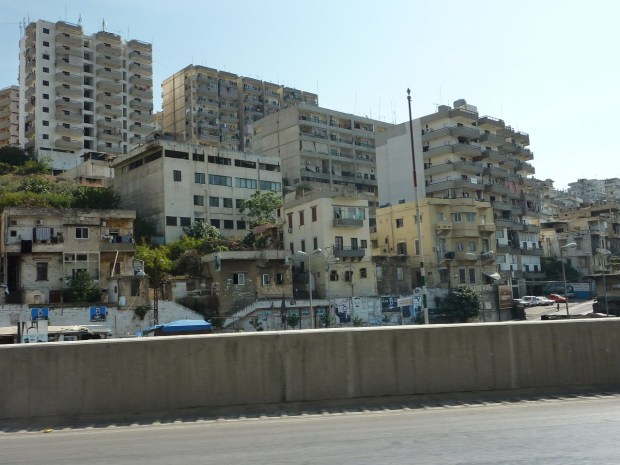
Beirut