Chad

Chad is a landlocked nation in north central Africa. It is the fifth largest country in Africa in terms of area and the largest of Africa’s 16 landlocked countries. Lake Chad, after which the country is named, is the largest wetland in Chad and the second largest in Africa. Lake Chad occupied 130,000 sq mi of the Chad Basin 7,000 years ago, now it covers only 6,875 sq mi. Sadly it is falling victim to the Sahara and is receding northwards each year and may soon not even be in Chad.

Not long ago, geologically speaking – what is today the Sahara, was green savannah teeming with wildlife. During the African Humid Period, roughly 11,000 to 5,000 years ago, a vibrant animal community including elephants, giraffes, hippos, and antelope lived there. The last remnant of the “Green Sahara” exists in the Lakes of Ounianga in northern Chad, a series of 18 interconnected freshwater, saline, and hypersaline lakes now protected as a World Heritage site.

Extensive deforestation has resulted in loss of trees such as acacias, baobab, dates and palm trees. This has also caused loss of natural habitat for wild animals and lions, leopards and rhino have been almost decimated. Poaching is a serious problem in the country, particularly of elephants for the profitable ivory industry. Elephants are often massacred in herds in and around the parks by organised poaching. The problem is worsened by the fact that the parks are understaffed and that a number of wardens have been murdered by poachers.

Since independence from France in 1960, Chad has suffered instability stemming mostly from tension between the mainly Arab-Muslim north and the predominantly Christian and animist south. The only thing that unites the two is abject poverty. The United Nations’ Human Development Index ranks Chad as the seventh poorest country in the world, with 80% of the population living below the poverty line. In 2005, Transparency International’s Corruption Perceptions Index named Chad (tied with Bangladesh) as the most corrupt country in the world.

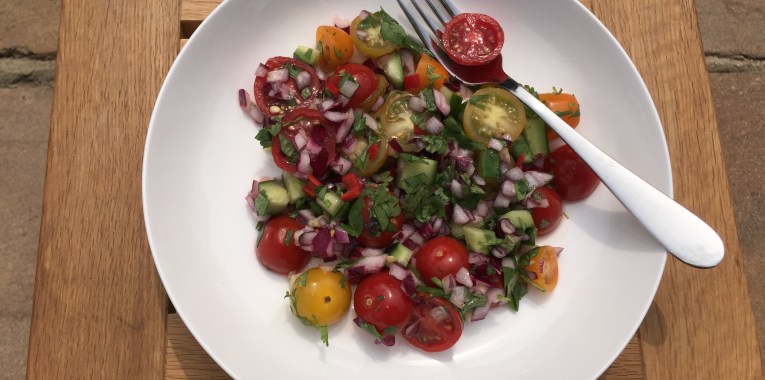
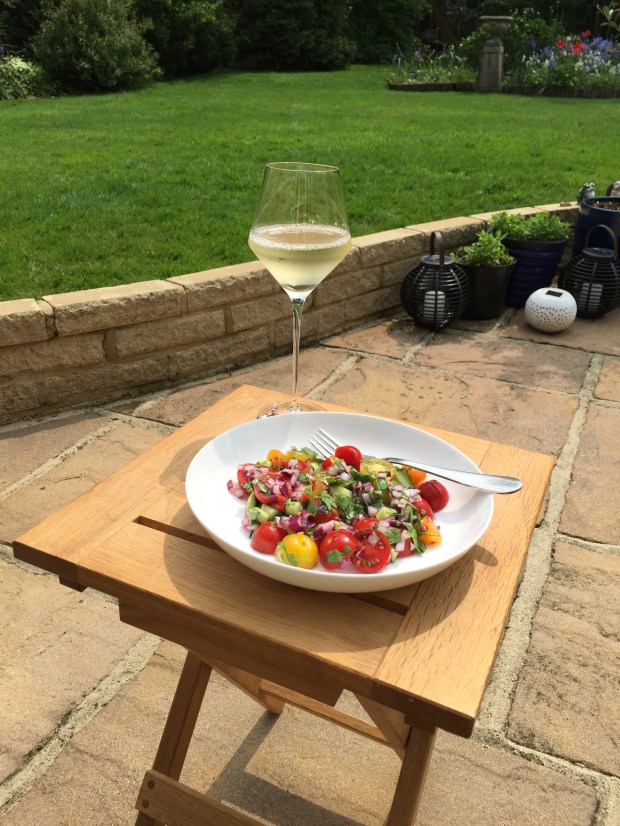
Despite all this, Chad possesses a rich cultural heritage and the cuisine offers a variety of grains, vegetables, fruits and meats. Fish is abundant in northern Chad, including tilapia, perch, eel, carp and catfish. Some of the recipes I came across during my research include Jarret de Boeuf (slow cooked beef and vegetable stew), Broiled Fish (A recipe from the villages along the Chari River) , Kisser (sourdough crepe) , Fangasou (fried doughnuts made of millet or wheat flour) and Maharagwe (beans in coconut milk). I decided to make Kachumbari (Chadian Tomato & Onion Salad) which I enjoyed al fresco in my garden on a rare sunny day in the UK! Unbelievably simple and it tasted so zingy and fresh – I absolutely loved it.

Rating 10/10

Serves 1
Prep time: 10 mins
Cook time: 0 mins

1/4 red onion, thinly sliced (or diced)
8 cherry tomatoes – red & yellow, halved (use ripe ones, ideally that have been on the window shelf for a while)
2 inches of cucumber, middle removed and diced
1/2 red chilli, seeds & placenta removed and sliced
Handful of fresh coriander, chopped
The juice of 1/2 lime

Combine all ingredients in a mixing bowl and toss until well combined and serve immediately.

IMG_9158
Ingredients for Kachumbari (Chadian tomato and onion salad)


IMG_9170
Kachumbari (Chadian tomato and onion salad)

IMG_9161
Kachumbari (Chadian tomato and onion salad)
chad sahara
Chad Sahara

Chile

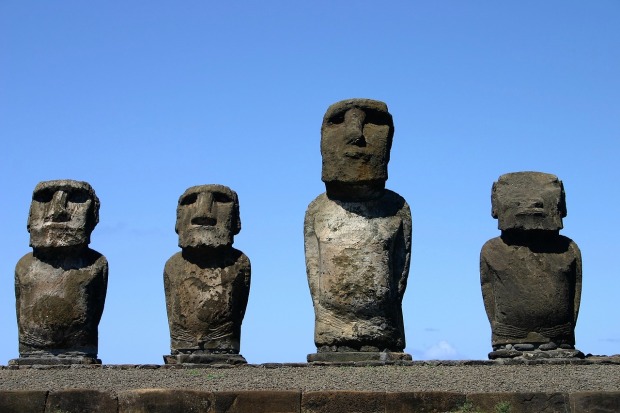
I’m lucky enough to have been to Chile and it really is one of the most stunning countries in the world with a remarkable variety of climates and landscapes. It stretches for 4,000 km down the west coast of South America between the Andes to the east and the Pacific Ocean to the west, but averages only 175 km wide. Chilean territory also includes the Pacific islands of Juan Fernández, Salas y Gómez, Desventuradas, and Easter Island in Oceania. Chile claims about 1,250,000 square km of Antarctica, although all claims are suspended under the Antarctic Treaty. 80% of Chile is covered by mountains.
The diverse climate of Chile ranges from the world’s driest desert in the north—the Atacama Desert—through a Mediterranean climate in the centre, humid subtropical in Easter Island, to an oceanic climate, including alpine tundra and glaciers in the east and south.

Some facts about this extremely diverse nation:
The Atacama Desert is the driest place in the world. It witnessed the longest record of 40 years without rain.
The world’s southernmost city “Puerto Williams” is in Chile.
Chile has the second largest volcano chain in the world after Indonesia and Ojos del Salado Volcano, located on the border of Chile and Argentina, is the highest active volcano in the world.
Escondida is the largest copper mine in the world and Chile produces a third of the world’s copper.
It ranks 5th in the world for wine production, at 1,832,000 tonnes per annum.
Gabriela Mistral was the first Latin American to receive a Nobel Prize in Literature in 1945.
Chile’s national bird, the Andean condor is the largest flying bird in the world by combined measurement of weight and wingspan. It has a maximum wingspan of 3.3 m.
The largest bunch of grapes ever grown was by Bozzolo Y Perut Ltda of Santiago, Chile weighing 9.4 kg (20 lb 11½oz).

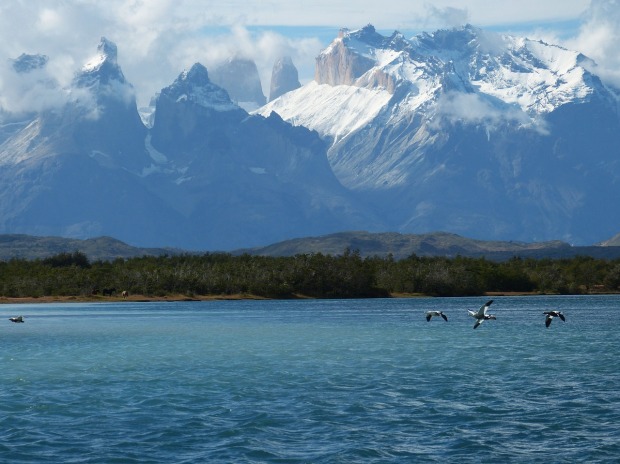
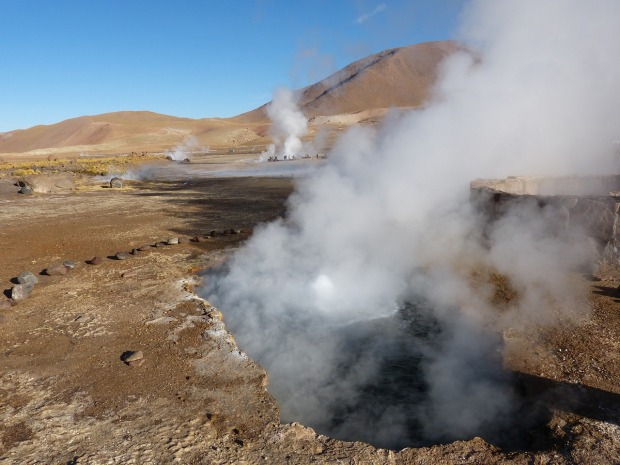
Having had first hand experience, there are so many attractions for the visitor. My highlights would include the breathtaking Torres del Paine National Park, meandering up the steep hills in Valparaiso, the peace and tranquility watching El Tatio Geysers in the Atacama desert at sun break and sipping wine whilst watching the beautiful sunset at La Serena beach.

Chilean cuisine takes influence from traditional Spanish, as well as the indigenous Mapuche culture. Recipes in Chile are notable for the variety of flavours and ingredients, with the country’s diverse geography and climate. There are many regional specialities including asado (barbequed meat) in the north, Pastel de choclo (layered pie with meat and corn) from the central valley and Mapuche chicken in the south. Other popular recipes include cazuela (stew with fish, meat or poultry), Chicharrón de papa (meat and fat from llama and lamb, boiled and then fried) and Leche asada (baked milk dessert with caramel). I decided to make empanadas, as I remember enjoying them very much when I was in Chile. They can be filled with a variety of ingredients, but traditionally they are filled with minced beef & onions. The recipe I found also included raisins, olives & hard boiled egg in the filling, which I’m not a fan of, so I opted to leave these out. The pastry was very simple to make and easy to work with. I will definitely be experimenting with different fillings.

Rating: 9/10

Makes 10 – 12
Prep time: 1 hour
Cook time: 1 hour 10 mins

For the dough:
1/2 cup milk
1/2 cup warm water
2 tsp table salt
1 lb all-purpose flour
2 egg yolks
3 oz melted butter

For the beef filling:
2 tbsp of oil
2 lb good quality minced beef
1/2 tsp paprika
1/2 tsp dry oregano
1 tsp salt
Pepper to taste
1/2 tsp of cumin
1/2 cup water
1 large onion chopped
1 tbsp all-purpose flour

Optional other filling ingredients:
20 black olives, chopped
40 raisins
2 hard-boiled eggs, chopped

To make the dough:
Mix together the milk, water and salt and stir until salt is completely dissolved
In a large bowl combine the flour and egg yolks, and mix using a knife
Add butter and gradually add the milk & water mix to form a dough
Knead dough for about 10 minutes until it is smooth and elastic
At this point you can put it in clingfilm in the fridge until you’re ready to use it.

To make the filling:
In a large frying pan, heat oil at medium to high heat
Fry the meat for 3 minutes without mixing
Turn over and brown for another couple of minutes
Add paprika, oregano, salt, pepper and cumin, and mix well
Add water and chopped onion
Cover and cook for 30 minutes on low heat
Add flour and mix well, modifying the seasoning if you like
Turn off heat, leave to cool and refrigerate

To assemble:
Preheat oven to 175c
Separate dough into 10 – 12 portions and cover with a clean kitchen cloth
Working each portion individually, shape into a ball and with a rolling pin smooth out the dough to about the size of a side plate (8 inches)
Fill each with 2 tablespoons of beef (you can also add a few raisins, chopped olives & chopped hard boiled egg if you like them)
Make sure to release trapped air before closing. Lightly brush the edges with milk, press firmly and fold. Brush the top of the empanadas with egg before putting them in the oven.
Bake for 30 to 35 minutes until browned, keeping a close eye on them. If they bubble up or swell, poke with a toothpick, so that they don’t come undone or open up.
Serve hot


torres-del-paine-675737_1280
Torres del Paine
el-tatio-1038353_1280
El Tatio geysers, Atacama desert
easter-island-1336918_1280
Maoi statues, Easter Island

Antigua and Barbuda

Separated by a few nautical miles, Antigua and Barbuda are in the middle of the Leeward Islands, part of the Lesser Antilles. There are also a number of smaller islands (including Crump Island, Lobster Island, Wicked Will Island and Prickly Pear Island). Columbus named Antigua after the church of Santa Maria de la Antigua in Seville, Spain. Antigua has a population of 85,632, mostly made up of people of West African, British, and Madeiran descent.

The Bird family has controlled the islands since Vere C. Bird founded the Antigua Labour Party in the mid-1940s. While tourism and financial services have turned the country into one of the more prosperous in the Caribbean, law enforcement officials have charged that Antigua and Barbuda is a major centre of money laundering, drug trafficking, and arms smuggling. Several scandals tainted the Bird family, especially the 1995 conviction of Prime Minister Lester Bird’s brother, Ivor, for cocaine smuggling.

Cricket is the national sport of Antigua and it has produced several famous cricket players including Sir Vivian Richards, Andy Roberts, Richie Richardson and Curtly Ambrose.

Eric Clapton founded The Crossroads Centre, a drug and alcohol addiction rehabilitation centre in 1998. For nearly twenty years Antigua served as Eric Clapton’s refuge from his drug-riddled rock stardom. Mr Clapton thought of the island as a safe and serene place where he could begin the process of healing from very devastating life events and situations. He writes in his 2007 autobiography “It really has been one of the only places on earth I’ve found where I can completely discard the pressures of my life and blend into the landscape. Clapton calls the land of Antigua his second home.

Tourism accounts for over half of the country’s GDP, with annual visitors of around 250,000. Some of the key highlights for the visitor are Nelson’s Dockyard (18th century British naval base), the port town of St John, beaches at Hawksbill Bay and Barbuda’s Codrington Lagoon.

Some of the recipes I came across were Pork with bacon & banana, Fungie (cooked cornmeal like polenta), Dukuna (sweet steamed dumpling), Antiguan fish broth and Fruit cake. I opted to cook Antiguan Jerk Chicken, which can be slowly cooked wings or breast on the bone.

Rating: 8/10

Serves 2
Prep time: 10 mins
Cook time: 4 hours

2 chicken breast quarters (with skin and on the bone)
1 tsp ancho chilli powder
1 tsp ground allspice or 1/2 tbsp allspice berries
1 tsp black peppercorns
1 tbsp honey
1 tbsp brown sugar
1 tsp dried chilli flakes
t tsp freshly grated ginger
1 tsp fresh parsley, chopped

Preheat the oven to 140c
In a mortar and pestle, grind all the spices together
Add the honey and brown sugar and continue to grind well
Add the chopped parsley and ginger and grind till a paste forms
Massage the paste all over the chicken breasts with your hands – it’s a messy job!
Place the chicken breasts in a lidded casserole pot with 1/4 cup of water and cook in the oven for 4 hours
After 4 hours, shred the chicken using a fork
Serve in pitta bread, sub rolls or wraps with a slice of melted cheese and hot sauce

Mali

This is a land locked country, some say in North Africa, others say West Africa. Mali lies in the torrid zone and is among the hottest countries in the world. Most of Mali receives negligible rainfall and droughts are very frequent.

Mali has considerable natural resources, with gold, uranium, phosphates, kaolinite, salt and limestone. It has the third highest gold production in Africa (after South Africa and Ghana). Despite this, Mali is one of the poorest countries in the world with an average worker’s annual salary of approximately US$1,500.

Infamous Timbuktu, known as the remotest place on earth, is a city in Northern Mali. Goods from the Mediterranean shores and salt were traded in Timbuktu for gold from the 11th century. The prosperity of the city attracted African and Arabs who were both scholars and merchants. To sum it up, Timbuktu was the city of Divine light, the city of knowledge, the city of trade and the city of hospitality.
It is home to three of the oldest mosques in West Africa. The Centre de Recherches Historiques Ahmed Baba houses 23,000 Islamic religious, historical and scientific texts from all over the world. The oldest manuscripts date from the 12th century, but there are countless other priceless works. Mali is also home to the world’s largest mud brick building – the Great Mosque of Djenne, built in 1907 and became a Unesco World Heritage Site in 1988.

Rice and millet are the staples of Malian cuisine. Popular dishes include fufu (pounded cassava), jollof rice, and maafe (peanut stew). A friend of my sister has lent me a cookbook with many traditional recipes from countries all over the world (thank you Laurie).  I was pleased to find it included one for Mali called Meni-meniyong (Sesame seed sticks) which sounded quite tasty. Unfortunately they didn’t turn out well at all as they were far too sticky and soft to actually eat, so sadly the first recipe of the challenge to end up in the bin (the photo is deceptive!).

Rating: 0/10 (so sorry Mali)

IMG_9013


Bangladesh

Bangladesh is located at the apex of the Bay of Bengal and shares borders with India and Myanmar. It is the world’s eighth-most populous country. Three of Asia’s largest rivers, the Ganges, the Brahmaputra and the Meghna flow through Bangladesh forming the fertile Bengal delta, the largest delta in the world.  At 2,172,000 square kilometers, the Bay of Bengal is the largest bay in the world. Poverty is widespread with many Bangladeshis living on less than $1 a day, however, promisingly the poverty rate has reduced from 57% in 1990 to 25.6% in 2014.

The country is the world’s largest contributor to United Nations peacekeeping. In 2006, Bangladeshi Muhammad Yunus won the Nobel Prize in Peace “for efforts to create economic and social development from below”.

Bangladesh is home to much of the Sundarbans, the world’s largest mangrove forest which is a UNESCO World Heritage Site. Other highlights include the Buddhist remains at Paharpur and the 15th-century mosques and mausoleums of Bagerhat, both of which are also Unesco World Heritage Sites. Cox’s Bazar is home to the world’s longest natural sea beaches, which are 75 miles long including mud flats. Dhaka, the capital of Bangladesh is one of the world’s most populated cities, with a population of nearly 17 million people. It is known as the rickshaw capital of the world, with daily traffic of over 600,000 cycle rickshaws.

The Royal Bengal Tiger is Bangladesh’s national animal. This majestic creature has a roar that can be heard up to 3 kilometers away. Sadly, it is now an endangered species. Bangladesh has an abundance of wildlife including clouded leopards, saltwater crocodiles, black panthers and fishing cats. It also has one of the largest population of Irrawaddy dolphins and Ganges dolphins.

Rice is the main staple of Bangladesh cuisine and is served with a wide range of curries. There are regional differences in the cuisine, the Western region is known for authentic Bengali recipes while the Central region including Dhaka, favours fresh water fish. Dishes include Murgir Jhol (chicken curry), Chirer Polao (flattened rice with vegetables), Rui maacher kaalia (fish curry), Doi Maach (fish in yoghurt sauce), Sandesh Mishti (milk based sweet), Bandhakopir Torkari (Bengali Cabbage, Potato and Pea Curry) and Cholar daal (lentils). I opted to cook Dhaka Chicken Karahi (chicken curry) which was particularly spicy and tasty. I added lime juice and creme fraiche to tone it down a little.

Rating: 8/10 (although Bern said it was 9/10 with the additions I made to the dish!)

Serves 2
Prep time: 15 mins
Cook time: 30 mins

2 tbsp oil
1 & 1/2 ginger & garlic paste
2 large chicken breasts cut into chunks
1 medium piece ginger, sliced
1/2 tbsp crushed cumin seeds
1/2 tbsp crushed coriander seeds
1 tbsp red chilli flakes
1/2 tsp salt
1/2 cup water
1 onion, chopped
2 tomatoes, chopped
2 green chillies
Fresh coriander
1/2 tsp all spice powder

Heat the oil in a pan to a medium heat and fry the ginger and garlic paste for a few seconds.
Add the chicken and stir well to coat.
When the chicken changes colour (after a few minutes), add sliced ginger, cumin, coriander, red chilli flakes and salt and mix.
Add the water, reduce the heat and simmer for 10 minutes.
Add sliced green chillies, onions, tomatoes and fresh coriander, stir well and cook for 15 minutes. Add more water if it starts to dry out.
Add the all spice powder, stir well and cook for a minute.
Sprinkle with fresh coriander and serve with cooked basmati rice.

Estonia

The territory of Estonia consists of a mainland and 2,222 islands and islets in the Baltic Sea. It is bordered to the north by the Gulf of Finland, to the west by the Baltic Sea, to the south by Latvia, and to the east by Lake Peipus and Russia.

Invaded by both the USSR and Germany during WW2 and after, Estonia became independent (for the second time) in September 1991. The Singing Revolution is the term used for the events between 1987 and 1991 that led to the independence of Estonia, Latvia and Lithuania. The term was coined by an Estonian activist and artist, Heinz Valk, in an article published a week after spontaneous mass night-singing demonstrations at the Tallinn Song Festival Grounds. In 1989 in a landmark demonstration for independence, more than two million people formed a human chain stretching through Lithuania, Latvia and Estonia, called the Baltic Way. Despite not being directly involved in the WW2 (only fighting against the occupation of its land), Estonia lost around 20-25% of its population during the war; some left the country and some died as a result of the war.

The first version of the Skype software was created by three Estonians (Ahti Heinla, Priit Kasesalu, and Jaan Tallinn) in 2003, in cooperation with Janus Friis from Denmark and Niklas Zennström from Sweden. Today it has nearly 700 million users worldwide, of which over 100 million use it each month. Most of the development team and nearly half of all employees of Skype are still situated in Estonia. It is often described as one of the most internet-focused countries in Europe with Tallinn being listed among the top 10 digital cities in the world.

Tallinn’s Old Town is listed as a UNESCO World Heritage Site and it’s highlights include the award winning KUMU art museum, the Alexander Nevsky Orthodox Cathedral and Kadriorg Park. The residents of Tallinn receive completely free public transport, which has helped to reduce cars in the city and decrease pollution.

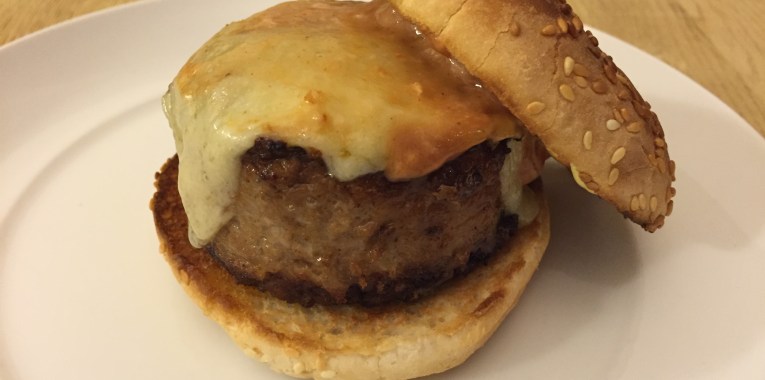
Traditional Estonian cuisine has substantially been based on meat and potatoes, and fish in coastal and lakeside areas. Today it is influenced by many countries. Recipes I came across include Taidetud vasikarind (Roast stuffed shoulder of veal) , Kringel (cinnamon buns), Karask (Barley bread) and Rosolje (sausages served with potatoes). I decided to cook Hakklihakotlet (ground meat patties) and I served them in burger buns with melted cheese. They were simple to make and pretty tasty.

Rating: 8/10

Makes 8 patties

Prep time: 20 mins
Cook time: 20 mins

220g lean ground beef
220g lean ground veal
220g ground lean pork
2 eggs
1 1/2 cup fresh breadcrumbs
1 tsp salt
1⁄4 tsp ground black pepper
1⁄2 cup onion, finely chopped
1/4 cup cold water
4 tablespoons vegetable oil

In a large mixing bowl, combine everything except for 1 cup bread crumbs and the oil, and knead with your hands for 5-10 minutes or until mixture is smooth, light and fluffy.
Moisten your hands with cold water and shape the mixture into 8 thick, round patties, then dip each in the remaining bread crumbs, coating all sides.
Heat the vegetable oil in a heavy frying pan over a medium to high heat.
Fry the patties 4 at a time for about 5-10 minutes on each side, keeping an eye on the heat so that they brown but don’t burn.
To make sure that they are fully cooked insert the tip of a knife into one of the patties and look to see that there is no pink. If it is still pink in the middle, lower the heat and cook for a few minutes longer.
Serve in burger buns with your choice of melted cheese.


Greece

Greece is on the Balkan Peninsula in southeastern Europe. It is mostly dry and mountainous with a large mainland and more than 1,400 islands, of which 227 are inhabited.  Greece has 9000 miles of coastline, making it the 10th longest coastline in the world.

Greece has one of the longest histories of any country, and is considered the cradle of Western civilization.  It is the birthplace of democracy, Western philosophy and the Olympic games.  Athens is one of the world’s oldest cities with the first inhabitants present around the 11th-7th millennium BC.

Some interesting stats – it has by far the lowest number of fatal transport accidents per capita in the EU, one of the lowest death rates for cancer and one of the lowest divorce rates in the EU.

Three of the original Seven Wonders of the Ancient world were in Greece – the Statue of Zeus at Olympia, the Temple of Artemis at Ephesus and Colossus of Rhodes, none of which exist today.  The amazing sights of the Parthenon, the Acropolis and Ancient Olympia are some of Greece’s ancient treasures, which along with it’s striking landscapes, and pleasing climate entices 16.5 million visitors a year.

Greece is the third largest producer of olives in the entire world.  There are estimated to be around 120,000,000 olive trees in Greece, and some of the olive trees from the 13th century are still producing olives today.

The cuisine of Greece dates back several millennia, is hugely varied and includes a wide array of ingredients.  Greek cuisine has evolved and absorbed numerous influences and influenced many cuisines itself.   Some of their typical dishes are Fasolada (bean and vegetable soup), Souvlaki (skewered meat or fish), Moussaka (casserole of aubergine, minced meat and potato), Saganaki (fried cheese), Keftedes Arni (lamb meatballs), Sofrito (veal escalopes from Corfu).  From the many recipes I came across, eventually I decided to cook Rabbit Stifado (slow cooked stew) which originates from Corfu.

Rating: 8/10

Serves 4 (alongside potatoes & veg)
Prep time: 10 mins + 2 hours marinating
Cook time: 1hr 15 mins

1 rabbit, jointed
2 tbsp tomato puree
2 bay leaves
4 tbsp red wine vinegar
150ml olive oil
1/4 tsp sugar
4 garlic cloves, roughly chopped
1 small cinnamon stick
Salt and black pepper
1/2 tsp allspice
1 sprig rosemary
150ml red wine
300ml hot water
675g button onions, whole

Rinse the rabbit pieces and place them in a mixing bowl together with the bay leaves and vinegar.
Mix well and leave to marinate for at least 2 hours.
Remove the rabbit from the marinade and pat dry with kitchen paper.
Heat half of the olive oil in a large saucepan until hot, add the rabbit and fry them in until quite brown on all sides.
Add the garlic, bay leaves, spices, rosemary, wine, tomato puree and sugar and the hot water.
Season with salt and pepper, bring to the boil mixing well then reduce the heat, cover and simmer for about 1 hour.
Meanwhile, heat the remaining olive oil in a frying pan, add the onions and saute gently for 15 minutes stirring occasionally, until golden all over.
After the rabbit has been cooking for 1 hour, add the onions and oil from the frying pan to the saucepan.
Mix, then re-cover and simmer for a further 15 minutes.

Burundi

Burundi is a landlocked country in the African Great Lakes region of East Africa. The Twa, Hutu and Tutsi peoples have lived in Burundi for at least 500 years. Burundi has been plagued by ethnic conflict between the majority Hutus and the Tutsis, who tend to dominate the government and army—but are only 14 percent of the population. A 2003 cease-fire and new government offered hope for peace, however this peace came to a shattering end in 2015 when President Nkurunziza decided to run for what many Burundians believed to be a constitution breaking third term in office. Violence broke out before the election, and has escalated since. The entire country is now considered a no go area for travellers.

Burundi is one of the most eroded and deforested countries in all of tropical Africa. The cutting of forests for fuel is uncontrolled despite legislation requiring permits. Only about 5.7% of Burundi’s total land area is protected.

Burundi is one of the world’s poorest countries, owing in part to its landlocked geography, poor legal system, lack of economic freedom, lack of access to education, and the proliferation of HIV/AIDS. The World Happiness Report 2016 update ranked Burundi as the world’s least happy nation.

Bujumbura’s Lake Tanganyika beaches are some of the best urban beaches of any landlocked country in Africa. A small spring at Kasumo, 115km southeast of Bujumbura might be the southernmost source of the River Nile. Drumming is an important part of Burundi’s cultural heritage. The world-famous Royal Drummers of Burundi have performed for over 40 years.

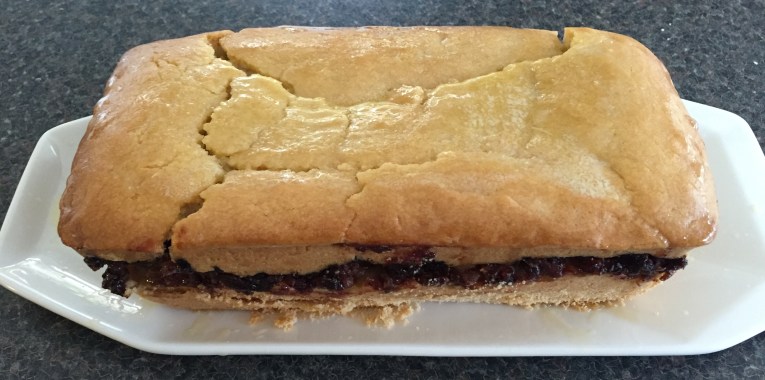
A typical Burundian meal consists of sweet potatoes, corn, and peas. Due to the expense, meat is eaten only a few times per month. Recipes I came across included Marahagwe (bean and vegetable stew), Ibiharage (fried beans) and the somewhat strange pairing of banana with beans. I opted to make date & banana loaf, which although it was a little dry, the flavour was pretty good.  Untraditionally, I did however serve it with clotted cream as I felt it was too dry on it’s own.

Rating: 6/10

Serves 8
Prep time: 20 mins
Cook time: 30 mins

260g butter, melted
1 cup sugar
2 eggs
4 cups flour
1/4 tsp salt
1 tsp baking powder
1 large or 2 small bananas
1 & 1/2 cup chopped dates
2 tbsp powdered sugar
1 tbsp ground cinnamon

Preheat the oven to 175c.
Beat 230g of the melted butter with the sugar until well blended.
Add the eggs one at a time mixing well before adding the second one.
Add the flour, salt and baking powder and mix well.
Line a loaf tin with parchment paper.
Spread half of the mix in the bottom of the tin and level the surface with your fingertips.
Add the sliced bananas.
Remove pits from dates, chop coarsely and pout on top of the bananas.
Cover with the remaining cake mix.
Bake for about 30 minutes until golden brown in an oven.
Remove from the oven and brush the top of the cake with the remaining 2 tablespoons of melted butter.
Sprinkle the surface with a mixture of powdered sugar and cinnamon.

India

India, the seventh largest country by area and second largest by population with over 1.2 billion people.

India was once a continent. More than 100 million years ago, when dinosaurs roamed the earth, most of what is now India was an island.  It had broken off from an ancient supercontinent, referred to as Gondwanaland by paleogeographers and was moving slowly northwards.  About 50 million years ago, the India continental plate collided with Asia, buckling the coastal area of both continents and creating the Himalayas.   Evidence of this ancient history is provided by fossilised sea shells that can still be found high in the mountains. The plate on which the subcontinent rests continues to press slowly northwards, and is the reason why the height of Mount Everest increases slightly every year.

India has three of the world’s top ten megacities – one more than China. According to the UN, Delhi is now the second-largest urban agglomeration in the world, with Mumbai ranked seventh and Calcutta tenth.  The population of Delhi and its immediate urban hinterland is now over 22.65 million, and is only surpassed by Tokyo.  The 486.6-million worker Indian labour force is the world’s second-largest, as of 2011.  The service sector makes up 55.6% of GDP, the industrial sector 26.3% and the agricultural sector 18.1%.

India’s telecommunication industry, the world’s fastest-growing, added 227 million subscribers during the period 2010–11, and after the first quarter of 2013, India surpassed Japan to become the third largest smartphone market in the world after China and the U.S.

There are more road deaths in India than any other country in the world.  Officially about 115,000 people die on Indian roads each year – though a recent British Medical Journal study suggests that the true number of fatalities is closer to 200,000.

India has the world’s largest film industry.  More than 1,100 movies are produced, on average, each year – that’s slightly ahead of Nigeria, twice as many as the American film industry and ten times as many as Britain produces.

Some interesting facts about the Taj Mahal:

– It took 22 years to build from 1631 to 1653.
– 20,000 workers and 1,000 elephants were involved in the build.
– Today’s value of the Taj Mahal is estimated to be around $10 billion dollars.
– It was built by Shah Jahan (Prince Khurram) for his wife – Mumtaz Mahal (Arjumand Bano Begum).
– Between 2 – 4 million people visit every year.

Indian cuisine is hugely diverse and is known the world over.  Indian food differs across the various regions and is also heavily influenced by religious and cultural choices and traditions.  Thankfully with a little help from my friend Aditi, I chose to cook 3 dishes – Murgh Punjabi (chicken curry from Punjab), Peas Pulao (peas with rice) and Chana Saag (chickpeas with spinach).

Overall rating: 8/10.  The chana saag was a little too watery, so I have adjusted the recipe below with reduced water.
 
For the Murgh Punjabi:

500g chicken with bones or boneless (based on preference)
2-3 medium sized onion
3 tomatoes on the vine
3 garlic cloves
1 tsp chopped ginger
2-3 tbsp oil
Masala’s:
1 bay leaf
4 – 5 whole peppercorns
2-3 whole cloves
Half a cinnamon stick broken into smaller pieces
2-3 black cardamom
1/2 heaped tsp cumin seeds
Salt to taste
Pepper
Red chilli powder – to taste
4-5 teaspoons chicken curry masala powder
Fresh coriander, chopped

Sauté chopped onions till dark brown in the oil

Add chopped tomatoes
Keep sautéing mixture till the tomatoes and onions are well cooked and start releasing the oil
This should take 15-20 mins
Wait for mixture to cool and grind to paste consistency in a mixer
In a deep bottom pan, take some oil, add chopped ginger and chopped garlic
Once golden brown add bay leaf, peppercorns, black cardamoms, cinnamon, cloves and the cumin seeds
Once the cumin seeds are sizzling, add the onion tomato paste that you made earlier
Let it all cool together for 2 mins and then add red chilly powder, chicken curry powder, freshly ground pepper and salt to taste
Sauté mixture for 3-4 minutes
Add washed chicken pieces to the pan now
Sauté for 7-8 minutes till all the pieces are nicely covered with the masala and are sealed
Now add water (half a cup of water if you want the curry to have a thick consistency and want to serve it with Indian bread or 2 cups of water (approx) if you want to serve it with rice and want it to be more liquids)
Now bring to boil and once it’s boiling, put a lid on and reduce the flame to low for the chicken to simmer and cook for 10-15 minutes.
Keep stirring occasionally to ensure it doesn’t stick to the bottom of the pan16. Once cooked, garnish with chopped coriander and juliennes of ginger

For the Peas Pulao:

1 1/2 cups of basmati white rice
1/4 cup frozen peas
1 tsp cumin seeds
3 cups water (double the rice)
1 tbsp oil
Salt to taste
2 -3 pinches garam masala powder

In a deep bottom pan, heat the oil

Add the cumin seeds, once they start to sizzle, add the peas
Sauté for 2 minutes and add the rice
Add salt to taste and sauté the peas and rice to mix together
Add the water, bring to a boil
Let all the water get absorbed by the rice and peas and once you start to see holes in the rice, cover it with a lid and turn the flame off
Let it cook in its own steam for 7-10 mins, open the lid and spread the rice gently and turn it from top to bottom so that every rice particle can stand out separately and no lumps are formed
Put the lid again for another 4-5 mins
Your rice is ready, garnish with garam masala powder for aroma and flavour

For the Chana Saag:

Oil
250g spinach, washed
1/3 tsp cumin seeds
400g can of chickpeas
1/2 tsp dry ginger powder
3/4 tsp coriander powder
1/2 tsp fennel seeds
1/4 tsp cumin powder
1/2 tsp chili powder
1/2 tsp garam masala
1 tbsp tomato puree
400g can chopped tomatoes or passata
Salt to taste

Heat 1 tablespoon of olive oil in a tall stockpot.

Add the spinach leaves and 1/4 teaspoon salt.
Cook for about 5 minutes breaking down the spinach leaves until wilted and pulped but some liquid remains.
Remove to a separate bowl.
Heat 1 more tablespoon of olive oil in the same stockpot. Add the cumin seeds and fry for 1-2 minutes until they sizzle.
Add the chickpeas and 1 tsp salt.
Remove from heat and add the ground spices.
Return to heat and mix in the tomato puree and canned tomatoes.
Cook for 1-2 minutes and then add 1 cup water.
Cover and cook for about 10-15 minutes.
Add the spinach with its liquid and cook for another 5-10 minutes on low heat.
Taste and adjust salt and chili as needed.


Benin

Benin is a country in West Africa, bordered by Togo to the west, Nigeria to the east, and Burkina Faso and Niger to the north. About 42 African ethnic groups live in Benin, with most people living on its small southern coastline on the Bight of Benin.  It was formerly called Dahomey, a kingdom that rose to prominence in about 1600 and over the next two and half centuries became a regional power, largely based on its slave trade. Dahomey was also widely known for its corps of female soldiers known as the Dahomey Amazons.

Benin is widely seen as the birthplace of voodoo. They hold an annual Voodoo festival in Ouidah on Voodoo Day (January 10th), which is a public holiday. There is a national Voodoo museum.  Voodoo is more than a belief system, it is a complete way of life, including culture, philosophy, language, art, dance, music and medicine.

Oscar nominated Djimon Hounsou (of Gladiator and Blood Diamond) was born in Cotonou, Benin.

It offers the visitor many interesting sights including the Parc National de la Pendjari, which is one of the best wildlife parks in West Africa. Lions, cheetahs, leopards, elephants and hundreds of other species thrive here.  Other highlights are Grand Popo (palm fringed beaches), the colonial buildings of Porto Novo (the capital) and Grand Marche de Dantokpa (the large market in Cotonou).

Recipes I came across for Benin include Ago Glain (spicy crab, tomato and onion stew) , Akkra Funfun (white bean fritters) , Talé Talé (deep fried banana fritters).  I opted to make Yovo doko (Beninese sweet fritters) which I served for breakfast.  The kids enjoyed them with chocolate spread!

Rating: 8/10

Makes about 40 fritters
Prep time: 10 mins
Cook time: 30 mins

Peanut oil
500g plain flour
170g caster sugar
1/2 tsp vanilla powder
15g yeast
500ml water
Salt

Put the flour, yeast, salt, sugar and water in a bowl and mix with your fingers until it is well blended.
In a large frying pan, heat the oil to low – medium.
Place spoonfuls of the mixture around the pan and fry for 6 minutes on each side and then 2 minutes again on the first side.
Drain on kitchen towel and serve with a dusting of icing sugar.

Malawi

Malawi lies landlocked in southeast Africa.  It was formerly known as Nyasaland.  The name Malawi comes from the Maravi, an old name of the Nyanja people that inhabit the area. The country is also nicknamed “The Warm Heart of Africa”.  Lake Malawi, which takes up a third of Malawi’s area is a huge freshwater lake, lined with excellent beaches and filled with colorful fish, as well as the occasional hippo and crocodile.   Lake Malawi was once called “The Lake of the Stars” by the famed Scottish explorer David Livingstone, because lantern lights he saw from the fishermen’s boats resembled the stars at night.

Malawi has been independent from Britain since 1964.  President Hastings Kamuzu Banda ruled for more than 25 years until democratic elections in 1994 brought in new leadership.

Apparently Malawi is the only country in the world that has a Carlsberg factory (with the exception, of course, of Denmark) – so Carlsberg beer is sold here at just about 35p!

Highlights for the visitor are aplenty with several wildlife national parks and reserves (Nyika, Nkhotakota, Lilongwe and Majete to name a few), the beaches of Likoma Island, Mt Mulanje and the impressive Manchewe Falls.

Popular cuisine of Malawi includes different types of fish, nsima (ground corn), kachumbari (tomato & onion salad) and kondowole (cassava flour & water). They also enjoy tea & coffee, so I opted to cook a dish called Mandasi (doughnuts) which are generally served with a hot drink.  We had some family visiting for the weekend so I served these for breakfast alongside Yovo Doko fritters from Benin and the kids really tucked in!!

Rating: 9/10

Makes 12 doughnuts
Prep time: 10 mins
Cook time: 15 mins

2 cups plain flour
Pinch of salt
2 tsps of baking powder
2 tbsps of sugar
1 beaten egg
1 cup of milk
Vegetable oil for frying

Mix the flour, salt, baking power in a bowl. Add the sugar, egg, milk and beat until smooth.
Drop spoonfuls of the batter into a deep fat fryer with hot oil and fry until golden brown, turning once.
Drain on kitchen towel and serve with a dusting of icing sugar.


The Gambia

The Gambia is the smallest country in Africa.  It is mostly surrounded by Senegal, except for a short strip on the Atlantic coastline.  The River Gambie (from which the country takes it’s name) flows from east to west for three hundred miles, the entire length of the country.

The Gambia gained its independence from the UK in 1965.  A short-lived federation of Senegambia was formed between 1982 and 1989. In 1991 the two nations signed a friendship and cooperation treaty, but tensions have flared up intermittently since then.

The Gambia’s economy is dominated by farming, fishing, and especially tourism.  They have 100,000 tourists visiting each year, mainly from Europe, and 50% are from the UK.  Among birdwatchers it is revered as one of Africa’s best birding destinations with more than 560 different species spotted.  Other highlights include the Atlantic Coast resorts with it’s lovely beaches & fishing villages, Banjul market (the capital), taking a pirogue ride through the mangroves and James Island slavery museum.

Recipes I came across for The Gambia were Domada (peanut & tomato paste), Superkanja (okra & beef stew), Base nyebe (rich stew of chicken or beef with green beans and other vegetables) and Chere (steamed millet flour balls).  I decided to make Cashew Nut Ngato (cashew nut brittle), which in all honesty turned into a bit of a disaster.  I’m not sure if the ingredient ratios I followed weren’t quite right or if I should’ve bashed the nuts before adding them to the sugar, but either way it wasn’t great!

Rating: 3/10

Japan

Japan is a place I’ve always wanted to go to, but I haven’t quite made it yet.  A quote from Chris Rowthorn on the Lonely Planet website sums it up beautifully;
“I’ve spent most of my adult life in Japan and now it feels like home to me. I love the food: it’s incredibly varied and nourishing and there seems to be no end to the culinary discoveries one can make. I love the combination of a hike in the mountains followed by a long soak in an onsen. But, most of all, I love the meticulous and careful nature of the Japanese people, reflected in every aspect of Japanese life, from trains that run right on time to sublime works of art. Put it all together and you come away with a country that still intrigues me even after two decades of living there.”


Japan is a stratovolcanic archipelago of 6,852 islands. The four largest are Honshu, Hokkaido, Kyushu and Shikoku, which make up about ninety-seven percent of Japan’s land area.  Over 70% of Japan is mountainous and there are over 100 active volcanoes.  The population of 126 million is the world’s tenth largest.  It has the world’s third-largest economy by nominal GDP and the world’s fourth-largest economy by purchasing power parity.  Japan has the highest life expectancy ranking in the world with an overall life expectancy of 84 (vs 81 in the UK, which is ranked no.20).


Some quick facts …
Coffee is very popular and Japan imports approximately 85% of Jamaica’s annual coffee production.
On average there are around 1,500 earthquakes every year in Japan.
Japan is the largest automobile producer in the world.
It is home to the world’s longest railroad tunnel at 54 kilometers (33 miles) – the Seikan Tunnel linking Honshu to Hokkaido.
As of 2011, Japan overtook France in the highest number of Michelin starred restaurants and has maintained the title since.


I received a few suggestions from friends for Japanese recipes including Shabu shabu (hotpot of meat & vegetables), Katsu curry (deep fried pork or chicken in curry sauce) and Okonomiyaki (savoury pancake).  Other traditional dishes include miso soup, soba or udon noodles, sashimi (raw fish), chahan (fried rice), tempura (deep fried fish or vegetables), gyoza (dumplings) and teriyaki (grilled meat, fish or vegetables).


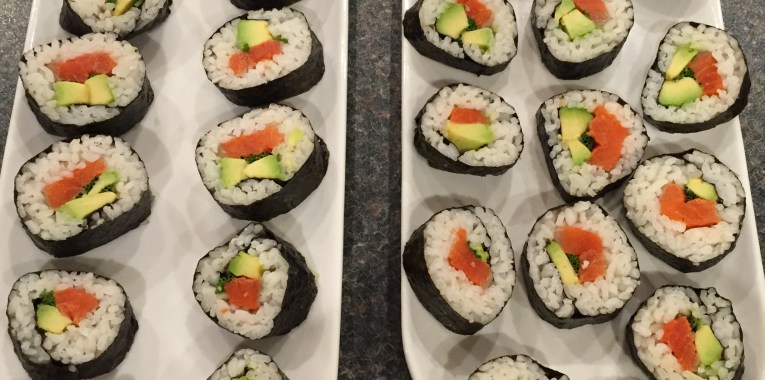
As I was having a little get together with friends I decided to make Maki-zushi (sushi rolls) with salmon & avocado to serve as a nibble with drinks.  It seemed the jury is still out for some of my guests when it comes to raw fish.


Rating: 8/10

Makes 32 sushi rolls
Prep time: 20 minutes
Cook time: 10 minutes

300g sushi rice
2 tbsp rice or white wine vinegar
1 tsp caster sugar
1 large avocado
juice ½ lemon
4 sheets nori seaweed
2 previously frozen salmon fillets thawed
1 bunch chives
Soy sauce & wasabi to serve

Put the rice in a small pan with 600ml water. Bring to the boil and cook for 10 mins until the water is absorbed and the rice is tender. Stir through the vinegar and sugar, cover and cool.
Skin, stone and slice the avocado. Put in a bowl and squeeze over the lemon juice, turning the avocado to ensure the pieces are covered.
Divide the rice between the nori sheets and spread it out evenly, leaving a 1cm border at the top and bottom. Lay the salmon over the rice, followed by the chives and finally position the avocado across the centre.
Fold the bottom edge of the seaweed over the filling, then roll it up firmly. Dampen the top border with a little water to help it seal the roll. Repeat to make 4 rolls. At this stage, the rolls can be wrapped individually in cling film and chilled until ready to serve.
Using a serrated knife, cut each roll into 8 rounds. Serve with sweet soy sauce for dipping.

Ukraine

Ukraine, the largest country in Europe (excluding Russia) is 603,628 square kilometres with a coastline of 2,782 kms.  It borders the Black Sea, Poland, Romania, and Moldova in the west and Russia in the east.  The geographic center of Europe is considered to be in a small Western Ukrainian town called Rahiv.  Ukraine’s population has been declining since the 1990s because of its high death rate and a low birth rate. The population is shrinking by over 150,000 annually since 1993.  Ukrainians are of Slavic origin. About 75% of the population is ethnic Ukrainian. The largest minority group is the Russians at about 20%.

The territory of modern Ukraine has been inhabited since 32,000 BC. During the Middle Ages, the area was a key centre of East Slavic culture, with the powerful state of Kievan Rus’ forming the basis of Ukrainian identity.  It has been ruled and divided by a variety of powers, including Lithuania, Poland, the Ottoman Empire, Austria-Hungary, and Russia.  It is currently in territorial dispute with Russia over the Crimean peninsula which Russia annexed in 2014 but which Ukraine and most of the international community recognise as Ukrainian.

Ukraine suffered the world’s worst recorded nuclear accident. On the morning of April 26, 1986, reactor No. 4 at the Chernobyl Nuclear Power Plant, 80 miles north of Kiev, exploded, sending radioactive contaminants three miles up into the atmosphere and out over parts of Europe, Asia, and North America.

For the visitor it offers a diverse range of sights and activities namely; the Carpathian mountains and National Park, the 16th century Khan’s Palace, Yalta, the laid back beach resort, the quaint town of Lviv, a Unesco World heritage site and Kyiv, the capital with plenty of cultural points of interest.

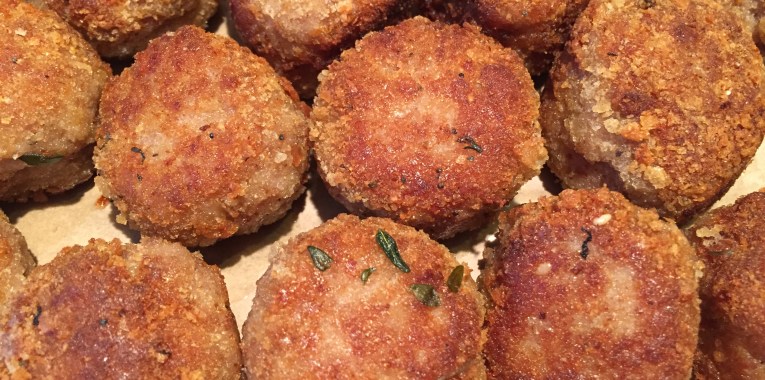
The diet of Ukraine features chicken, pork, beef, fish and mushrooms.  Popular traditional dishes include varenyky (dumplings), nalysnyky (filled pancakes) and of course chicken kiev.  Some other recipes I came across were Kruchenyky (meat rolls), Pyrizhky (stuffed pastry buns) and Shynka (baked ham).  I opted to cook Mazuricks (turkey cutlets with cheese), which I served to a number of guests as a bit of a snack along with drinks and they went down extremely well!

Rating: 9/10

Serves: makes 34 bite size mazuricks
Prep time: 20 mins + 40 mins cooling

Cook time: 15 mins

750g turkey mince
112g finely grated cheddar cheese
75g butter
2 eggs
37ml milk
150g plain flour
75g breadcrumbs
2 tbsp vegetable oil
A few sprigs of thyme
2 garlic cloves bashed
Salt & pepper

Put the turkey mince into a mixing bowl. Melt the butter and add to the meat, stir well.
Add the eggs, milk, salt, pepper, flour and cheese to the meat. Stir well until fully combined.
Shape into balls, sausages or patties and roll in breadcrumbs.
Put them into bowl with a tightly fitted lid and store into fridge for 40 mins.
Heat the vegetable oil in frying pan, add thyme twigs and garlic.
Once garlic is browned, remove it from the oil along with thyme.
Fry the mazuricks on both sides in the flavoured oil, approximately 10 – 15 minutes (depending on the size).
I wasn’t serving them straight away, so I heated them up in the oven on 170c for 10 minutes before serving.

Belarus

Belarus (meaning “White Russia”) is a landlocked country in Eastern Europe bordered by Russia to the northeast, Ukraine to the south, Poland to the west, and Lithuania and Latvia to the northwest. Alexander Lukashenko has been the country’s president since 1994. Belarus has been labeled “”Europe’s last dictatorship”” by some Western journalists on account of Lukashenko’s self-described authoritarian style of government. Belarus is the only country in Europe which retains capital punishment in law and in practice.

About 40% of Belarus is covered by forests and it also has 11,000 lakes. About 70% of the radiation from neighboring Ukraine’s 1986 Chernobyl nuclear disaster entered Belarusian territory, and about a fifth of Belarusian land (principally farmland and forests in the southeastern regions) was affected by radiation fallout. Belarusians continue to suffer from high incidences of cancer and birth defects, and about 25 percent of the land is considered uninhabitable. The United Nations and other agencies have aimed to reduce the level of radiation in affected areas.

Most of the monuments in Belarus dedicated to Lenin. In every city there is a Lenin Street. Highlights for visitors to Belarus include Radziwill Palace Fortress, the Museum of the Great Patriotic War, the 16th century Mir Castle and the Chagall Museum (which houses some of Marc Chagall’s designs and lithographs but sadly there aren’t more Chagall paintings in Belarus because his work was banned by the Soviet government).
Belarus has four UNESCO-designated World Heritage Sites: the Mir Castle Complex, the Nesvizh Castle, the Belovezhskaya Pushcha (shared with Poland), and the Struve Geodetic Arc (shared with nine other countries).

Some of the recipes I came across for Belarus were Zrazy (stuffed meat rolls) , Mazurka (almond cake) , Machanka (pork stew) and Draniki (potato pancakes). I opted to cook Lazanki (Belarusian pasta). I served it with a mushroom, ham and cheese sauce. It was pretty simple and easy to make and tasted good. I would cook the pasta a bit less and make the sauce a bit looser next time! You could also add some saffron to the water before making the pasta in order to give it more of a pleasant colour, as it was a bit anaemic.

Rating: 7/10

Serves: 4
Prep time: 30 mins
Cook time: 7 mins

For the lazanki
1 egg
350g plain flour
5g salt

For the sauce
50g plain flour
70g butter
150ml milk
100g bacon or lardons
75g sliced mushrooms
50g grated cheddar

For the lazanki
Beat the egg.
Add 1/2 cup of water to the egg, add salt and flour (250 g) and then carry on adding flour in small quantities until the dough comes together.
Mix the dough with your hands and divide it into 3 equal parts.
Roll out all of the dough (use a pasta machine if you have one – keep flouring the dough as you put it through)
Cut the dough into small squares with a sharp knife.
Boil salted water, add the lazankis and cook for approximately 7 minutes (or 5 minutes if you like it a bit al dente).
Put lazankis onto the plates and pour over the sauce.

For the sauce
Put the flour & 50g of the butter in a saucepan over a medium heat and stir to a paste.
Add the milk slowly to form a sauce and keep stirring for 5 minutes. Remove from the heat.
Meanwhile heat a small frying pan and fry the bacon until browned, about 5 minutes. Remove to a plate.
Add remaining butter to the pan and fry the sliced mushrooms for 5 minutes.
Heat the sauce on a low heat and add the cheese to the sauce, mix it in, then add the bacon and mushrooms and stir through.


Mauritania

Situated in West Africa, Mauritania (officially the Islamic Republic of Mauritania) is in western North Africa.  The country derives its name from the ancient Berber Kingdom of Mauretania, which existed from the 3rd century BC to the 7th century, in the far north of modern-day Morocco.  Part of French West Africa until independence in 1960, Mauritania is influenced by Arab as well as African cultures.  Some of the world’s richest fishing grounds lie off the coast. The population still largely depends on agriculture and livestock for their livelihood.  Fish exports account for 60% of foreign earnings.
 
Mauritania passed a law to abolish slavery only in 1981. It is one of the last countries to do so.  Despite the legislation against slavery, there still exists around 90,000 slaves in Mauritania according to 2003 estimates.
 
Nouahchott, which means “place of the winds,” was designated as the country’s capital only in 1960 and is therefore one of the world’s newest capitals.  It’s highlights include Port de Pêche (fish market), Mosquée Saudique and the Musée National.
 
Tourists are also attracted to Atar, the ancient capital of the Almoravid kingdom, and Chinguetti, with houses and mosques dating back to the 13th century.
 
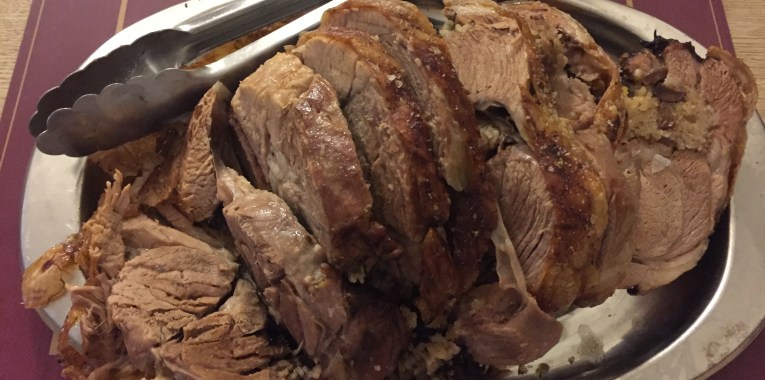
The cuisine of Mauritania has an overlap with Moroccan cuisine in the north and Senegalese cuisine in the south.  Some traditional dishes include Thieboudienne (Cheb-u-jin), a coastal dish of fish and rice, considered to be the national dish, Mahfe (goat or camel meat in a peanut, okra and tomato sauce) and Cherchem (lamb couscous).  I opted to cook Méchoui, whole roasted lamb.  I followed a brilliant recipe from a fellow ‘around the world cook’ Sasha Martin.
 
Rating: 9/10
 
Serves: 6
Prep time: 30 mins
Cook time: 3 hours
 
1 deboned leg of lamb
1/4 cup raisins
2 pitted dates, chopped
4 dried figs, chopped
1 onion, diced
1 cup rice, uncooked
2 1/2 cups stock
salt & pepper
1/2 tsp coriander
 
Chop the onion, dried fruits, and add to a skillet with rice, stock, salt, pepper and ground coriander. Cover and simmer for about 10 minutes and then let it cool slightly.
Preheat the oven to 160C.
Stuff the lamb with the rice & fruit mix and then tie up the lamb with string.
Put the remaining rice mix in a small casserole dish and cover with foil.
Roast the lamb for 2 1/2 to three hours. Put the casserole of stuffing in for the last 30-45 minutes of roasting.
Let the meat rest for 10 minutes before slicing.
Serve with the extra rice and roasted carrots.
 

Guinea-Bissau

The Republic of Guinea-Bissau on the Atlantic coast of West Africa is bordered by Senegal to the north and Guinea to the south and east.
Guinea-Bissau is among the world’s least developed countries, with most people engaged in subsistence agriculture and fishing.  More than two-thirds of the population lives below the poverty line.  It’s history is one of painful wars and coups and since 1974, no president has successfully served a full five-year term.


Tourist attractions include the Former Presidential Palace in the capital of Bissau, Orango Islands National Park (home to rare saltwater hippos) and the beautiful island of Bolama.


The food of Guinea-Bissau is dominated by rice, fruit, vegetables and peanuts.  Soups and stews are popular.  Recipes I came across include Frango com bagique (chicken with spinach) , Macarra with Citi (Chicken with peanuts and palm oil), Bolinhos de mancarra com peixe (fish and peanut balls).  I decided to cook Cafriela de Frango (grilled spicy chicken) which was very simple and really tasty.
 

Rating: 9/10

Serves: 4
Prep time: 10 mins + 3 hours marinating time
Cook time: 45 mins
1 medium chicken, jointed
1 tsp salt
5 hot chilies, sliced
3 cloves garlic, crushed
1 medium onion, sliced
1 1/2 lemons, juice only
salt
1 tbsp vegetable oil

Place the chicken pieces in a large plastic zipper bag with the garlic, chilies, half the sliced onions and lemon juice. Marinate for 3 hours (or more) in the fridge.
Add the oil to a large skillet and add the marinated ingredients.
Add 3/4 cup of water and cook over a medium heat, covered, for 30 minutes, until the chicken is cooked through, adding a little more water if it is drying out.
Preheat the BBQ or grill.
Remove the chicken to a plate leaving the excess liquid in the pan.
BBQ or grill the chicken pieces for 15 minutes or until well browned.
In the meantime heat the liquid adding the rest of the finely sliced onions. Cook over a medium heat for 15 minutes, adding a little more water if necessary.
When the chicken is well-browned, place it onto a serving plate and pour the sauce over it.

Moldova

Moldova is a landlocked nation located in eastern Europe, between Ukraine and Romania, although it is only a stone’s throw from the Black Sea. Most of Moldova was part of Romania before World War II, and two-thirds of Moldovans speak Romanian. It gained independence in 1991.

Moldova has a very vibrant wine industry dating back many many years. 67 Million bottles are exported every year. Vineyards planted in villages around the houses used to make home-made wine, or “vin de casa”. Many families have their own recipes and strands of grapes that have been passed down through the generations. Since 2013 Russia has imposed a ban on Moldovan wine being sold in the country, ever since Moldova signed a draft treaty with the European Union. This has damaged the wine industry of Moldova significantly.

According to Trip Advisor the top 3 things to do in Moldova are: 1. Stefan cel Mare Park in Central Chişinău (the capital). Formerly known as Pushkin Park, it is the oldest park in Moldova and spans about 7 hectares. – Victory Memorial and Eternal Flame is the national memorial commemorating the nameless Moldovan soldiers who fell during WWII. – Milestii Mici winery. Its underground wine city in limestone stretches for 250 km of which 120 km are currently in use. Milestii Mici cellar complex is recognized to be the largest in the world.

Recipes that I came across during my research include; Ciorba (sour soup) , Mititei (minced meat), Mamaliga (cornmeal mash) , Sarmale (stuffed cabbage rolls), Colțunași (dumplings). I opted to cook the popular dish Zeama (chicken noodle soup). It had a subtle flavour and felt like a healthy bowl of goodness! According to my husband a bit of chilli would’ve given it a nice zing!

Rating: 7/10

Serves: 2 hungry people
Prep time: 10 minutes
Cook time: 1.5 hours + 30 mins standing time

4 chicken thighs on the bone
800ml water
salt & black pepper
1/2 medium onion, chopped
1/2 medium carrot, chopped
1/2 big fresh tomato, chopped
100g egg noodles (I used medium but fine would be better)
2 tbsps lemon juice
1 tbsp finely chopped medium celery stalk (reserve celery leaves, if any)
1 tbsp finely chopped fresh parsley
1 tbsp finely chopped fresh dill weed
3 fresh thyme sprigs

Saute the onion and carrots until soft in a deep stock pot. Add the chicken and water then bring to a boil.
Turn heat down to medium-low heat and simmer for about 45 minutes to an hour. Skim any froth.
Add a teaspoon of salt, black pepper, tomato and celery and cook for 5 minutes.
(The recipe didn’t say to do this, but I’m not a fan of chicken on the bone in a bowl of noodle soup so at this point I removed the chicken to a plate, removed the skin & bones, cut it up and then placed it back into the pot)
Add the egg noodles and lemon juice.
Continue cooking on medium-low for about 5 more minutes.
Add the fresh herbs (including celery leaves, if any).
Cover, remove from heat. Let stand for at least 30 minutes to let flavors blend.


North Korea

The world’s most secretive country is situated in the northern part of the Korean Peninsula.  Early European visitors to Korea remarked that the country resembled “a sea in a heavy gale” because of the many successive mountain ranges that crisscross the peninsula.


After the Japanese surrender at the end of World War II in 1945, Korea was divided into two zones by the United States and the Soviet Union, with the north occupied by the Soviets and the south by the Americans. Negotiations on reunification failed, and in 1948 two separate governments were formed: the Democratic People’s Republic of Korea in the north, and the Republic of Korea in the south. An invasion initiated by North Korea led to the Korean War (1950–53). Although the Korean Armistice Agreement brought about a ceasefire, no official peace treaty was ever signed.  Both states were accepted into the United Nations in 1991.
North Korea has the highest number of military and paramilitary personnel in the world, with a total of 9,495,000 active, reserve, and paramilitary personnel.


It isn’t impossible to visit North Korea, however it isn’t straightforward.  Koryo Group offer group or independent tours to North Korea from China.
You can expect to pay from €1,800 for a 3 night basic tour departing from Beijing, including round-trip tickets to Pyongyang on Air Koryo, accommodation, guide fee, private transport, meals, and entry fees.  You cannot travel alone at any time, you must always be accompanied by 2 state employed guides.


A few of the highlights according to Lonely Planet include Paekdu (the country’s highest mountain and an extinct volcano with a vast crater lake at its centre), Pyongyang’s Juche Tower and the Arirang Mass Games annual event in May.


Korea cuisine is based on rice, meat & vegetables. Some of the recipes I came across include Dae Ji Bool Gogi (spicy marinated pork) , Chap Chee or Japchae Noodles (mixed vegetables with noodles) , Bulgogi (Korean grilled meat on skewers) and Naengguk (cold soup).  I decided to cook Kalbi (BBQ short ribs).  The recipe called for short cooking time, although the beef short ribs I bought stated they should be slow cooked.  The marinade was really tasty but our palates would’ve preferred the meat to be slow cooked.


Rating: 6/10


Serves 2 – 3
Prep time: 10 minutes + 3 hours or overnight marinating
Cook time: 25 minutes


1/2 cup soy sauce
1/2 cup brown sugar
1/2 cup water
1 garlic clove, minced
2 spring onions, chopped
1 tbsp toasted sesame oil
700g beef short ribs


In a bowl, stir together the soy sauce, brown sugar, water, garlic, green onions, and sesame oil until the sugar has dissolved.
Place the ribs in a large plastic zipper bag. Pour the marinade over the ribs, squeeze out all the air, and refrigerate the bag for 3 hours to overnight.
Preheat an outdoor grill to medium-high heat, and lightly oil the grate.
Remove the ribs from the bag, shake off the excess marinade, and discard the marinade.
Grill the ribs on the preheated grill until the meat is still pink but not bloody nearest the bone about 10 – 12 minutes per side.
Serve with boiled rice.


Taiwan

Taiwan, officially the Republic of China, is an island of approximately 36,000 square kilometers.  It is one of the most densely populated countries in the world with 649 people per km2.  The island was given the name “Formosa” (meaning “beautiful”) by the Portuguese in the 16th century.  The political situation of Taiwan is still up in the air and the question remains as to whether it should stay independent as territory of the Republic of China (ROC); become unified with the territories now governed by the People’s Republic of China (PRC) or formally declare independence and become the Republic of Taiwan.  In July 2009 the leaders of China and Taiwan exchanged direct messages for the first time in more than 60 years, albeit in their respective party functions, and not as national leaders.  In June 2010, the two countries signed an historic trade pact that was described by some analysts as the most significant agreement in 60 years of separation.


Taiwan blends scenic mountains, hidden waterfalls, historic temples and technology driven skyscrapers.  The five famous tourist magnets outside Taipei are the Taroko Gorge, Alishan (mountain resort), Sun Moon Lake, Lukang (urban township) and Kenting (national park known for its white-sand beaches, caves, coral reefs & northern mountains).  Taipei is Asia’s 2nd most richest city and features the 3rd tallest building in the world, the Taipei 101 tower.


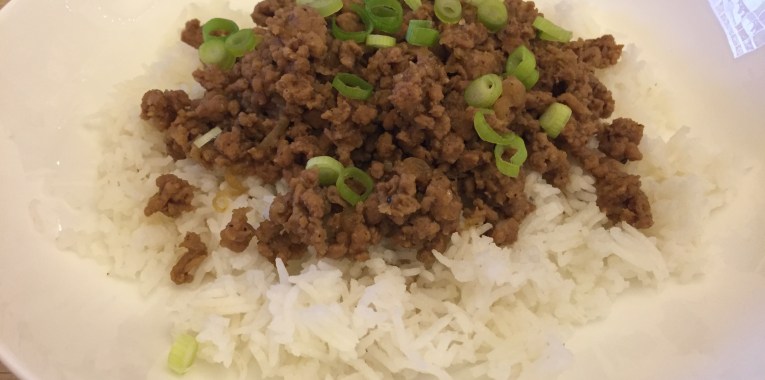
Popular ingredients in Taiwanese cuisine are pork, seafood, chicken, rice & soy.  Some of the recipes I came across include Pork chops with noodle soup , Bah-Tzang (Taiwanese rice dumpling), Gu Bah Mi (beef noodle soup) and Cuttlefish geng (soup).  Chou Doufu ‘stinky tofu’ which is marinated in brine made from decomposing vegetables and shrimps wasn’t high of my choices to cook but is a popular street food.  I opted to cook Ló͘-bah-pn̄g (minced pork rice), which we thoroughly enjoyed.


Rating 10/10


Serves 3-4
Prep time: 10 mins
Cook time: 45 mins


1 cup thinly sliced shallots
2 tbsp oil
500g organic minced pork
4 tbsp white wine
60ml soy sauce
1 tbsp sugar or honey
2 cups water
1 tsp black pepper
1 star anise
1 bay leaf
1 tsp five spice powder
salt to taste
2 spring onions


Heat a large cast iron skillet on medium heat with 1 tbsp of the oil.
Once the oil is hot add the shallots and fry until they turn light golden in color – about 5 minutes.
Remove the shallots from the pan, transfer to a plate lined with a paper towel and set aside.
In the same skillet add the remaining oil and the minced pork on a high heat.
Break up the mince and stir until the pork starts to brown.
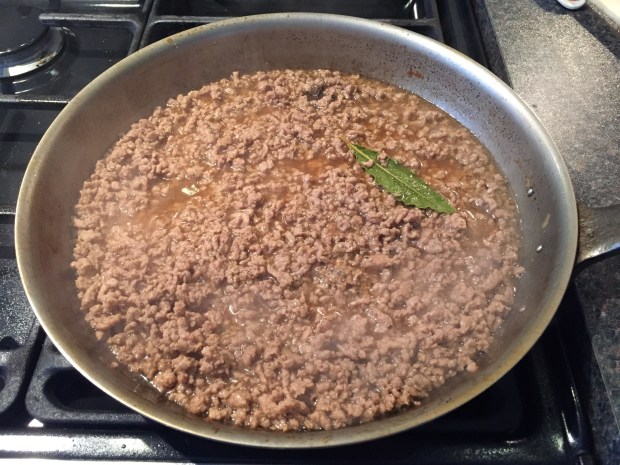
Add the wine, soy sauce, sugar or honey, water, pepper, star anise, bay leaf, and five spice.
Stir to combine, bring the liquid to a boil and then reduce to a low heat.
Cover and let simmer for 30 minutes, stirring every 10 minutes.
While the pork is simmering, take the fried shallots and crush them with a mortar and pestle to a paste or blend them in a mini mixer.
After the pork has simmered for 30 minutes, stir in the crushed shallots and let everything simmer for another 10 minutes.
Salt to taste.
Remove from the heat, garnish with sliced spring onions and serve over boiled rice.
IMG_8464
Ingredients for Taiwanese minced pork

In the same skillet add the remaining oil and the minced pork on a high heat.
Break up the mince and stir until the pork starts to brown.
Add the wine, soy sauce, sugar or honey, water, pepper, star anise, bay leaf, and five spice.
Stir to combine, bring the liquid to a boil and then reduce to a low heat.
Cover and let simmer for 30 minutes, stirring every 10 minutes.
While the pork is simmering, take the fried shallots and crush them with a mortar and pestle to a paste or blend them in a mini mixer.
After the pork has simmered for 30 minutes, stir in the crushed shallots and let everything simmer for another 10 minutes.
Salt to taste.
Remove from the heat, garnish with sliced spring onions and serve over boiled rice.

IMG_8471
Taiwanese minced pork
taiwan-654398_1280
Taiwan

img_84881

Ló͘-bah-pn̄g (minced pork rice)


taiwan-553521_1280
Taiwanese monk